Welcome to the mindfulness meditation podcast presented by the Rubin Museum of Art.
We are a museum in Chelsea,
New York City that connects visitors to the art and ideas of the Himalayas and serves as a space for reflection and personal transformation.
I'm your host,
Dawn Eshelman.
Every Monday we present a meditation session inspired by a different artwork from the Rubin Museum's collection and led by a prominent meditation teacher from the New York area.
This podcast is a recording of our weekly practice currently held virtually.
In the description for each episode,
You will find information about the theme for that week's session,
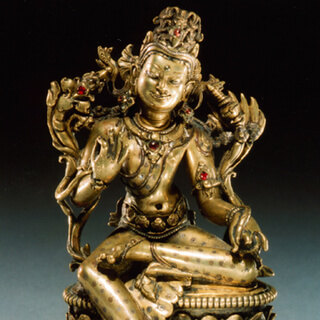
Including an image of the related artwork.
Our mindfulness meditation podcast is presented in partnership with Sharon Salzberg and teachers from the New York Insight Meditation Center,
The Interdependence Project,
And Parabola Magazine.
And now,
Please enjoy your practice.
Tashi Delek.
Tashi Delek,
Welcome.
Welcome to our weekly virtual mindfulness meditation with Rubin Museum of Art.
This program is presented in partnership with Sharon Salzberg,
The Interdependence Project,
And Parabola Magazine.
My name is Tashi Chodron.
We are a museum of Himalayan art and ideas in New York City,
And we are so glad to have all of you join us for today's session where we combine art and meditation online.
We are delighted to have as a teacher for today Kate Johnson,
Who we will introduce in just a moment.
So for today's session,
We will take a look at a work of art from our collection.
We will have a brief talk from our teacher,
And then we will have a short set,
About 15 to 20 minutes.
So for the month of November,
Our theme is resilience,
Something that I think we have all,
Especially as a New Yorker,
We've shown fighting for this pandemic.
And so that's the theme.
So I'd like to introduce our wonderful guest teacher for today,
Kate Johnson.
Kate has been with us many times,
And we are so thrilled to have Kate back.
Thank you,
Kate.
Hi.
Kate works at the Intersections of Spiritual Practice,
Social Action and Creativity.
She has been practicing Buddhist meditation since her early 20s and is empowered to teach through Spirit Rock Meditation Center.
Kate holds a BFA in dance from Allen Alley School,
Fordham University,
And MA in performance studies from NYU.
Kate is a core faculty member of MIT's Presencing Institute and has trained hundreds of leaders and change makers in using social presence in theater and mindfulness and dance improvisation with methodology used to inform strategic planning and systems change in our complex world.
Thank you so much for Kate joining us.
Thank you so much,
Tashi.
Hi,
Everyone.
It's been very exciting to see you begin to check in to hear where folks are from.
It's wonderful to be with you today.
And I'm here at my home in Philadelphia.
There's some construction going on next door,
So this is welcome to work from home.
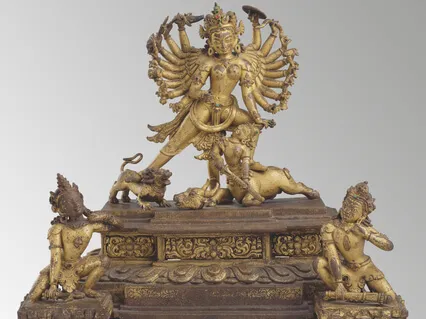
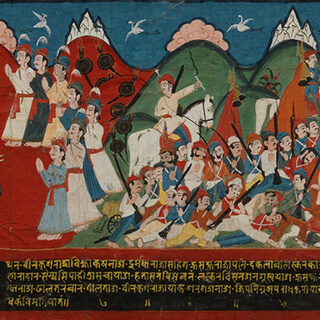
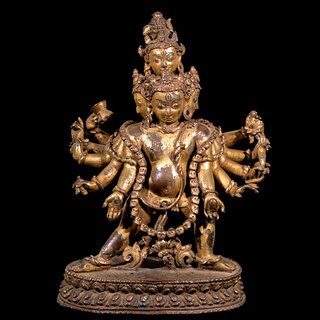
But I'm really excited to be able to explore the artwork with you today of Durga,
Who is in a position of killing some demons of ignorance.
And so when you look at the image again after our meditation and in the work with the River Museum staff,
You'll see that Durga is in a stance that looks familiar to many of us who take yoga before.
It's kind of like a warrior stance.
And she's got her staff that is ready to slay these demons.
Durga is a mother goddess,
But she doesn't have motherhood on one note.
It's not only the kind of nurturing aspect of motherhood,
But it's also the fierce compassion of it.
And when it comes to resilience,
I think she invites us this image to contemplate not only what we need to add to be more resilient,
But what we need to let go of as well.
So I think resilience,
As I experience it,
Is often defined as the ability to experience stress and to maintain my integrity,
Structurally,
That I might get pulled off balance,
But I can come back to center,
But also emotionally and even spiritually,
That we can go through difficulties of which there are no shortage right now,
Pandemics of multiple kinds happening in addition to,
For those of us who live in the US,
The aftermath of a contentious election.
And for those of us who live all over the world are seeing changes and stressful occurrences politically and socially where we live.
So yeah,
Resilience is not always just about adding more things to our life to support us,
More practices,
More working out,
More healthy food,
More friendships,
But sometimes it's actually about letting go.
And so what I'd love for us to contemplate in our practice today is the question,
What is it that needs to die in order for me to have more resilience?
And I know this is a little bit of a dramatic question,
And I think letting go can feel that way.
There's a song that I was thinking about as I was preparing for this.
It came to mind by an artist named Erykah Badu,
Who some of you may know,
And it's a song called Bag Lady.
And she says,
Bag lady,
You're going to hurt your back dragging all those bags like that.
I guess no one ever told you all you must hold onto is you.
So when we're,
Especially in the middle of a pandemic,
Trying to pretend like everything is normal and holding on to all of the activities,
All of the responsibilities,
All of the roles that we held before our world completely changed and wonder why we're feeling a little bit stretched out and distracted and stressed,
Things have changed.
And there's maybe a need to let go and simplify in a way that can help you maintain balance.
So that'll be the contemplation that we'll add in at the end of our practice today.
But in the body of our meditation practice,
I'd love for us to embody the activity of letting go by paying attention,
Especially to our out breath.
And this was a practice that was encouraged by the Tibetan Lama,
Chonyam Trimparampushe.
When he taught this peaceful abiding style of meditation,
He taught his students to primarily focus on the experience of the out breath and to let the in breath come in naturally.
And I think that this activity is an amazing embodiment of that experience of intentionally letting go,
Emptying out,
And then allowing what comes to come in this case,
The breath.
So as with all mindfulness meditation,
We will use our,
An anchor today that the opportunity is to use the breath.
And from time to time,
Our minds will of course wander to the future,
To the past,
Create fantasies,
Redo conversations.
That's completely natural and normal.
Our activity is to,
On a moment to moment basis when we're with the breath,
Pay special attention to the out breath and let that be the focus of our awareness,
The sensations that are experienced with the out breath.
And the in breath can just be a moment of gap or space in the mind.
Or if we notice the mind has wandered,
We take that moment to let it go in a sense to let that thought stream die and then to come back to the feeling of the breath.
And there's no,
Here in the Northern hemisphere,
It's the middle of autumn,
The leaves are dying off the trees.
It's actually a really wonderful time seasonally to contemplate what it is to let go and simplify in order to maintain resilience.
And in the case of the earth,
It's to take some time to rest.
So I'll go ahead and start and guide you and drop in a little bit of contemplation at the end.
I hope this practice is helpful for you in your life today.
So go ahead and close your eyes or you can focus them to the space in front of you if you'd like.
And taking a moment to just feel what it's like to be inside of a body right now on your particular spot on the earth.
And allow your mind and your heart to catch up with where your body is at this moment by paying attention to the feelings that are arising in your entire body.
So first noticing the places where your body is touching the floor,
The chair,
The cushion,
The bed,
Whatever you're sitting on.
And send your awareness downward,
Allowing the weight of the body to be supported by whatever is holding you up at this moment fully.
Feeling aware of the back of your body and the strength of your back,
The natural dignity of the spine,
And uprightness of being a human being.
And allow the strength of your back to create softness in the front of your body,
Softening the skin around the eyes and the eye sockets,
Letting the eyelids become heavy and soft,
Relaxing the cheeks.
No need to make any expression now.
You can allow the jaw to relax.
Perhaps the teeth even separate a little and the lower part of the jaw recedes into the face,
Softening the throat,
Across the collarbones,
Softening the space of the heart,
The front ribs,
The belly can relax and be as big as it wants to be.
So strong back,
Soft front of the body,
On top of the head,
Extending upward towards the sky.
And just feeling how even putting yourself in this physical posture of meditation is a letting go of some kind,
A renunciation,
A not doing of so many other things that we may be called to do today.
And reminding yourself before we begin with a breath of your intention for showing up today to meditate what brought you here.
And let whatever aspiration or motivation drew you to this space to light up your heart and give you energy.
And now see if you can,
Without altering it in any way,
Just bring your awareness to the breath,
The feeling of your breath in your body,
And noticing where you can feel it most vividly.
For me,
I've been loving to feel my breath in my belly.
It's lower to the ground and it feels very grounding to me lately.
But see where you enjoy just noticing the feeling of breathing,
The rising and falling,
Or the fullness and emptying,
Or the changes in temperature and pressure and flow.
And now,
As you gather your awareness around the feeling of your breath,
See if it's possible to really allow yourself to fully experience the out-breath from the time the in-breath pauses and turns,
And then the entire length of the breath moving out of your body until the last piece of air leaves your body and there's a little gap there.
And then allow the in-breath to just come in naturally.
Out-breath and pay more attention.
In-breath,
Relax the mind.
And to help you to support this special attention on the feeling of out-breath,
As you notice yourself breathing out,
You can say to yourself these words,
Let go.
Let go.
Let go.
And allow,
If you can,
Any extra tension or obstruction,
Irritation,
Heaviness to just ride out on the out-breath,
Letting it fall away,
Disappear,
Even if just for a moment.
So I'll be quiet for a while and allow you to practice a bit on your own,
Reminding yourself of these instructions,
Paying attention to the out-breath especially,
Letting the mind relax on the in-breath,
Using the words let go on the out-breath to encourage this softening and simplifying of the mind.
And of course,
From time to time,
You'll notice that the mind is not letting go.
It picks something up and it's running with it.
And that's totally okay.
When you notice that,
You get an opportunity to let go again,
Coming back to the feeling of breathing and especially the out-breath.
Okay.
You you you Let go you you you you you you you inviting any gripping or tightness or grasping to release with every out breath you you you you you you again letting go letting go of any blame or shame letting go of anything that doesn't belong to you allowing all of that to ride out with the out breath you you you you're tossing a pebble into a pond and watching the ripples and the question is this what needs to die in order for me to be more resilient you're thinking in your own mind heart life what in me needs to die in order for me to be more resilient more able to experience stress without losing my integrity one needs to die or be let go of one needs to die or be let go of one needs to die or be let go of one needs to die or be let go of one needs to die or be let go of one needs to die or be let go of one needs to die or be let go of one needs to die or be let go of one needs to die or be let go of one needs to die or be let go of one needs to die or be let go of one needs to die or be let go of one needs to die or be let go of one needs to die or be let go of one needs to die or be let go of one needs to die or be let go of one needs to die or be let go of one needs to die or be let go of one needs to die or be let go of