Welcome to the Mindfulness Meditation podcast.
I'm your host,
Dawn Eshelman.
Every Wednesday at the Rubin Museum of Art in Chelsea,
We present a meditation session led by a prominent meditation teacher from the New York area.
This podcast is a recording of our weekly practice.
If you would like to join us in person,
Please visit our website at rubinmuseum.
Org slash meditation.
We are proud to be partnering with Sharon Salzberg and teachers from the Interdependence Project.
The series is supported in part by the Hemera Foundation.
In the description for each episode,
You will find information about the theme for that week's session,
Including an image of a related artwork chosen from the Rubin Museum's permanent collection.
And now,
Please enjoy your practice.
Good afternoon,
Everybody.
Good to see you.
Welcome to Mindfulness Meditation.
My name is Dawn Eshelman,
Although I think I know most of you in the room here.
Anybody here for the first time?
Welcome.
Great to have you.
So we are here this month talking about the theme of liberation.
And if you remember,
Last month our theme was listening.
And there is,
In fact,
A link between these two themes,
Listening and liberation.
If you have made it upstairs to the sixth floor to experience our exhibition called The World is Sound,
You may have encountered a kind of unique offering in a museum setting.
It's an area where you can lie down and you can listen to the recitation of the Bardo,
Or the Tibetan Book of the Dead,
As it's known in the West.
And it is read by no one other than Tashi Chodron,
My fabulous colleague.
And it is a translation of that text in English.
This Tibetan Book of the Dead is meant to be read to a person as they are passing on.
And the understanding is that hearing is the last sense to go.
And so through this opportunity of listening,
Liberation is possible.
So that is the connection between listening and liberation.
In this setting,
We will explore the meaning of that word liberation through Tibetan Buddhist lens,
But also through a secular lens and through other lenses as well,
I'm hoping.
And so I encourage you to explore that word in whatever way makes the most sense and is the most meaningful for you.
So the art that we're looking at today comes from that exhibition as well,
The World is Sound on the sixth floor.
And it comes to us from the Bon tradition.
Bon religion is Tibet's indigenous religion.
It was practiced before Buddhism came to Tibet in the seventh century and is still practiced today.
And the religions have much in common.
They both teach this methodology to achieve liberation from the cycle of death and rebirth that we were just talking about that is the Bardo plays a part in.
And as well,
They share this concept that we can be free from the ignorance of our own minds.
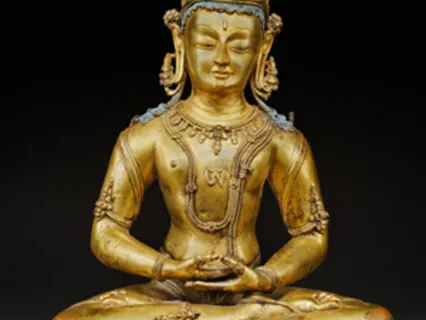
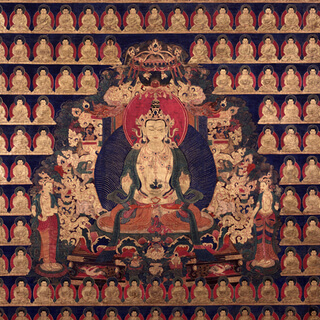
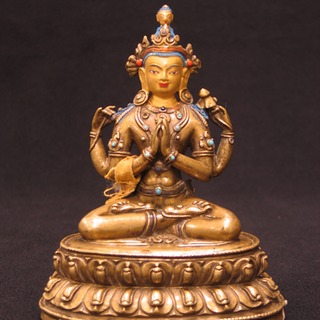
The figure that we're looking at today is Kunzang Akor.
And this sculpture here is from Nepal,
14th century.
And we can see that this figure has on,
Is resting with his hands in meditation.
Quite a peaceful pose here,
Peaceful figure.
And he has a crown with an inscribed Tibetan symbol of Ah on his heart.
And while Om is the mantra,
The seed syllable in Tibetan Buddhism that is really the primordial sound,
For Bon,
That same sound is Ah.
And that's what we're seeing here today.
So we'll talk a little bit more about this idea of liberation and what it can mean for us in our meditation practice with our teacher today,
Kate Johnson.
Great to have you back,
Kate.
Kate,
She teaches mindful yoga in New York City public schools and Buddhist meditation at the Interdependence Project.
She holds a BFA in dance from the Alvin Ailey School at Fordham University and an MA in performance studies from NYU.
She has trained at Spirit Rock Meditation Center,
The Interdependence Project,
Laughing Lotus Yoga,
Our neighborhood yoga studio.
From the Presencing Institute,
And she's working on a book about waking up to power and oppression as a spiritual practice,
Published by Parallax Press this coming fall.
Please welcome her back,
Kate Johnson.
Thank you.
I feel like coming clean and saying that my book isn't going to be published this fall,
It's going to be published in the spring.
It takes a long time to write a book and I had never done it before,
So I just didn't know.
Anyway,
Now that we've established this honest relationship,
It's really good to be here.
And yeah,
I just keep thinking,
How cool is the Rubin,
You know,
This sound installation.
I was having dinner with someone last night and they mentioned how it was just the coolest thing they'd ever experienced in a museum setting.
So it's really rad,
The work that y'all are doing.
So yeah,
We're here today to talk about liberation and my companion in this teaching is Kuzong Akor,
As Dawn mentioned.
And I read in researching for today that this is an image that often appears in memorial images like death memorials,
That this sound,
Ah,
The seed syllable,
In some systems of thought is said to be the first sound that we make when we come into this world and the last sound that we make when we leave this world.
And so there's this guardian at that gate,
That threshold,
And some memorials.
And I was thinking about this because today is August 9th,
2017.
But on August 9th,
2014 was the day that Michael Brown,
An unarmed black teenager,
Was killed in Ferguson,
Missouri by Officer Darren Wilson.
I was actually on a meditation retreat when that happened,
So I found out about it from the cab driver when I was leaving a two-month silent retreat from Massachusetts.
But to come out of that experience and really see that a community that I'm a part of and love had been harmed and was really on fire,
I still remember that feeling.
Some of you might remember what it was like.
And in re-acquimating to daily life after this retreat and really the very different world that I felt like I was coming back to,
I was having some conversations with my mother who's a really nice white woman who lives in a conservative rural town in Ohio.
Grew up in Missouri actually in a town that I kid you not called Boonville,
Missouri.
And where she grew up to marry a black man,
But when she was a child,
Black people literally lived on the other side of the tracks from where she lived.
And they did not mix.
But movie theaters,
Black folks sat up top.
She sat downstairs.
And so certainly there was a lot of growth between that time and when she fell in love with and married my dad.
But when we were having this discussion about what had happened and how I was going to process this,
She kind of had this…I was talking about how sad I was,
How unjust I felt it was and she was like,
Well I don't know,
Katie.
I read somewhere that Michael Brown might have stolen a cigar that night and that he didn't stop when the police officer told him to stop.
And this is my mommy.
So it's like,
Okay,
Mom.
And I have a younger brother,
Jonathan,
Who is also a very tall black man now.
And I was like,
You know,
Mom,
John stole a bunch of stuff when he was a teenager.
Would it have been okay if an officer shot him?
And I could see the shift in her from like,
Oh no,
That would not be okay.
And to suddenly say,
Oh,
Maybe something happened here that wasn't quite right.
And then that moment of,
I love Dawn's words,
I wrote them down,
The moment when we become free of the ignorance of our own mind.
I saw that happen in our conversation and I was so grateful that we have this loving relationship where we can listen to each other and enter into these conversations long enough so that we can both be transformed.
And so when liberation like this…this is what the Buddha said was possible,
That it's actually possible in moments of our own lives,
In ordinary moments of conversation like this,
To be for roots of greed,
Hatred,
And delusion to actually know where to stand on.
They can become completely uprooted.
And it's very complex how it happens interpersonally.
There's got to be love there,
There's got to be time there,
There's got to be all these right conditions.
But we can start to practice what that might be like in our relationship with ourselves in meditation practice.
And so that's part of what we're going to be working with today.
So there's…in the tradition that I'm mostly trained in,
Which is the Theravada Buddhist tradition,
Insight Meditation,
There's two main practices.
One is what we often do when I come here,
Which is more of a…it's called Samatha or Samatha.
It's a stabilizing practice.
So this is where we use the breath or another object and we bring the mind back,
You know,
And it wanders away and we bring it back as a way to start to gather and unify the attention and really create a settled and concentrated mind,
Which is also a very powerful mind.
When we are all scattered all over the place,
We kind of lose our center,
Lose our power.
But if all the contents of mind and heart can kind of be gathered in one place,
This is a very powerful and stable way to be.
It's also very satisfying for the mind.
And that from this stability,
We actually have the capacity to,
In a more nuanced way,
In a loving way,
Investigate our experience.
And so I'll guide a little bit of that investigation.
One of my favorite ones for kind of noticing when there's,
You know,
All these three poisons that we can be liberated from in meditation,
From greed,
From hatred and delusion,
They all come with this,
They're forms of clinging.
And that can be experienced,
Certainly mentally,
Where we have,
We're stuck on a view,
We have a particular idea of how things are,
How things should be,
And there's no room for flexibility,
That there's no possibility for change.
Often when that happens,
There's a attendant kind of physical experience where we actually are holding or we're like numb or kind of like resisting or like,
You know,
There's going to be all kinds of manifestations of what this is.
So one thing,
So we'll start with a stabilizing practice,
We'll move into a more open awareness where we'll just notice what's arising in each moment with a stable mind.
And from time to time,
I'll ask you,
I'll invite you to contemplate this question,
Caught or not caught?
So it's just so simple to be able to,
In any moment,
Kind of notice,
Okay,
There's a thought arising,
There's a sensation,
There's an emotion,
There's a story.
Am I caught by it in this moment?
Do I buy it?
Is there no space for my actual relationship with the reality of this moment?
Or am I not caught?
Can I see this thought as a thought,
This feeling as a feeling,
And also be aware of this body sitting,
This heart beating,
Breathing?
Yeah,
We'll just keep it simple like that.
It's important to know how we get caught so that we can start to know how we get free.
So I'll go ahead and guide us for a little while.
Okay,
So why don't we go ahead and just find a way to sit comfortably as possible.
Of course,
Human body isn't always that comfortable,
But just do our best and see if the feet can contact the floor,
Hands can rest on the thighs or class in the lap or somewhere else where they feel comfortable.
And if it's accessible to you,
Closing the eyes,
Or if you prefer or if you feel very sleepy,
Letting the eyes be softly open,
But just focus at the space in front of you.
And allowing,
If you can,
The sensation that the body is resting.
Maybe feeling the echoes of the movement that it took to get to the seat,
Perhaps some activation from reflecting on current events or some grief in the heart,
But letting the body rest and connecting with the feeling of the floor and the earth that's beneath the floor.
And locating a sensation in the body that feels good,
That feels easily accessible,
Kind of calming and soothing.
So for some people,
This is the feeling of breathing using the sensation of inhaling and exhaling as an object to place our attention and maintain our interest from moment to moment.
But if you find that's agitating,
Also great to use the sensation in the hands or the feet.
And allowing this sensation to be the home base for your experience for the first half of this meditation.
And of course,
From time to time,
The mind will wander,
Just gathering it back to the sensation that you chose to rest in.
Noticing if the mind has wandered and gathering it back around the sensation of breath,
The hands or the feet,
Gathering and unifying the attention,
Resting the awareness.
Indeed.
Okay.
Hmm.
Yeah.
And so it's fine to stay with this practice of resting the awareness and just guiding it back when it moves if you still feel a little scattered and want to do more settling.
But if you'd like,
You can also experiment now with a little more open awareness where you just allow yourself to notice whatever is most primary in your experience in any moment.
In one moment,
It might be the breath,
Noticing in breath,
And might be a sound,
Might be a sensation in the body,
A mood in the mind.
So it's almost like falling back into awareness and allowing yourself to watch the experiences that show up on the screen of the mind.
And the quality of mindfulness is just knowing what's happening while it's happening.
Okay.
Okay.
And from time to time,
Just dropping in the question,
You know,
What's happening now,
And am I caught or not caught?
And it's fine to go back to being with what's happening in the experience or resting the mind.
Okay.
Okay.
And what's happening now?
Caught or not caught?
And then settling back into awareness.
Okay.
Okay.
Okay.
And what's happening now?
Caught or not caught?
And then moving back again into just awareness.
Okay.
Okay.
Okay.
Okay.
Okay.
Okay.
Okay.
Okay.
And then these last few moments of practice,
Just taking time to reflect on the great potential benefits of a mindfulness practice for you and for all the people that you interact with,
People you know,
People you don't.
And if there's any person or group of people that you'd like to share the benefits of your practice with,
Just inwardly in your heart,
You know,
Bring that person or group of people to mind.
And perhaps there's a person or group of people you'd like to be more free for and more available to.
And letting that inspire your heart.
Okay.
Thank you for your practice.
That concludes this week's practice.
If you'd like to attend in person,
Please check out our website,
Rubinmuseum.
Org slash meditation to learn more.
Sessions are free to Rubin museum members,
Just one of the many benefits of membership.
Thank you for listening.
Have a mindful day.