Welcome to the Mindfulness Meditation Podcast.
I'm your host,
Dawn Eshelman.
Every Wednesday at the Rubin Museum of Art in Chelsea,
We present a meditation session led by a prominent meditation teacher from the New York area.
This podcast is a recording of our weekly practice.
If you would like to join us in person,
Please visit our website at rubinmuseum.
Org slash meditation.
We are proud to be partnering with Sharon Salzberg and teachers from the New York Insight Meditation Center.
The series is supported in part by the Hamera Foundation.
In the description for each episode,
You will find information about the theme for that week's session,
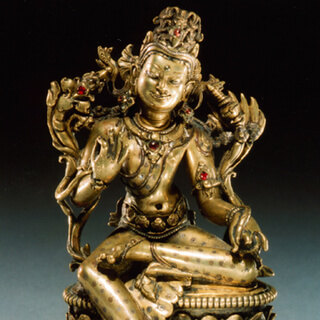
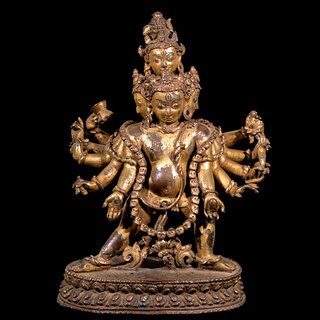
Including an image of a related artwork chosen from the Rubin Museum's permanent collection.
And now,
Please enjoy your practice.
Good afternoon,
Everyone.
How are you doing?
It's not that bad outside,
Right?
And what better place to be?
Welcome.
Welcome to our weekly mindfulness meditation here at the Rubin Museum in partnership with Hamera Foundation,
Presenting partners Sharon Salzberg,
The Interdependence Project and Parabola Magazine.
My name is Tashi Chodron.
I think I've said it so many times.
I host a monthly program called Himalayan Heritage.
It's first Wednesday of each month.
And guess what?
Today is the first Wednesday.
So this evening,
We'll be celebrating Lord Ganesha's birthday,
Partnering with India Home.
So the ritual is this month's theme and the art connection we have.
So this image that you see here,
It used to be on the second floor,
But due to a recent rotation,
The prayer wheel is not on the second floor,
Although Jeremy will take you to a surprise destination.
So this is a prayer wheel.
It's filled with prayers and it's practiced in the Tibetan Buddhism by all schools.
There is the Nyingma,
Which came to Tibet in the eighth century,
Then the Sakya,
Khaju,
Gelug,
All the four schools and Bern,
Which is the pre-Buddhist.
All schools of Tibetan Buddhism,
They practice,
Use the prayer wheel.
The idea behind this wheel is that the mantras in different deities,
Whether it's the Tara,
Which is the 10 syllable mantra,
Or the five,
Six pages of prayer that is condensed down,
Or the Avalokiteshvara,
The Buddha of Compassion,
The mantra will be the six syllable,
Om Mani Pedme Hum.
So the prayers will be printed on the papers and will be rolled and will be inside the prayer wheel.
And the idea behind this is that when you spin the wheel,
The prayer is read that many times.
So that much more blessing or the merit or the prayer is recited,
That's the idea.
So can you imagine how many prayers will fit in these prayer wheels?
So there are different sizes.
I brought you one sample.
These are called handheld prayer wheels.
And then there are giant one where maybe about eight to 10 people can circle one big giant wheel.
And inside this,
There is prayers and you spin it clockwise like that,
Right?
So the refugee camp that I was born and raised in India,
I've seen our elders,
You know,
In one hand they have the prayer wheel.
In the other hand,
Guess what they have?
The beads,
The mala,
Right?
And guess what they're doing with their mouth?
Praying.
Great.
And guess what they're doing with their feet,
With their legs?
Perhaps break dancing?
Circumambulating.
Can you imagine multitasking and so much good merit?
In one hand spinning prayer wheel,
The other hand the beads and with their mouth they're reciting mantras and with their legs,
You know,
Feet they're walking around the temple.
But what I've learned from the elders is that all this good merit,
It's not about me,
Myself,
Or I,
Me and myself.
It's very important to dedicate for the benefit of all sentient beings.
Regardless of whether you pray for three minutes or three hours,
Very,
Very important to dedicate.
So this ritual,
You know,
That's the connection and my personal connection that I wanted to share with you.
And for today,
We are very,
Very fortunate to have Sharon again.
Thank you.
And Sharon is the co-founder of Insight Meditation Society Berry,
Massachusetts,
Studying and teaching for 45 years.
Sharon's book,
Real Love,
Is you can find it up in our gift shop.
It's one of the bestseller and Sharon needs no introduction.
Please help me in welcoming Sharon.
Thank you.
I'll be here next week too.
Isn't it outrageous?
How are you all?
It's nice and cool in here.
So it was very funny having two,
What will turn out to be two talks on the same topic.
And I was thinking in writing,
Like when you're writing a book or something like that,
Or you're giving a series of talks,
It's always tempting to withhold something.
Like I don't want to use all the good material right away because then I have nothing.
And so one of the sort of things I've learned was like,
Give it all up.
Something else will happen.
Whereas if you start to parse it out and think,
Well,
Once I was here three times in one month and that was like three talks on one topic,
And that I better save something for.
.
.
So we'll see.
Because somewhere either today or tomorrow,
I want to talk about sharing merit as a very beautiful ritual.
Maybe next week.
We'll see.
I mean,
Next week,
Much more.
But it was interesting having this topic.
It's another interesting thing is that the museum itself decides on the topics and then gives the speaker a sample of different art pieces that you can choose amongst them.
So ritual was such an interesting topic.
In every school of Buddhism,
There is ritual.
In the Theravada school,
The Buddhism of Southeast Asia,
The earlier teachings,
We would say,
There are also some kind of snarky comments about rites and rituals.
When you get to a certain attainment of realization,
You will see through rites and rituals,
Things like that.
And yet,
What does that mean?
I think it takes a very careful examination.
So upon pondering it,
I thought that there were a couple of different things involved in that encouragement to see through.
I mean,
It's really seeing through empty rites and rituals is what it comes down to.
So I do think there are two things.
One is just presence.
It's one thing if you are turning the prayer wheel and thinking about.
.
.
That was a beautiful shawl I saw the other day online.
Maybe I should go back.
I wonder if I could find that site again.
Maybe there's even a sale.
I wonder if I missed the Labor Day sale the whole time.
You're spinning the prayer wheel or doing your beads.
You're just absent.
And so in some ways,
The kind of tokenism of the activity has taken over.
And I think that instead of feeling it's oneself and the cultivation of our minds and our hearts and our being and being present and offering.
.
.
I love prayer wheels,
Which is why I chose this depiction.
Because the idea is that it's like in Asia,
The movement is sending those prayers out.
It's boundless.
The prayer we offer is generative.
It's really moving throughout because if it's a prayer flag,
Then it's because of the wind.
If it's the actual canister,
Then it's because of that movement.
And it's so beautiful if we're present,
If we're aware of what is happening.
And that speaks to,
I think,
The second principle that is important to look at,
Which is that in the growth of a state religion,
What happens often is that it becomes someone else's job to purify,
To connect to the divine,
However it's phrased,
To understand the truth of things.
And so we kind of pay them to do a ritual and it's up to them.
And we're very happy because it's someone else's job.
It's a lot of work to really work with your own mind and mind states and circumstance and things that happen.
And so there is this sense of deferring.
And yet,
Is that true?
Can we really palm it off?
It's like a conscript in the Civil War or something like that.
You do it.
Can it possibly be transformative for us to just have someone else do it?
I mean,
If you ask someone to pray for you,
Which many people do,
I think something else happens when you think about it and you let it in and you honor their practice and you consider how many years have they devoted to the purification of their minds and how beautiful to be able to receive and things like that.
That's very different than just writing a check or doing something like that.
So I think rituals are beautiful and they're very powerful because they're about connection.
It's like a doorway that amplifies our experience.
We connect to ancestry.
We connect to timelessness.
We connect to the sense of boundlessness,
Not just what's happening in the room,
But our prayers are going out.
We connect to giving and receiving as we offer and also as we receive if we're paying attention.
And so just as I thought there were two issues,
I think there are two real considerations.
One is,
Of course,
Attention.
Are we paying attention?
And as our attention wanders,
As it inevitably does,
Can we come back and realize,
Oh,
That's the potency,
That's the magic of the moment is in being there.
And the other thing has to do with intention,
Which is really the beginning.
What's motivating us?
What's the spark?
What's having us doing this,
Whatever it may be,
Like performing this ritual or asking for this ritual to be done in some way?
What's really going on?
What's the tone of what we're wanting?
And that's something very important to pay attention to as well because there's a lot of power in that.
And that will bring us to the idea of sharing merit.
If the ritual has potency,
Then is it really just so that we can have a good time tonight or get a bigger apartment or whatever we think the accumulation of merit will do for us?
Or is it a kind of resource that is about also connection and offering and this kind of cyclical process of regenerating energy,
Regenerating this positive energy,
And then giving it away,
Which ironically produces more of it.
And so it's this continual replenishment as we do it.
So maybe I will save some of that for next week.
Okay,
Let's sit together and cultivate some attention.
So as you know,
I'm sure I really do consider the critical moment if you're sitting,
Say,
And trying to establish awareness on something like the feeling of the breath,
The critical moment really does happen after the mind has wandered.
That's where our intention also comes into play.
It's very easy to think,
Ah,
It's such a short sitting,
I might as well figure out what I'm going to have for lunch.
Or and or to freak out,
I can't believe my mind wandered again.
I'm just like the worst meditator in the room.
I can't believe it's all that happens.
I'm just like,
They're not thinking,
They're perfect.
Both of which just lead to a kind of accelerated,
Intensified distraction.
So rather than falling into those habit patterns,
It's actually very powerful to realize you've been distracted to gently let go and to come back.
See if you can sit comfortably,
You can close your eyes or not,
However you feel most at ease.
And settle your attention on the feeling of the breath wherever you feel it most distinctly.
Just a normal natural breath,
However it's appearing,
However it changes.
So you might find it strongest at the nostrils or the chest or the abdomen.
You can bring your attention there and just rest.
See if you can feel one breath.
You don't have to get ahead of the breath to feel the next one.
Just this one.
My early practice,
I used to say to myself,
You're breathing anyway.
All you need to do is feel it.
Relax.
Because I was like so hyped up,
I was trying to feel this breath and the next 50.
It's just this one breath and you're breathing anyway.
These images or sounds or emotions,
Fantasies may come up and pull you away and spin you around for a while.
That's okay.
Or you may fall asleep.
You realize that.
See if you can let go gently.
And then bring your attention back to the feeling of the breath.
Doesn't mean you failed.
Doesn't mean you blew it in some way.
It's fine.
Hallo.
.
.
Halloween.
.
.
Halloween.
.
.
Halloween.
.
.
Thank you.
Thank you.
Thank you.
Thank you.
Thank you.
Thank you.
Thank you.
Thank you.
Thank you.
Thank you.
Thank you.
Thank you.
Thank you.
Thank you.
Thank you.