Welcome to the mindfulness meditation podcast.
I'm your host,
Dawn Eshelman.
Every Wednesday at the Rubin Museum of Art in Chelsea,
We present a meditation session led by a prominent meditation teacher from the New York area.
This podcast is a recording of our weekly practice.
If you would like to join us in person,
Please visit our website at rubinmuseum.
Org slash meditation.
We are proud to be partnering with Sharon Salzberg and the teachers from the Interdependence Project and the New York Insight Meditation Center.
In the description for each episode,
You will find information about the theme for that week's session,
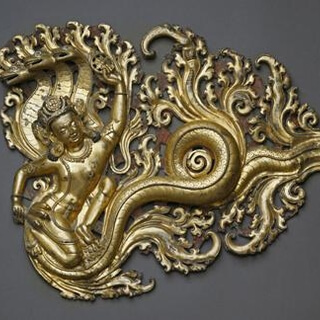
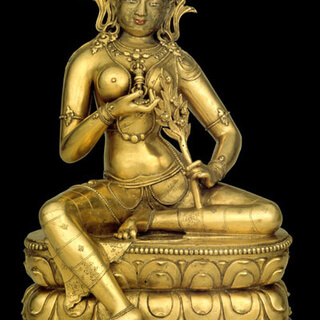
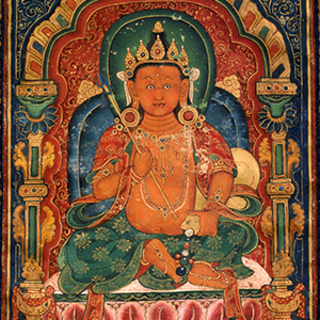
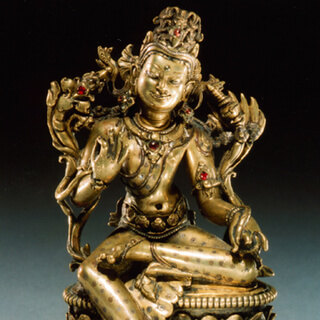
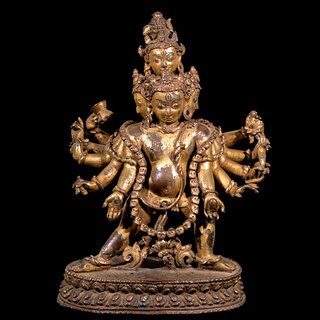
Including an image of a related artwork chosen from the Rubin Museum's permanent collection.
And now,
Please enjoy your practice.
Sharon is going to guide us into how we can be whole.
Being whole,
What does that mean?
When we all just see through our limited perception a fractal of existence.
And so that's what we're going to explore,
Not only today,
But for all the sessions that Sharon Salzberg is going to be here for the month of March,
Which is a happy thing indeed.
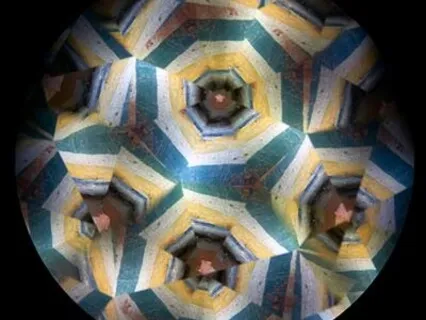
So what you have just seen as you came in were these fractal impressions.
These are stills from Kandroma,
Which is a video installation on the fourth floor,
Part of our Sacred Spaces exhibition.
And this was an artwork that was created by an art collective called Soundwalk,
Who walked the Himalayas recording found sounds and installed those sounds in the Sacred Spaces exhibition on the fourth floor.
They also custom made a kaleidoscope,
Which they then focused on things that were ephemeral,
Like prayer flags.
And so that kaleidoscope effect that you see here is actually in video form mesmerically upstairs on the fourth floor.
So I hope you want to follow Jeremy upstairs afterwards to experience that in real time.
But that's an example of the fractal impression of what we perceive only part,
Ever part of the whole.
So how do we understand what that whole is?
Well,
Fortunately,
We have the accomplished meditation teacher,
Sharon Salzberg,
To guide us there.
Sharon,
If you need an introduction to Sharon,
Let me just do it for you.
She's the co-founder of the Insight Meditation Center in Barrow,
Massachusetts,
Been teaching and being a pioneer of meditation practices for over 45 years,
Ever since birth,
Basically.
And she does not stop making her teachings and insights available.
And her latest book is called Real Love,
The Art of Mindful Connection comes out in June.
And I'm sure we'll be celebrating that publication here as well,
Because basically,
The Rubin is Sharon's home,
We hope,
And yours as well.
So Sharon,
Will you make us whole again?
Sharon Salzberg,
Everyone.
We're already whole.
That's the secret.
Now you don't have to come back three more times.
Hello.
This is kind of my home,
Actually,
Which is a wonderful,
Wonderful thing to be able to say.
I'm a little sick,
As you can hear,
But I feel okay.
I've just been traveling.
And so my flight from San Francisco was delayed five and a half,
Or maybe it was six hours the other day.
I walked into my apartment at 415 in the morning.
Somewhere in my really low period at the San Francisco airport after five hours,
Somebody came up to me and said,
Are you Sharon Salzberg?
And I thought,
Thank goodness I'm not having a temper tantrum.
Like on the ground.
So I really felt like doing,
You know.
And I said,
Oh,
Are you on this flight?
And she said,
No,
I'm on this other flight,
But I saw you from,
You know.
Hi.
So it is a great delight to be here.
And I've been fascinated with fractals.
I'm not sure I fully understand them at all,
But I've been fascinated with fractals for a long time.
As I do understand it,
A fractal is when a part of something can represent the whole.
Like if you look at a part of a coastline,
It represents the entire coastline.
If you look at a part of a fern,
It is representative of the entire fern,
Right?
So that glimpse of just a part brings us to a sense of the whole inherently.
And as soon as I began to hear about that and see these representations,
I started thinking about the path to liberation.
Because I think it is exactly like that.
Our mind,
Certainly my mind,
Is conditioned to want more,
To get more instruction,
The more elaborate,
Sophisticated instruction,
A different method,
A more esoteric,
Exotic,
Elaborate explanation.
And to think that you kind of got it already can be very frustrating,
Because that implies we have to live it,
Right?
There's something else we have to do to make that real.
So I have often spoken,
I'm sure many of you have heard me talk about my first meditation course,
Which was the first time I sat,
Which was in India in January of 1971.
And the first instruction I received was,
Sit and feel your breath.
Just sit and feel your breath.
And even then I was disappointed.
I thought,
You know,
Where's the magical,
Esoteric,
Fantastic technique that's going to wipe out all my suffering and make me a totally happy person?
So I waited and waited and waited and kept doing what they suggested I do.
And it's been over 45 years.
Sometimes it's not that different,
Right?
I mean,
There are lots of different approaches,
There are lots of different techniques,
But it's not like that was one-on-one,
You know,
Never to be seen again once mastered,
Because right in there,
That seemingly simple instruction,
It's like a fractal.
There's a tremendous amount about the entire path.
Sit down,
Put your attention on the feeling of the breath.
There's a lot spoken or unspoken about balance there.
Sometimes people feel,
You know,
If they like get a death grip on the breath,
Their minds won't wander and actually they'll wander more.
The instruction actually is rest your attention lightly,
Like a butterfly resting on a flower.
That's something different.
I think one of the things we see about our lives,
If we start bringing mindfulness to activities,
Is that we often apply inappropriate force.
We try too hard.
I have a friend who decided,
We were just kind of choosing activities throughout the day,
And he decided that brushing his teeth was going to be his mindfulness exercise.
And he said the first thing he noticed was that he was holding onto that toothbrush so tightly it might as well have been a jackhammer,
About to leap out of his hand and cut off his head.
And he found that interesting.
He thought,
I wonder if I do that a lot.
I think we kind of do do that a lot.
So we rest our attention lightly.
That's not that easy.
And just as I was surprised to discover,
Most of us discover it's not like 900 breaths before your mind wanders,
Right?
It's two,
Or one,
Maybe it's four,
And then we're gone.
We're lost in the past somewhere,
Not in a useful way,
But in a kind of useless way.
Very often they say when our minds go to the past,
We go back to some incident where we now have some regret.
But not to see how we might make amends or for lessons learned,
We just go over it and over it and over it and over it.
And or our minds go to the future and we create a scenario that has not happened and may never happen but we're filled with anxiety because of it.
Like,
I don't know,
I have to book this flight.
What if I book another flight and it's like going to be one o'clock and maybe there'll be a blizzard,
God knows.
And I want to be at Kennedy for like 24 hours.
I'll never get to Maui.
Really?
First of all,
It's like May or something.
It's just because I'm in that mood now.
Nothing's going to work.
So our minds jump to the past,
Jump to the future,
And there comes this magic moment when we realize,
Oh,
It's been quite some time since I last felt a breath.
There's mindfulness there.
That's significant.
We realize when we're present,
We realize I've been lost.
I've been disconnected.
That's part of the whole.
I have a teacher who had a kind of trick question he used to ask people,
Which was something like,
How many breaths can you be with before your mind starts to wander?
And the reason it was a trick question was because they felt it took a good degree of mindfulness to notice how much your mind wandered.
So a good answer was like two breaths.
If you said,
I can be with my breath for 45 minutes and my mind never wanders,
They thought you were so lost in space that you don't have a clue what was going on.
And sometimes I used to be in the back of the room and I'd hear him ask people that.
And they'd say,
I can be with the breath for 45 minutes and my mind never wanders.
And I think,
Don't say that.
Do you think that's such a good answer?
It's not such a good answer.
So shining a light on when we're present,
When we're distracted,
What we're feeling,
What's going on is a part of the whole.
We do that right in that moment.
Oh,
It's been quite some time since I last felt a breath.
We practice letting go,
Which is essential to the entire path.
And we learn nothing else.
And we learn that.
That's enormous.
It's also not so easy.
When we think of letting go,
We think of rejection and spurning something and saying it's worthless.
This is very different.
It's a very gentle relinquishing.
It's like saying not quite now.
Either my attention needs to be here or done this 90 billion times in the last 15 minutes.
It's kind of enough.
Or what's it like to recognize what I'm feeling and realize I have a choice?
I can follow it into it or I can let it go.
That's the power of awareness.
Not because we hate what's going on or we fear it,
Because we kind of don't need it right now.
That's what one of my teachers once called exercising letting go muscle.
That's enormous.
And we begin again.
We bring our attention back to the feeling of the breath,
Which inevitably to do that well means we're doing it with kindness toward ourselves.
Because that's also not so easy.
More commonly it's like,
Damn it,
I'm thinking,
Why am I always thinking?
No one else in the room is thinking.
I'm like the worst meditator that ever lived.
All of which not only extends the period of the distraction,
Sometimes considerably,
But so demoralizing.
It's so exhausting.
There's something so pure in a way about letting go and beginning again.
It is an expression of our wholeness.
So it's not like we're seeking wholeness in each of these moments we're resting in a kind of integrity or wholeness.
And it's expressing itself.