Welcome to the mindfulness meditation podcast.
I'm your host,
Dawn Eshelman.
Every Wednesday at the Rubin Museum of Art in Chelsea,
We present a meditation session led by a prominent meditation teacher from the New York area.
This podcast is a recording of our weekly practice.
If you would like to join us in person,
Please visit our website at rubinmuseum.
Org slash meditation.
We are proud to be partnering with Sharon Salzberg and the teachers from the Interdependence Project and the New York Insight Meditation Center.
In the description for each episode,
You will find information about the theme for that week's session,
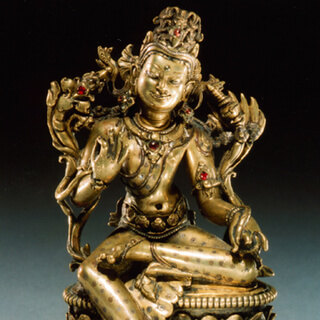
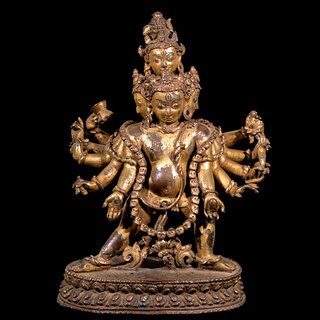
Including an image of a related artwork chosen from the Rubin Museum's permanent collection.
And now,
Please enjoy your practice.
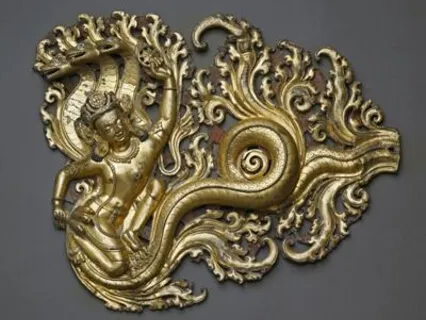
We're looking today at this beautiful naga.
And this naga is from 14th century Tibet or Nepal.
This is a piece from an exhibition we have on our fifth floor,
Which is called Nepalese Seasons,
Brain and Ritual.
And the naga is a really interesting,
Kind of powerful and mischievous serpentine figure that appears in monsoon clouds,
Just as the monsoon clouds are really reaching their full kind of maximum capacity and are about to burst.
It is said that at that moment,
You can sometimes see animal figures,
Including the naga,
In those clouds.
And the naga is a harbinger of the great monsoon waters to come,
Which is,
Of course,
Incredibly important for the region's bounty that following season.
And I think it's really interesting to note that the naga is associated not only with the clouds,
The monsoon clouds,
But with the ocean and waters below.
So there is a symbiotic relationship there.
The water that the naga inhabits,
Of course,
Goes up into the atmosphere and creates the rain that comes back down again.
So we are seeing this naga here coming out of carefully detailed motif known as cloud foliage.
And in fact,
We're seeing a kind of fractal image.
And a fractal is a recurring pattern that we often see in nature that really helps us understand the part in relationship to the whole.
They're in fact the same.
And I'll give you a couple of examples from nature here.
We see this all the time.
But the one that comes to mind here,
Of course,
We see the storm cloud imagery here and the kind of wisps and curls of clouds.
It also looks a little bit to me like a fern,
A fern frond.
And if you look very closely at a fern frond,
You can see the shape of the tiniest leaf reflects in fact the shape of the whole,
The whole fern itself.
This is imagery from an actual storm cloud.
So we're seeing that repeating pattern here as well.
And we'll take a look at a different form of water.
This is frozen water,
Or a snowflake,
Also looking a little bit like that fern frond.
So again,
This idea with fractal imagery that we're looking at throughout the month is evoking that sense of wholeness and reminding us that there's an inseparable relationship between the part and the whole.
So we are so happy to have Sharon Salzberg here for almost the whole month this month.
She is of course the co-founder of the Insight Meditation Society in Berry,
Massachusetts,
The author of many wonderful books,
Including Real Happiness,
Which is upstairs in the shop.
And has been studying and teaching for decades,
And we're so pleased to have her here again today.
Please welcome her,
Sharon Salzberg.
And welcome back,
Dawn.
Hello.
So fractals is my favorite thing in a way.
How a part of something can represent the whole,
And I've often,
Often,
Just as I said last week,
Thought that we can see that in terms of a path to liberation,
That it's not necessarily healthy to think of it as the sort of tedious climb disconnected from the end result.
But it's,
I think,
Much more truthful to see that each moment of a full expression of what we're bringing forth,
Say,
In a moment of practice,
Is representative of the whole.
My teachers in India would always say things like,
A moment of mindfulness is a moment of freedom.
It's a moment of enlightenment.
Only we want more than a moment,
Which is the point,
Not to somehow see it as so remote or disconnected from what's happening right now.
But to understand our goal is to try to increase the frequency.
If you try to have an experience you're not having,
Like my mind needs to be more pure,
Or I need to be seeing this in a more subtle level,
Or I have to see what's underneath this feeling,
But you're actually not seeing what's underneath the feeling,
Then what you're practicing is frustration.
And I say that with great confidence,
Having practiced that for a very long time.
I don't have the right experience.
It needs to be more subtle.
But when I realize,
Oh,
That's not the point,
That what I or we subjectively experience as depth is actually a result of frequency.
It's more moments of mindfulness in a row.
Even if what you're mindful of is something really crude and you wouldn't boast about it to anybody,
It's more superficial than you would like,
Or whatever your notion is of what should be happening.
It is what's happening.
And we want more moments of mindfulness of it in a row.
And because it will probably not be perfectly continuous,
Our minds wander,
We get lost,
We get overcome.
It means starting over again as quickly as we can.
Not sort of belaboring the distraction.
Why did I go there?
Why am I a mess?
I haven't practiced for decades,
Really.
I should be better than this.
So here again we have letting go and beginning again.
But it's quite a different conceptualization,
Right?
Rather than thinking about what we're lacking,
Depth,
Subtlety,
Some alternative state of consciousness,
Transcendence,
Bliss.
We may be lacking many things from that particular point of view.
But from another point of view,
We're lacking nothing.
Because the experience is not kind of the point.
The point is how we're relating to the experience.
And that is in our hands.
Even when we forget and we get overcome,
We can then remember.
It's like,
Oh right.
You can't really change pain to pleasure,
For example.
Or turbulence to serenity.
But you can relate very differently to that pain.
And that's its own kind of pleasure.
You can relate very differently to that turbulence.
And that's its own kind of serenity.
And it's like massively empowering because that we can do.
So I told Dawn I looked at that image.
And what I really saw was emergence.
And I thought that too is like a fractal.
It's so representative of what my understanding is anyway of the nature of a path to liberation.
In that we,
You know,
Most of us start out with a kind of normal conventional consumerist mentality,
You know,
Like,
God,
It would be great to have a great insight this afternoon.
Then I don't have to sit again tonight.
I can tell everyone at work,
Like,
Wow,
You wouldn't believe what happened to me.
And so we usually practice,
Or it's easy to practice,
In that mode.
We want and we're craving and we're kind of looking,
You know,
Where is it?
If we get a glimmer,
We hold on to it.
But really the whole practice works in a very different way.
And that is the belief that our goal,
Our work is to try to bring our system into greater and greater balance.
Right?
So we have both energy and calm.
We have both relaxation and interest.
We're not leaning forward into our experience trying to keep it from changing.
We're not kind of leaning back trying to shun it or pretend it's something else.
Our work is to bring our whole being into greater and greater balance with the belief that it's out of that balance that everything we want will emerge.
The insight,
The qualities like love and compassion.
It's also a different way of practicing rather than thinking,
Look,
Where's the love?
I had three minutes yesterday.
I should have ate today.
It's the same work.
Just to keep working with that kind of deepening,
Deepening,
Deepening balance,
Which is also in our hands,
Is something that we can do.
And I love that sense of emergence.
It's creating the conditions for what we want to emerge,
To arrive,
To arise.
And I think that's really the spirit.
It's both the spirit of the fractal,
Like there we are,
One moment,
And it's right there.
And it's also the spirit of,
I think,
The most onward leading kind of practice.
So why don't we practice together?
You can sit comfortably,
Close your eyes if you like.
If you get really sleepy and your eyes are closed,
It's fine to open your eyes and continue on.
In terms of your posture,
See if you can have your back straight without being strained or over arched.
You want some energy in your body,
But you also want to be relaxed.
If you like,
You can start by listening to sound.
The sound of my voice or other sounds.
It is a way of relaxing deep inside,
Allowing our experience to come and go.
It's like the sounds wash through you.
I was once practicing with Tibetan teachers,
Sukhneer Pache,
And there were,
I don't know,
Maybe 60 of us in the room.
And he said,
No,
I want you all to touch space.
I think every single one of us picked up our hands and like poked in the air with our fingers.
And he laughed and laughed and he said,
You're already touching space.
Space is touching you.
So see if you can make that flip for a moment.
You're settled into your being.
Space is touching you.
There's nothing you need to reach out for.
And within that,
Let your attention,
Let you settle on the feeling of the breath.
The breath is happening anyway.
There's nothing special you need to do.
Simply feel it.
Me.
Nothing.
If you like,
You can use a quiet mental notation,
Like in,
Out,
Or rising,
Falling,
To help support the awareness of the breath,
But very quiet.
So you stay in that space of allowing the breath to come and go.
Okay?
As you find your attention is wandered,
You've been lost in thought,
Spun out in a fantasy,
Or you fall asleep,
Truly don't worry about it.
We say the most important moment is the next moment after you've been gone,
After you've been lost.
See if you can let go gently.
And with some kindness toward yourself,
Just return your attention to the feeling of the breath.
If you have to do that,
Let go and begin again a million times in the next few minutes,
It's fine.
.
.
.
.
.
.
.
.
.
Thank you.
Take care.
That concludes this week's practice.
If you'd like to attend in person,
Please check out our website,
Rubinmuseum.
Org slash meditation to learn more.
Sessions are free to Rubin Museum members,
Just one of the many benefits of membership.
Thank you for listening.
Have a mindful day.