Hi,
This is Rena from Rena Davis Wellness,
And this is a short yoga practice to address anxiety.
When we talk about anxiety in a very general way with yoga,
We want to fold forward in anxiety to help protect the chest.
Oftentimes we feel safe when we're anxious.
Whereas with a depressive episode,
You might want to open up the heart to feel more joy and more openness and bliss.
To get started today,
We're going to take balasana,
Or child's pose.
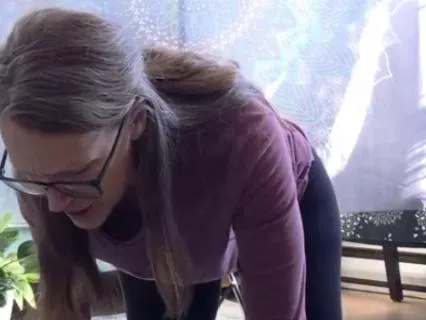
So coming over onto our hands and knees.
We're just going to be pushing back hips to the heels.
Knees can either be wide or closed.
Toes are together in this position,
And then we push back in the hips.
For this starting pose,
We're just going to take the hands behind,
Palms are facing up to the ceiling,
And release the head to the floor.
Breathing here allowing the back body to move as you inhale.
Feel the opening there.
As you exhale,
Let that sink in just a little bit more.
We're taking long exhalations here.
Let's do two more.
On this next exhale,
We're just going to release the arms up to the front of the mat.
And you might push into the hands to deepen that stretch into the hips.
Long as hell again.
And then bring your left hand either on top or outside of the right hand.
And we're going to open the left side body here by just shifting over to the left a little bit.
Only to your comfort level.
You might be sounding the breath using Vijayu Pranayama,
Or ocean sounding breath.
If that's part of your practice.
One more right here.
Hands come back into a neutral position and then right hand on top of left.
This time opening the right side of the body,
Shifting the right hip open and nice,
Long,
Deep breaths.
If you're trying to sound the breath,
You're pulling back in the tongue a little bit to the back of the throat.
Two more breaths.
Last breath,
And then the hands are coming out to shoulder distance apart once again,
And we rise up.
Hands come directly under the shoulders.
Knees are gonna pop right underneath the hips and we're gonna move into some cat cow here.
I'm going to shift a little bit more to the side so you can see what I'm doing here.
In our feet,
We have cups of the feet to the floor.
As I mentioned,
The wrists are right underneath the shoulders.
As you move into cow pose,
We're dropping the belly,
Lifting sitting bones toward the ceiling,
Lifting head up.
And then as we exhale,
We move into cat pose,
Rounding the back as much as possible,
Letting the head drop.
Next inhalation,
You move into your cat,
Cow,
Sorry.
And as the exhale starts to come,
You move to cow.
I'm getting them mixed up.
Move at the pace of your own breath here.
One more time in each direction.
And then we'll move into a neutral spine.
In your neutral spine,
You've got a little bit of tightness in the belly.
So you're thinking about just pulling the belly up a little bit,
Bracing here.
We're not trying to get the belly button to the back,
Just bracing here to hold steady.
And then we're going to take the knees a little bit closer together.
And then taking your left knee,
Pop it behind your right knee,
Widen the feet open,
And then come back into gomakasana legs.
Cow-faced legs.
And then inhale yourself back up.
And we'll do three more just like that.
Push back.
Maybe take a breath right here.
And then up we go.
Inhaling forward.
Exhale back.
A breath.
And inhale forward.
Let's do one more in this side.
And then forward we go.
Bring the knees back into neutral.
And then we'll take that to the other side.
The left knee coming in behind the right knee,
Widen the feet out,
And we push back on an exhalation.
Take a breath.
And then we inhale forward.
Exhale back.
Take that inhale to the front.
We'll do two more.
Nice long breath right here.
You inhale up.
And one more time.
One up again,
Uncross the legs,
Bringing them to neutral.
And then we're going to take our right foot and bring it forward.
So that our ankle is stuck right below the knee here.
So you'll see that I'm not in a great big lunge right here.
If you prefer to be in a big lunge,
You go for it.
That would just mean widening the feet a little bit more and coming into that.
But for our purposes right here,
I'm just going to keep wide laterally between that back knee and the front foot.
And we're going to just drape over our front knee.
So we're just letting the head release,
Supported by the front leg,
Together to maintain that strong balance in the foundation.
You can keep your hands down here,
Or if you prefer,
You could take hands to opposite elbows and hug in and let the shoulders just round here.
Take a couple more breaths.
One more inhale.
Last exhale,
Releasing the hands if they're up.
And then we'll take that front foot back.
Left foot comes forward.
If this isn't working for you,
You take that foot any way you wish.
Mode of transportation is not a problem here.
Again,
Stacking the knee over the ankle.
Getting yourself in a comfortable position.
You could be using a pillow on this front leg if that felt better for you.
And then letting the head release.
Hands can stay down or you hug.
I need a little more width and then holding on to opposite elbows.
So if you find you're falling,
Your feet or your foot and knee might be too close together,
Like on a tightrope as opposed to a railroad track.
So that's something to consider.
Let's take two more breaths here.
And then we release the hands.
The sides of the front foot.
This time we're going to bring this leg in a little bit more,
Tuck your back toes under and step forward.
Feet can come about hip distance apart and we're going to stand to rise.
Facing forward.
Right here we're just going to widen out a little bit more in the feet so we're more shoulder width apart or even a little bit more than shoulders we're just going to take some swinging motion here so we're going to let the knees be really soft and just come into what I call knocking on the kidneys.
Just taking some movement that feels right.
Go at the pace that feels good for you.
It doesn't have to be what I'm doing right now.
It doesn't even have to be the movement I'm doing right now.
Maybe you prefer to come up.
Or side to side across the chest.
Whatever feels right.
We just want to be loose here.
Generally when we're doing somatic type work,
We don't want to be super posed.
So we want to make sure it feels good.
Keep on breathing.
You might shift your eyes over one direction as you start to move in that direction.
Take them all the way to the side so that your eyes are shifting side to side.
You might be able to see that,
Yes,
My knees are moving one direction and the other.
You're breathing again,
Maybe using that Ujjayi Pranayama.
If you're not using UGI,
That's totally okay.
Maybe you're just taking long inhalations,
Long exhalations.
And then holding steady right here.
Taking the arms up,
Maybe pressing behind the head and just open the chest for just a moment.
And then coming all the way forward.
Knees bent as much as you want them bent.
Hands can come down to the floor,
Anywhere along the legs that feels good for you.
Let the head release.
Side to side here,
You might bend one knee and then the other.
Getting into the hamstrings right here.
So do what you need to.
You could be taking your hands to a chair as well in front of you.
Couple more right there.
And then walking the heels toward each other so that they're sitting bone distance apart.
And right here,
You can just let that head hang forward and maybe hold opposite elbows once again.
I'm pretty bent in my knees here.
You don't have to have straight legs.
Breathing deeply.
Every exhalation allowing you to fold that little tiny bit deeper,
Thinking millimeters here.
And then hands can come down once again.
We're going to widen the feet out.
And if you feel like it's a good idea,
You can come into malasana or a low squat.
We're just using this as a transition to get back to the floor.
So if this isn't a thing that you want to do,
That's totally all right.
We're just going to have a seat.
As you come down,
Onto your mat once again.
We're just going to shift so that we are going to come into another twist.
So right here,
I'm just going to take my left foot over towards my right hip.
This top leg can come around.
And then we're hugging the knee.
If this doesn't work for you,
The other option is to keep your front leg straight and then hug the knee this way.
We're not trying to get the deepest twist here.
Again,
We're coming close with the chest and the leg.
And then if it feels good,
You open up in the head.
Looking behind you perhaps.
Breathing deeply.
And then release it.
Take that to the other side,
Extending that leg,
Switching over your choice of which one you want to take here.
And then hugging.
Looking across.
Perhaps over your back shoulder or toward a point that feels right for your neck today.
Two breaths.
As you exhale,
Turning around to the front.
And then taking the legs out front once again.
Right here we're going to take paschimottanasana or seated forward bend oftentimes we like to just get a little bit of the flesh away from the sitting bones as we come into this pose bent in the knees once again keep them soft and then lengthen the spine as you fold in.
You can reach your toes if that's an option for you or anywhere along the legs that feels right.
You breathe with sound.
Two breaths right here.
On your next exhale,
Maybe you go that tiny little bit deeper.
And then we rise on an inhalation.
Sitting up tall,
We're going to bend the knees once again.
I'm just going to shift forward.
And you can roll yourself down onto your back or whatever you need.
Maybe you'll hold on to get some support with that roll down.
Coming onto the bath.
We're gonna just bring the knees towards the chest.
Let your head relax here.
If it feels good to take a little side to side motion,
You do that.
And then we're gonna release the left leg as we hold the right.
Into the chest.
And drop into a knee down twist.
So this left hand is coming outside the right knee.
We're going over only to the point that feels good for you.
The right hand can extend over to the side at shoulder height if that feels good.
You might look over at it as well.
Just going again to the point that's feeling good for you.
These twists are helping the stomach and internal organs to get a little squeeze.
Part of the reason we're doing that is because the vagus nervous touching into those parts of the body.
Getting a little activation there.
The parasympathetic nervous system.
Now guide that knee back up.
That leg can extend out,
Left knee towards the chest.
Give it a squeeze once again.
And if it's right for you,
You guide it across.
Left hand this time can be extending out to the side,
Opening only to the position that feels right for you.
This twist is supposed to feel good.
So if it's feeling really difficult,
Just back off a little.
You might put a block,
A bolster,
A pillow,
Some other books even underneath your foot or knee.
And do it the way it feels good.
You want to be able to rest in this position.
Another breath.
And then we guide that knee back up once again.
And both knees can extend on the floor in full Shavasana,
Palms faced up to the ceiling about 45 degrees away from the body with the knees about out to the corners of your mat or thereabouts.
If you prefer,
You can bend the knees,
Pop the knees together,
Keep the feet about mat distance apart.
You can rock the head side to side a few times.
Before coming into a final relaxation position.
If this is feeling a little bit too exposed for you,
Perhaps you take one hand to your chest,
One hand to the stomach.
And hold.
Your Shavasana this way.
Letting your breath be even.
Letting yourself relax fully.
Feeling the warmth.
Of the hand.
As you hold your chest and stomach letting every effort go.
Resting as long as it feels right for you.
Another alternative to shavasana on the back is to come into a fetal position on the side where you are dropping one arm below the head,
Keeping the knees bent and taking a rest this way.
Whatever feels best,
As I've mentioned before.
When it feels like the right time to get up,
You are gonna drop yourself into fetal position and use your top hand to push yourself up to a seated position.