So before we did an investigative meditation we went through the sense spaces and we went through parts of the body and we investigated feelings and we investigated this sense of self.
And that was as a preliminary because today I want to go through the second Sutta that the Lord Buddha taught,
The Anattalakana Sutta.
Now the thing about this Sutta is that it's fairly straight forward and it's really important to have a sense of context and it's actually very profound and it's one of the reasons I like to leave it for a few days into the retreat.
That if the mind is a little more quiet and there's a little more mindfulness and a little more wisdom present that it goes in a bit more deeply.
It's pretty straight forward and self explanatory so I'll just read it and it's fairly short.
So this was taught in Saanath at the Deer Park.
Lord Buddha has already taught the Dhammacakka Sutta.
Set the wheel of Dhamma in motion,
Anya kondanya attained to stream entry with his insight.
All things of the nature to arise,
Of the nature to cease.
And then the Buddha taught Anya kondanya and the other four bhikkhus,
This next Sutta.
And thus have I heard,
Once the Blessed One was staying in a Deer Park at Isipatana near Varanasi,
There the Blessed One addressed the group of five bhikkhus.
Bhikkhus,
Form is not self.
If form were self,
Then this form would not tend to affliction.
And one could say of form,
Let my form be thus,
Let my form be not thus.
Indeed bhikkhus,
It is since form is not self that it leads to affliction and none can have it of form.
Let my form be thus,
Let my form not be thus.
Meaning body.
So the Lord Buddha is saying we have very little control over our bodies.
Bhikkhus,
Feelings are not self.
If feelings were self,
Then feelings would not tend to affliction.
And one could say of feelings,
Let my feelings be thus,
Let my feelings be not thus.
Indeed bhikkhus,
It is since feelings are not self that they lead to affliction and none can have it of feelings.
Let my feelings be thus,
Let my feelings not be thus.
Bhikkhus,
Perception is not self.
If perception were self,
Then perception would not tend to affliction.
And one could say of perception,
Let my perception be thus,
Let my perception not be thus.
Indeed bhikkhus,
It is since perception is not self that it leads to affliction and none can have it of perception.
Let perception be thus,
Let it not be thus.
Bhikkhus,
Mental formations are not self.
If mental formations were self,
Then mental formations would not tend to affliction.
And one could say of mental formations,
Let my mental formations be thus,
Let my mental formations be not thus.
Indeed bhikkhus,
It is since mental formations are not self that they lead to affliction and none can have it of mental formations.
Let my mental formations be thus,
Let my mental formations be not thus.
Bhikkhus,
Consciousness is not self.
If consciousness were self,
Then consciousness would not tend to affliction.
And one could say of consciousness,
Let my consciousness be thus,
Let my consciousness be not thus.
Indeed bhikkhus,
It is since consciousness is not self that it leads to affliction and none can have it of consciousness.
Let my consciousness be thus,
Let my consciousness not be thus.
So it's true,
Isn't it?
If feelings were our self,
We would choose to be happy,
Wouldn't we?
And you know,
You've probably had some experience already these last few days of like having an emotion in the mind,
A feeling,
An unpleasant mental feeling and really not wanting it to be there and really wanting to let go of it and maybe even having enough mindfulness and wisdom to see this is unskillful,
It's not necessary,
I don't need it,
I don't want it,
It's time to let it go.
And yet it's still there.
Sometimes it can be let go of with mindfulness and wisdom and sometimes it's not,
But we don't have control over these things.
Same with physical feelings,
The knee pain,
Who wants knee pain?
Who wants sore shoulder muscles?
And we can't just say go away and they go away,
They have their own nature.
So too with the consciousness and the mental formations.
And the Buddha continues his teaching.
What do you think bhikkhus is form permanent or impermanent?
The bhikkhus answer impermanent,
Venerable sir.
That which is impermanent,
Is it satisfactory or unsatisfactory?
Unsatisfactory,
Venerable sir.
That which is impermanent,
Unsatisfactory,
Subject to change,
Can it rightly be regarded thus?
This is mine.
This am I.
This is myself.
No venerable sir.
What do you think bhikkhus is feeling permanent or impermanent?
Impermanent venerable sir.
That which is impermanent,
Is it satisfactory or unsatisfactory?
Impermanent venerable sir.
That which is impermanent,
Unsatisfactory,
Subject to change,
Can it rightly be regarded thus?
This is mine.
This am I.
This is myself.
No venerable sir.
What do you think bhikkhus is perception permanent or impermanent?
Impermanent venerable sir.
That which is impermanent,
Is it satisfactory or unsatisfactory?
Unsatisfactory,
Venerable sir.
That which is impermanent,
Unsatisfactory,
Subject to change,
Can it rightly be regarded thus?
This is mine.
This am I.
This is myself.
No venerable sir.
What do you think bhikkhus?
And the Buddha asks about mental formations,
The same response,
And then he asks about consciousness.
Is consciousness permanent or impermanent?
That which is impermanent,
Is it satisfactory or unsatisfactory?
Unsatisfactory,
Venerable sir.
That which is impermanent,
Unsatisfactory,
Subject to change,
Can it rightly be regarded thus?
This is mine.
This am I.
This is myself.
No venerable sir.
Therefore bhikkhus,
Whatever is form,
Past,
Future or present,
Whether in oneself or external,
Whether coarse or subtle,
Whether inferior or superior,
Whether far or near,
Should be seen with right understanding thus.
This is not mine.
This am I not.
This is not myself.
Similarly,
Whatever are feelings,
Past,
Future or presently arisen,
Whether in oneself or external,
Whether coarse or subtle,
Whether inferior or superior,
Whether far or near,
Should be seen with right understanding thus.
This is not mine.
This am I not.
This is not myself.
Similarly,
Whatever is perception,
Past,
Future or present,
Whether in oneself or external,
Coarse or subtle,
Inferior or superior,
Far or near,
Should be seen with right understanding.
This is not mine.
This am I not.
This is not myself.
And the Buddha goes through the same with regards to mental formations and consciousness.
Whether inferior or superior,
Far or near,
Should be seen with right understanding.
This is not mine.
This is not myself.
Bhikkhus,
A wise,
Noble disciple who has listened well,
Sees this and is no longer fascinated by form,
No longer fascinated by feeling,
No longer fascinated by perception,
No longer fascinated by mental formations,
And no longer fascinated by consciousness.
Becoming dispassionate,
His passions fade away.
With the fading of passion,
His heart is liberated.
When liberated,
There comes the knowledge,
It is liberated.
He understands birth is exhausted,
The holy life has been lived out,
What was to be done is done.
There is no more of this to come.
This is what the Blessed One said.
The Bhikkhus of the group of five were glad,
And they delighted in his words.
Now while this discourse was being delivered,
The hearts of those five Bhikkhus were liberated from taints through clinging no more.
So then after this Sutta was taught,
The first five Arahants,
Including the Buddha,
That was six Arahants in the world.
So this last paragraph actually describes a very profound process.
Here it's been translated as fascinated,
And I think I prefer to use the word deluded.
So we tend to be deluded by forms,
And deluded by feelings,
Deluded by perceptions,
And we start to think that there is self,
And that other people are self.
That's a type of delusion.
So when we see this more truthfully,
An interesting thing occurs.
This word nibbidā in Pali,
Weary.
So it's interesting because those of us who are interested in being peaceful and interested in being enlightened,
You wouldn't think that the word weary or weariness would have much of a role to play.
But it actually does.
So what happens in being fascinated,
Deluded,
Enchanted by the world?
And as we were talking when the Buddha was under the Bodhi tree,
We were talking this morning about the enlightenment process,
And he saw that the cause for attachment and clinging and craving was pleasant feelings,
Mental and physical.
So because of being attached to those pleasant feelings and desiring them,
That was the cause for clinging to them,
And that clinging causing birth.
So there is clinging,
There is attachment,
There is delusion.
So there's a lot of attachment,
As we know.
A lot of clinging.
So weariness plays a very important process.
When we look at the whole picture and we start to think,
Okay,
There is this much pleasure,
But then there's this much unsatisfactoriness,
And you start to get a sense for it's not a very good deal,
And you start to feel,
You know,
What would it be like if I let go of my attachment?
And you start to feel what it's like when you let go of your attachment.
More space,
More clarity,
More peace,
More serenity,
And you get a sense,
Oh,
This is nicer.
And you begin to trust that inner refuge that you have.
So it's not uncommon for people when they begin to meditate a lot to feel a pretty intense kind of weariness and boredom.
And this is a lot of what I was experiencing as a young monk and as a young man before becoming a monk,
And I relayed that conversation I had with Tanajana Nan about saying I just felt so oppressed by my own mind,
Sometimes I wanted to kill myself,
And he said,
That's normal.
And he said if you didn't have that quality of,
They say in Thai,
Bua nai,
Bored,
Bored with the world fed up,
If you didn't have that quality you wouldn't be coming seeking out the monk's life at the age of 22.
So this emotion plays a very powerful role.
It's as if this is what is peeling the fingers off the thing that we're attached to as a metaphor,
We're very attached.
And it's only through really seeing,
Look this is the pleasure,
And the Buddha says,
Know the pleasure,
There is pleasure.
And he says see the danger.
So how much suffering is occurring in relationship to being attached to the pleasure.
So we really have a close look at that and you say oh a lot of suffering.
And then there's a sense of being weary and you really begin to pay attention and there's a sense of oh it's very tiring isn't it?
It's very tiring trying to get what I want and not getting what I want and it's very tiring when I get what I want,
When that thing is gone,
Can't make it last.
And you begin to notice how fleeting,
Yes I really want,
I remember talking to a man once who had a BMW in Thailand and he said he had two happy days in the ten years that he owned his BMW.
The day that he bought it and the day that he sold it.
And in between he had ten years of dissatisfaction because it wasn't what he thought it would be and then it was expensive to repair.
And that's just one example of we're often let down,
We often think if I just get this I'll be everlastingly happy.
And you get it.
And you don't want to look,
You don't want to look,
You think well it didn't quite work so I wonder the next thing.
And after a certain amount of time we look at how many of those next things there have been.
And we start to get more wiser and you think yeah there is a certain amount of pleasure but it really doesn't last very long.
And you start to feel tired and have a really good look at that.
And if we can let go of our attachments,
These two things are growing together,
It's not just the weariness,
It's the experience of inner peace that occurs when you can let go of the craving.
So on one level there is weariness,
Boredom.
And what's it like when you sit through that?
You find it has a sobering effect on the mind.
Being wearied,
Being bored,
It's very painful but it forces you onto your sitting cushion.
And then you sit and you sit and you sit and you sit and you get some glimpses of cessation of this very painful emotion.
And then when that emotion is not there and there is no particular craving but there is no particular aversion and the weariness has kind of calmed down a little bit and you get this serenity.
That's nice.
These little glimpses of peace.
So the next thing that occurs is after weariness is this word dispassion.
So this also isn't really a pleasant experience to feel dispassionate towards all conditions and the five khandhas and the world and even towards everyone that you've loved.
Just this feeling of there's something here which really really hurts me and others and I want to put it down.
And this is very important because what happens is the mind which has been flowing out for eons,
Out the eyes,
Out the ears,
Out the tongue,
Out the nose and into interest in other beings.
It's being retracted through this process.
All this energy is coming back.
This is very important because it's those tentacles that are going out in all directions out the sense bases that are holding us in samsara.
And so through the process of being wearied and then becoming dispassionate the Buddha says,
Becoming dispassionate the bhikkhu's passion fades.
With the fading of passion his heart is liberated.
So it's just a few words strung very closely together but it's very profoundly important.
It's good to calm down the passions,
Sow with the passions,
To become weary and to become dispassionate.
This is an important part of the process.
So it's important to understand this because we can think that Buddha's practice is about becoming happier and happier and happier.
And it's actually not.
I don't even like the word happy myself very much.
And I don't want to sound unreasonable or sadistic or I prefer the word peace.
And so we can't attain a solid unchanging state of happiness.
We can't.
And if we could the Buddha would have discovered it and said this is it,
This is happiness.
But he didn't say that.
He said this is liberation from suffering.
And this is what Buddhas teach.
Buddhas teach suffering,
The causes of suffering and the way leading to the end of suffering.
The Buddha doesn't teach the path to happiness.
And it's not that there isn't happiness.
It's not that there isn't joy along the Buddha's path.
There is.
But it's not an unchanging solid dependable happiness.
And so it's just important to understand that some of these things that one might experience on an intensive meditation retreat,
You might get moments of real weariness.
And as another emotion occurs too,
It's mentioned in Thai,
It's called a sulot samwede in Thai,
Samwega.
This is a quality of sadness.
It's like when we begin to not be fascinated and we begin to be sobered up,
We get a bit of a sense of how sad it all is.
Just how often,
When you think you're a self,
When you've made that,
When you're already in that position,
You are just bound to suffer.
And it's going to come at you from every direction.
Because you have to age,
You have to sicken,
You have to die.
People that you care for,
Aging,
Sickening,
Dying,
You have to be associated with what you don't want to be associated with.
You have to be separated from what you don't want to be separated with.
That's the lot of everybody,
Even kings,
Movie stars,
Buddhas and bodhisattvas.
But Buddhas have let go of their attachment to it all so they don't suffer.
And they understand it as being natural,
Normal.
In Thai they use the word tamadha.
So there's another emotion,
And I remember I was experiencing this a lot when I was staying at Ajahn Anand's in my second panchayat and I was a bit worried about myself because this was a,
But I noticed something,
I noticed that this sadness would well up in the mind and it was so powerful and I thought,
Oh is it repressed emotions,
Is it depression,
But then I'd go and sit with it and it was as if the sadness was so huge that the sense of self was squashed by it or just kind of knocked out of the way.
And then I noticed,
It was difficult to describe,
But I wasn't sure if it was wholesome or not so I had to ask Ajahn Anand about it and he said this is one of the types of rapture.
And so I'm identifying it with my social conditioning.
It's not happiness so it mustn't be good.
But it was very,
Very peaceful.
And so I asked Ajahn Anand,
I said what is this?
And he says yeah this is rapture,
It's a mind with some concentration,
It's a type of,
And he says yeah is there peace?
And then I hadn't paid attention to that,
I hadn't paid attention to the fact that there was a very large quality of peacefulness present,
Very palpable.
And Ajahn Anand was saying yeah good,
Good,
Good,
Good.
And I'm like oh.
So then I began to notice,
I began to notice yeah when that quality of sadness,
When you really get how much dukkha there is and how much frustration you've practiced with and lived through and continue to live through and you get that,
It's,
There's a sobering and a sadness that occurs.
And in allowing the mind to be sobered in that way,
It becomes dispassionate.
So there's another simile the Buddha uses.
He says like trying to train the mind and liberate the mind,
He said the ordinary mind is like a green piece of wood in a wet,
In a puddle of water.
And he says like developing insight and samadhi and trying to get liberated,
You need a dry piece of wood on dry land because you have to catch it alight.
So it's like this process of keeping precepts,
Being generous,
Being ethical and then allowing the mind to become weary and sobered.
This is like taking the stick out of the water and leaving it on dry land.
And the delusions fall away.
The delusions about what we would like the world to be and those fall away.
And a much deeper understanding of what the world really is and what our experience really is and what the experience of all beings is,
That becomes much more clear.
And the mind reorients,
It turns inwards,
Sober,
Dispassionate.
And having become dispassionate,
It is liberated.
Again it's just a few words strung very tightly together but it's very profound.
So the important thing to understand is that the liberated mind is experiencing incredible bliss.
And again I don't like the word happiness because it's superior to happiness.
It's talking about something very profound and subtle and vast.
Something that kind of shines through above and beyond the self view.
So insight,
It's nice to understand.
Achenanan,
He sometimes talks in terms of cosmology and I really enjoy that.
My character appreciates that.
So samadhi he says is very bright and beings with samadhi have this quality of brightness.
He said but insight is like crystal clear clarity.
And in terms of what is highest and purest,
You have the brightness of samadhi.
It's very high and it's very pure.
He said but insight is higher.
It's higher than samadhi in terms of the merit it produces and in terms of the radiance that it produces.
This is why when the Buddha becomes enlightened you get a radiance blasting through the ten thousand world system and the whole world shakes because it's so profound.
And that moment that such a powerful mind with amazing samadhi that can fill the universe lets go of the whole universe in that instant.
Lets go of all of his attachment.
And then the insight shines through the whole of the universe the next moment.
Very profound.
So it's one of those things that we can only experience the more that we practice.
But most people find,
Although I said I don't like the word happiness,
Most people find that overall when they keep the precepts and they're generous and they meditate that they are happier than before because we suffer less.
So this is one of the ways to measure happiness is by how much less we suffer.
And so if we're honest we can notice that,
I did anyway,
I do,
That since giving precepts and being generous that there is less suffering in my mind.
And then of course as the mind becomes more sensitive you become more sensitive to suffering and that's an important part of the process.
Nothing is going wrong if that's happening.
You're supposed to become sensitive to suffering because as the Buddha said suffering is to be known.
And through knowing it we learn how am I causing it,
What is the craving.
And Ajahn Chah used to reduce and condense the teaching very succinctly and he would just say you suffer because of wrong thinking.
Full stop.
So if there is some suffering then there is some kind of wrong view.
If there is right view,
Everything is impermanent.
Nothing is a self.
Everything is unsatisfactory.
That's its nature.
Conditions are unsatisfactory.
Then there is nothing to contend with.
We just accept the truth.
And in that acceptance there is a certain type of peace,
A deep peace which is very nourishing.
But there are suttas where the Buddha explains that to have a sense of refuge is a type of happiness.
It is.
There is definitely joy in having a refuge and we lift that up when we practice Anusattis.
When we recollect the qualities of the Buddha it is joyful.
When we recollect the profundity of the teachings there is joy.
We recollect the example of the enlightened disciples there is joy.
Then when we keep the precepts there is lack of remorse and there is a sense of dignity and inner confidence.
So that's another kind of joy isn't it?
Another type of pleasant experience,
Internal.
So there is this.
And then there is pleasure involved in Samadhi.
And then there is even more pleasure involved in insight because there is that tremendous sense of letting go of something which is a terrible burden and experiencing the mind that isn't holding that burden.
But we have to,
You only get to that through having a really honest look at suffering and the causes of suffering which is why we see so much of it in our practice.
And it's a good thing to know suffering and to practice learning how we suffer and to let go of the causes because what it leads to is more and more moments of rapture,
More and more moments of serenity and moments of insight where for moments and all short periods of time we are able to put down the burden completely and then feel what an incredible resource the human mind is,
What a potential is right there and derive some confidence that one day you will be able to put it all down and you won't pick it up again and you will be able to help a lot of people along the way and that will be a very good thing.
So I offer that for your reflection.
Hope it's helpful to some people.
As I mentioned,
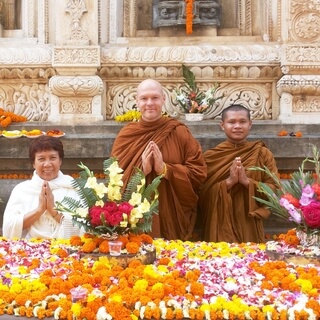
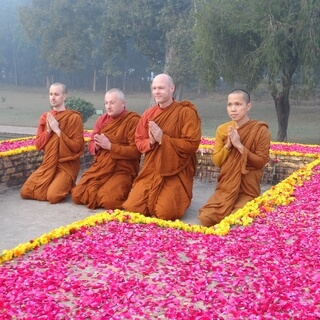
After your tea you have one more session of walking meditation and after your tea there's going to be a slideshow of pilgrimage in India.
They're about half way through your intensive retreat now and this is one of your rewards for having been so diligent,
A little bit of wholesome entertainment and after we do that we can do our puja.
And if there's still time we'll have our final seat.