In the name of the Lord,
The Most Gracious,
The Most Merciful.
Today in the Bodhi tree I noticed that we had a free schedule so it was people could practice as they chose and I noticed that many people sat for several hours in one place and I was just going to ask how many people felt quite peaceful at least in moments during those couple of hours.
It's very interesting isn't it because if you pay attention to the noise you can't,
You couldn't say that that was not a noisy place.
It's definitely a noisy place and I find myself sometimes at the Bodhi tree that it's possible to find a peaceful quality of awareness where although there's all those noises it's not sticking.
It just doesn't stick.
It's very interesting and because there's so much noise,
Close noise,
Intermediate noise,
Far noise and so many different noises,
When none of those are sticking,
When there's not that solid sense of a self listening and liking and not liking what it's like when there's a vast and broad sense of awareness that just is aware of sounds,
It's very very peaceful and so I don't think there's many places in the world where we could sit for a few hours with all of that noise and actually not get grumpy.
So there's something quite special.
I think we'd all agree that there's something quite special in there,
Isn't there?
So we're going to talk about what occurred the Enlightenment.
Last night we talked about the renunciation,
Talked a little bit about the birth of the Bodhisattva and about the renunciation.
Now we're going to talk about the process of enlightenment.
So if you recall,
Very interesting,
The Bodhisattva just had the intuition that the austerity wasn't working and that he needed to partake of some nourishment and allow his mind to enter into the first jhana,
Which he described as being a pleasure that was not unwholesome,
A wholesome type of pleasure that would be useful for his contemplations.
And then what happened was the five people who were practicing with him rejected him,
Thought that he'd reverted the luxury and that he'd lost the plot and that.
.
.
I just find this an interesting point.
I said it last night and I'll say it again.
It's interesting to notice that when even if you have a correct intuition and you're doing something with integrity based on sound understanding,
That you can't expect those around you to support you,
Necessarily.
So I just say that to everyone as Dharma practitioners that we don't do things because those around us agree that that's the right thing to do necessarily.
We follow our own deep intuitive understanding and a discriminative awareness because the path of wisdom and the path that leads to crossing over samsara is counter-intuitive.
It goes against what people in the world want and that's actually.
.
.
The Buddha says many phrases about that after his enlightenment.
He even thought about not trying to teach because he thought it would be too difficult.
People are so committed to the self-view and so committed to getting ahead within samsara or trying to get ahead within samsara.
Very few people are thinking in terms of going beyond samsara.
So anyway,
He had his correct intuition and he had some dreams that night as well.
So I'm going to talk about the Bodhisattva's dreams.
This is when he's given up the austerities and he's decided that he's going to practice the middle way.
Five dreams now appeared to the Bodhisatta.
It was the night before his attainment of enlightenment and the dreams were a premonition that he was about to attain his goal.
Just before the perfect one accomplished and fully enlightened,
Attained enlightenment,
Five momentous dreams appeared to him.
What five?
While he was still only an unenlightened Bodhisatta,
The great earth was his couch.
Himalaya,
King of the mountains,
Was his pillow.
His left hand lay in the eastern ocean,
His right hand lay in the western ocean,
His feet lay in the southern ocean.
This was the first dream that appeared to him.
So you imagine India in those days was many,
Many kingdoms.
The Kosaline kingdom was great and the Magadha kingdom was great.
And so to have this body stretching the entire subcontinent with the Himalaya as the pillow is very profound.
While he was still only an unenlightened Bodhisatta,
I find this phrase challenging myself,
Only an unenlightened Bodhisatta.
Remember we were reading last night when he was talking to Mara about all of Mara's squadrons and how he knew them perfectly and he was talking about all of the faults of a spiritual practitioner,
All of the defects of which he had none.
So keeping in mind that the only an unenlightened Bodhisatta was a pretty amazing being.
The second dream,
A creeper grew up out of his navel and stood touching the clouds.
This was the second dream that appeared to him and it foretold his discovery of the noble eightfold path.
While he was still only an unenlightened Bodhisatta,
White grubs with black heads crawled from his feet to his knees and covered them.
This was the third dream that appeared to him and it foretold that many white cloth laymen would go for a refuge to the perfect one during his life.
While he was only an unenlightened Bodhisatta,
Four birds of different colors came from the four quarters and they alighted at his feet.
They all became white.
This was the fourth dream that appeared to him and it foretold that the four castes,
The warrior nobles,
The Brahman priests,
The Burgesses and the plebeians would realize the supreme deliverance when the Dharma and the discipline had been proclaimed by the perfect one.
Given the context of ancient India with the caste system,
That's amazing.
Amazing that even to think that people of the lower caste could go beyond their caste and become enlightened.
That's revolutionary.
While he was still only an unenlightened Bodhisatta,
He walked upon a huge mountain of dirt without being fouled by the dirt.
This was the fifth dream that appeared to him and it foretold that although the perfect one would obtain the requisites of robes,
Alms,
Food,
Abode and medicine,
Yet he would use them without greed or delusion or clinging,
Perceiving their dangers and understanding their purpose.
So we do see in the modern world that gain,
Fame,
Honor and renown can do terrible things to monks.
In Thailand we have an income,
A lot of devotion and a lot of money and a lot of fame,
Too many cars.
If one is prone to becoming deluded,
Can become very deluded.
So that last dream,
The Buddha was not going to be affected by these things.
The enlightenment itself is described in a number of discourses and from several different angles,
As though one were to describe a tree from above,
From below or from various sides.
There is the description as the attainment of the three true knowledges told as following upon the development of meditation.
Then there is the description of it in terms of the discovery of the structure of conditionality,
That's paticca samuppada,
In the impermanent process of being and in terms of the search for the undeceiving interpretation,
The true scale of value in the problematic world of ideas.
Here is the description in terms of meditation leading up to the discovery of the four noble truths.
Now when I had eaten solid food and had regained strength,
Then quite secluded from sensual desires,
Secluded from unwholesome states,
I entered upon and abode in the first meditation,
Which is accompanied by thinking and exploring,
With happiness and pleasure born of seclusion.
But I allowed no such pleasant feeling as arose in me to gain power over my mind.
With the stilling of thinking and exploring,
I entered upon and abode in the second meditation,
The second jhana,
Which has internal confidence and singleness of mind without thinking and exploring,
With happiness and pleasure born of concentration.
But I allowed no such pleasant feeling as arose in me to gain power over my mind.
We'll keep coming back.
The Buddha is going to mention,
He actually mentioned in the list last night about the fact that he had the five spiritual powers when he was training under his teachers.
And later he mentions that the five spiritual powers lead to the deathless after his enlightenment.
I just want to comment here,
The Buddha is attaining these states of samadhi,
Which can delude beings as well.
But we can see here that his mindfulness,
Sata,
Virya,
Sati,
Samadhi and panya,
That his mindfulness,
This clarity that sees things without delusion,
Is in his mind established so that he's attaining these jhanas.
But no such pleasant feeling gained power over the mind.
With the fading as well of happiness,
I abode in onlooking equanimity,
Mindfully and fully aware,
Still feeling pleasure with the body.
I entered upon an abode in the third meditation,
Referring to which the Noble Ones announce he has a pleasant abiding who looks on with equanimity and his mindful.
But I allowed no such pleasant feeling as arose in me to gain power over my mind.
With the abandoning of bodily pleasure and pain and with the previous disappearance of mental joy and grief,
I entered upon and abode in the fourth meditation,
Which has neither pain,
Nor pleasure and the purity of whose mindfulness is due to onlooking equanimity.
But I allowed no such pleasure as arose in me to gain power over my mind.
When my concentrated mind was thus purified,
Bright,
Unblemished and rid of imperfection,
When it had become malleable,
Wieldy,
Steady and attained to imperturbability,
I directed,
I inclined my mind to the knowledge of recollection of past lives.
I recollected my manifold past lives,
That is to say one birth,
Two,
Three,
Four,
Five births,
Ten,
Twenty,
Thirty,
Forty,
Fifty,
A hundred births,
A thousand births,
A hundred thousand births.
Many ages of world contraction,
Many ages of world expansion,
Many ages of world contraction and expansion.
I was there so named of such a race with such an appearance,
Such food,
Such experience of pleasure and pain,
Such a life term and passing away thence I reappeared elsewhere and there too I was so named of such a race with such an appearance,
Such experience of pleasure and pain,
Such a life term,
Passing away thence I reappeared here.
Thus with details and particulars I recollected my manifold past life.
This was the first true knowledge attained to me in the first watch of the night.
Ignorance was banished and true knowledge arose.
Darkness was banished and light arose,
As happened in one who is diligent,
Ardent and self-controlled.
But I allowed no such pleasant feeling as arose in me to gain power over my mind.
When my concentrated mind was purified I directed,
I inclined my mind to the knowledge of the passing away and reappearance of beings.
With a divine eye which is purified and surpasses the human I saw beings passing away and reappearing,
Inferior and superior,
Fair and ugly,
Happy and unhappy in their destinations.
I understood how beings pass on according to their actions.
These worthy beings who were ill-conducted in body,
Speech and mind,
Revilers of noble ones,
Wrong in their views,
Giving effect to wrong view in their actions,
On the dissolution of the body after death,
Have reappeared in states of privation,
In an unhappy destination,
In perdition,
Even in hell.
But those worthy beings who were well-conducted in body,
Speech and mind,
Not revilers of noble ones,
Right in their views,
Giving effect to right view in their actions,
On the dissolution of the body after death,
Have reappeared in a happy destination,
Even in a heavenly world.
Thus with the divine eye which is purified and surpasses the human I saw beings passing away and reappearing,
Inferior and superior,
Fair and ugly,
Happy and unhappy in their destinations.
I understood how beings pass on according to their actions.
This was the second true knowledge attained by me in the second watch of the night.
Ignorance was vanished and true knowledge arose.
Darkness was vanished and light arose as happens in one who is diligent,
Ardent and self-controlled.
But I allowed no such pleasant feeling as arose in me to gain power over my mind.
So just trying to imagine what the experience of that Bodhisattva meditating would be like.
Recollecting a hundred of your past lives.
He said later ten thousand,
A hundred thousand.
But just imagine if you could recollect a hundred of your past lives.
And this habit that we have of grasping at this life as being me,
Mine,
Myself and permanent.
And then if you could see one life it was like this,
One life it was like that,
Another life it was like this,
Completely different.
And then you see,
Certainly you see it's not permanent.
Birth,
Death,
Birth,
Death,
Birth,
Death,
Birth,
Death.
And it's always changing,
Not a single life similar to the last.
And so ignorance disappeared.
Ignorance has to the true nature and true knowledge arose.
Knowledge into impermanence and I would assume knowledge into not self.
When my concentrated mind was thus purified I directed,
I inclined my mind to the knowledge of exhaustion of taints.
I had direct knowledge as it actually is.
This is suffering,
This is the origin of suffering,
This is a cessation of suffering and this is the way leading to the cessation of suffering.
I had direct knowledge as it actually is.
These are the taints that this is the origin of the taints and this is the cessation of the taints.
This is the way leading to the cessation of taints.
Knowing thus and seeing thus my heart was liberated from the taint of sensual desire,
From the taint of being,
From the taint of ignorance.
When liberated there came the knowledge it is liberated.
I had direct knowledge,
Birth is exhausted,
The holy life has been lived out.
What was to be done is done.
There is no more of this to come.
This was the third true knowledge attained to me in the third watch of the night.
Ignorance was banished and true knowledge arose.
Darkness was banished and light arose as happens in one who is diligent,
Ardent and self-controlled.
But I allowed no such pleasant feeling as arose in me to gain power over my mind.
Now here is the description in terms of the structure of conditionality,
In other words dependent arising.
Before my enlightenment while I was still only an unenlightened bodhisatta I thought this world has fallen into a slough for it is born ages and dies it passes away and reappears and yet it knows no escape from this suffering.
When will an escape from this suffering be described?
I thought what is there when aging and death come to be?
What is the necessary condition?
Then with ordered attention I came to understand birth is there when aging and death come to be.
Birth is the necessary condition.
I thought what is there when birth comes to be?
What is the necessary condition?
Then with ordered attention I came to understand being is there.
The Pali is bhava,
Becoming might be a better translation of that word.
Becoming is there when birth comes to be.
Becoming is a necessary condition for that.
I thought what is there when becoming comes to be?
What is its necessary condition?
Then with ordered attention I came to understand clinging is there.
When becoming comes to be clinging is a necessary condition.
What's the condition for clinging to arise?
Craving.
The condition for craving to arise is a feeling of pleasure,
Pain or neutral.
Contact is there when feelings come to be.
Sense contact.
The sixfold sense base is there for there to be feelings.
Sense contact.
What is there for the sixfold sense base to come into being?
What's the necessary condition?
And with ordered attention I came to understand name and form na'ma rupa maybe,
Mind and form.
Is there when the sixfold base comes to be?
Mind and form is necessary condition for that.
I thought what is there when mind and form comes to be?
What's the necessary condition?
And with ordered attention I came to understand consciousness is there.
When mind and form come to be,
Consciousness is a necessary condition for that.
I thought what is there when consciousness comes to be what's the necessary condition.
Then with order of attention I came to understand name and form is there when consciousness comes to be.
Name and form is a necessary condition for that.
I thought this consciousness turns back upon itself.
It does not extend beyond name and form.
And this is how it happens whether one is being born,
Aging or dying,
Passing away or reappearing.
That is to say it is with name and form as a condition that consciousness comes to be with consciousness as condition name and form with name and form as condition at the sixfold base of contact with a sixfold base as condition contact with contact as condition feeling with a feeling as condition craving with craving as condition clingin with clinging as condition being or becoming with becoming as condition birth with birth as condition aging and death come to be.
Thr borrowing station pain grief and pain,
Grief and despair.
That is how there is an origin to this whole aggregate mass of suffering.
Such was the insight,
The knowledge,
The understanding,
The vision,
The light that arose in me about things not heard before.
" So keeping in mind that Buddha was looking for a deathless,
He was searching for the deathless,
And he's using his order of detention which is stabilized by concentration.
What's the cause of death?
Birth.
So then he was investigating what's the cause of birth?
And Paticca Samuppada is probably the most complicated subject to understand,
But we can understand it in brief and we can understand the general principles.
So the first link as it's often taught is ignorance.
And because of ignorance,
Delusion.
So ignorance is not knowing.
Because we don't know we're deluded,
That means perceiving things incorrectly.
When we perceive things incorrectly,
That means thinking that the body and the mind is a self.
Then there's craving.
Craving for and craving not for.
I don't want this.
I don't want this pain.
I want that happiness.
You can see the delusions there.
There's actually no self.
There's no I.
When mindfulness and wisdom is really clear and really powerful,
When the five spiritual powers are functioning very powerfully,
They just see body as body,
Feelings as feeling,
And consciousness as the sense basis,
And it's not a self.
The self is a delusion.
So Lord Buddha was able to trace it back in seeing the true nature with his very very powerful mindfulness,
And especially with that insight into the impermanence,
Birth and death,
Birth and death,
Birth and death,
Able to trace it right back to previous verses that true knowledge arose as to the passing away of all those past lives,
And the ignorance fell away.
So you can see that.
So it's like taking a magnifying glass to it and investigating it and seeing all of what they call the dependent co-arising factors.
So we don't need to understand it actually.
What we need to do is cultivate the mindfulness that will see it.
So you start with ordinary mindfulness and then you have to be more and more determined,
And what happens is your mindfulness gets clearer and clearer,
And you just need to understand this is like a road map,
But you don't need to know what everything looks like.
You just need to go on the road,
And as you get to the next turn and you get to the next stop,
You'll know what it looks like when you get there.
But basically you need the quality of mindfulness that's going to see these conditions,
And it will.
You just keep practicing because mindfulness and wisdom is uprooting ignorance.
Mindfulness and wisdom knows things as they are,
And when the mind clearly sees things as they are,
Ignorance has to fall away.
Ignorance is not knowing.
So we apply the knowing,
Truth discerning awareness.
You just keep bringing this mindfulness to look at the experience of the body,
Bringing this mindfulness to look at the experience of the mind,
And the more you do that you'll see impermanence,
Impermanence,
Impermanence,
And the more you see that,
The sense of a self.
There'll be periods,
Tathachananda talks about temporary liberation,
Tatanga-vimuti.
Arjun Sumedho talks about glimpsing the deathless,
The unconditioned.
So you just do your practice diligently and you'll get glimpses of the deathless,
You'll get glimpses of the ultimate truth,
You'll get experiences of liberation,
And as you have those experiences your mindfulness will get clearer and clearer,
And all you need to know is this is what you will see as you're becoming enlightened,
But you don't need to understand it perfectly as a concept.
You just need to be aware of the feeling as a feeling,
Thoughts as thoughts,
Sights as sights,
Sounds as sounds.
So keep bringing the mindfulness to bear on the present moment experience and training the mindfulness,
And we just understand that this is where it's going,
That you'll be liberated through training your mindfulness and wisdom and concentration,
And this is what you'll see,
And then true knowledge will arise,
Darkness will disappear.
There's a third description of the enlightenment.
This description is in terms of the right judgment of the world of conditioned acts and ideas classified in its discourse into five aggregates within which all conditioned experience when analyzed can be classified.
Before my enlightenment while I was still only in unenlightened bodhisattva I thought in the case of material form of feeling,
Of pleasure painful or neutral,
Of perception,
Of formations,
Of consciousness,
What is the gratification,
What the danger,
And what the escape.
Then I thought in the case of each of the bodily pleasure and mental joy that arise in dependence on these things,
The five aggregates are the gratification,
The pleasure and mental joy is the gratification.
The fact that these things are all impermanent,
Painful,
And subject to change,
This is the danger.
The disciplining and abandoning of desire and lust for them is the escape.
As long as I did not know by direct knowledge as it actually is that such was the gratification,
Such the danger,
And such the escape in the case of the five aggregates affected by clinging,
So long did I make no claim to have discovered the enlightenment that is supreme in the world with its deities,
Its Maharas,
Its brahma divinities,
In this generation with its monks and brahmans,
With its princes and men.
But as soon as I knew by direct knowledge as it actually is that such is the gratification,
Such the danger,
And such the escape in the case of these five aggregates affected by clinging,
Then I claimed to have discovered the enlightenment that is supreme in the world with its deities,
Its Maharas,
Its brahma divinities,
In this generation with its monks and brahmans,
Its princes and men.
So this is basically there's one paragraph here which is incredibly pithy and important but also not that difficult to understand.
What is the gratification?
What is the danger?
What is the escape?
The gratification is the attachment to the pleasure,
Mental and physical.
What is the danger?
These things are impermanent.
What is the danger?
These things are impermanent.
So association with the disliked is suffering,
Separation from the liked is suffering,
That's the danger.
You don't just get the pleasant,
Do you?
And even when you get it,
It ceases and then you have the suffering of wanting it again.
What's the escape?
This is something very important to consider.
The disciplining and abandoning of desire.
So this is important to understand because this is the five precepts,
Isn't it?
It's putting your desire within a container.
The Buddha is only letting you do so many things and for very good reason.
Your desire has to be within a container because if it isn't within a container,
He talks about the wet log that can't catch a light.
You can't develop mindfulness and insight if the mind is too sensual.
But when it's taken out of the river and put on the bank and it begins to dry out,
It can develop insight.
So the disciplining and abandoning of desire,
This is the escape.
So the Buddha is enlightened.
Enlightenment has now been gained.
Being myself subject to birth,
Aging,
Ailment,
Death,
Sorrow and defilement,
Seeing danger in what is subject to those things and seeking the unborn,
Unaging,
Unailing,
Deathless,
Sorrowless,
Undefiled,
Supreme ceaseless bondage,
Nibbana,
I attained it.
The knowledge and vision arose in me.
My deliverance is unassailable.
This is my last birth.
There is no renewal of being.
And then there's a verse that the Buddha uttered,
Seeking but not finding the house builder,
I traveled through the round of countless births.
Oh,
Painful is birth ever and ever again.
House builder,
You have now been seen.
You shall not build the house again.
Your rafters have been broken down and your ridge pole is demolished too.
My mind has now attained the unformed Nibbana and reached the end of every kind of craving.
And reached the end of every kind of craving.
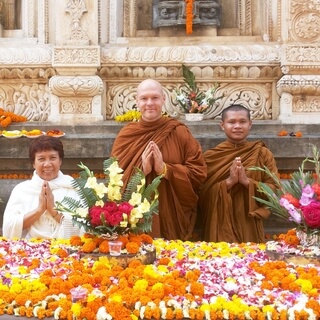
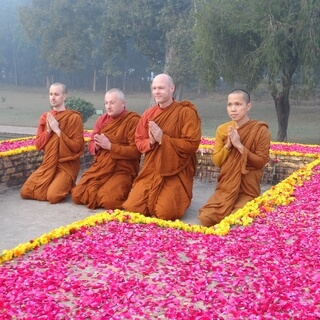
Since we're here in Bodh Gaya and since we're meditating at the Bodhi tree today,
And hopefully we'll be going there again tomorrow,
I'd like to encourage people now in the area of aspiration.
I think it's often the case that our aspiration is somewhat fuzzy.
That we call ourselves Buddhists,
We have faith in the Buddha.
But in terms of setting our minds clear what it is that we actually aspire to,
It's pretty fuzzy in many people.
And so one of the important,
Useful,
Helpful,
Wonderful things about coming on pilgrimage is like something about being in the place where this being attained the enlightenment,
That it becomes more real.
It's like we've heard it a thousand times but now it's like okay we get it.
The Buddha had a flesh and blood body.
He was born in Nepal.
He got enlightened in Bodh Gaya,
Here.
And then we actually give some thought,
Well what is enlightenment?
What's enlightenment?
I mean,
Do the chanting,
Iti bi so,
Iti bi so,
Mudang saranam gacchami,
But we can actually forget.
What are we thinking about?
So we're giving it some good thought.
What is enlightenment?
Complete cessation of every kind of suffering coming as a result of abandoning clinging.
Abandoning clinging through clear seeing,
Letting go of the attachment through clear seeing is not a self.
It's suffering.
Let it go.
When mindfulness is strong enough,
Samadhi is strong enough,
Wisdom is strong enough,
The mind lets go of the causes of suffering.
So in terms of aspiration,
One thing that I think is really important first,
Even before you set the aspiration,
Is acknowledging this is your potential.
This is really important because a lot of our practices,
The Buddha is this statue.
That's a nice statue.
This isn't a nice statue.
That's a great amulet.
This isn't a great amulet.
What did he teach?
What didn't he teach?
Philosophical ideas.
And it's like we sometimes brush over some of the most fundamentally important aspect of our practice.
Contemplating the fact of enlightenment.
Enlightenment is possible.
That was the Buddha's discovery.
Because there is a death,
There is a deathless.
Because there's the condition,
There is an unconditioned.
And it's to be realized.
And we ask ourselves,
Where is it realized?
This is an important question to ask.
Where are you going to realize nirvana?
Are you going to realize it in India?
Are you going to realize it in Thailand?
Are you going to realize it in a future life?
You're going to realize it in your mind.
Your mind.
Wherever you are at that time,
The Buddha's liberation occurred in his mind.
That was the potential of his mind that he realized.
And so you understand that occurred here.
That's just a detail in some respects.
An external detail,
The fact of the enlightenment occurred in his mind.
Your enlightenment's going to occur in your mind.
But before you experience that,
One thing that's really important,
The first of the five spiritual powers,
Faith.
Faith in your potential.
Because you're not going to get enlightened unless you really believe you have the power to be.
So you're going to have to be enlightened to have the power to be.
Sathā,
The first of the five spiritual powers,
If you have doubts,
The Buddha was enlightened but I can't do it.
You're not going to have a powerful enough faith to destroy the defilements.
Mara is going to make mincemeat out of you.
If you can be born again and again and again and again.
Oh you need to get a fighting spirit actually.
If you think of the Buddha in that cave,
The Bodhisattva in that cave,
Willing to experience the absolute extreme of pain.
He said no other being had experienced more pain in their striving.
That was the maximum amount of pain possible.
That's how determined he was to realize.
And the confidence that he spoke to Mara with,
I know you and I'm going to defeat you.
Okay you don't have to be a Buddha.
You don't have to fulfill all the Baramis because the Buddhas explain the practices that you need to do.
But you do need to feel confident that you can overcome the power of Kilesa and overcome Mara.
And you do need to feel confident about your potential.
So that's one of the things I want to ask you to meditate upon while we're here in Bodhgaya.
The Buddha overcame the power of greed,
Hatred and delusion.
He overcame endless rebirth,
Endless suffering.
He overcame it in his mind by overcoming ignorance.
And then the mind was liberated.
You have the potential,
The very same potential to liberate your mind and you have to do it yourself.
And you have to have faith in your potential and then you have a lot of determination.
You have to have determination.
Okay this is my ultimate potential but another phrase the Buddha said,
This result is possible by one who practices ardently and diligently.
So it's very clear this is the potential for one who practices ardently and diligently.
So there's no way around that.
We have to get around to actually doing it.
But I think first faith in the Buddha.
It's not the statue,
It's not the scriptures,
It's not the prince.
It's the ultimate nature of mind.
Purified mind.
That's what Buddha is.
Previous Buddhas with different names,
Future Buddhas with different names.
It's not self,
It's not a being.
It's a state of enlightenment.
The Buddha is the one that discovers it in an era where it's disappeared.
He rediscovers,
He talks about an ancient path that becomes covered and he rediscovers that and explains to people how to practice it.
So real Buddhahood is the enlightened mind and the Arahants also experience,
Realize the enlightened mind.
So that's what we have to do.
We have to enlighten the mind.
We have to uproot the darkness and the ignorance.
And as just explaining what the Buddha said,
We have to contain our attachment to pleasure.
We have to keep it within a container,
A safe container where we're actually weakening the power of delusion,
Of the attachment to the pleasure.
But that's the gratification.
The danger is that we get a lot of suffering along with the pleasure as we all know.
And we get rebirth along with our attachment.
So I just wanted to say that first.
The next thing I want to say is that you're in a really good place now to make the aspiration,
Make it really clear.
And I don't want to lead this because I think this is a personal thing.
I just want to say it now and I want you to take some time tomorrow or the next day.
I just wanted us to go in there and meditate a few times and feel the place and really arrive and to listen to the teachings about enlightenment.
But now I'm going to ask you out of metta for yourself and out of compassion for yourself to get really clear about your aspiration and make that aspiration firm and get some real resolve around it.
And so what is it?
Do you want to be enlightened?
I'm asking you now and you ask yourself,
Do you want to be enlightened?
Is there anyone that wants endless suffering?
Okay,
So that's great to know.
Do you believe you have the potential to be enlightened?
Okay,
Good.
So it's very important to be in touch with that.
That's very important.
That's part of the inner refuge,
The refuge of dharma.
The refuge of dharma is the nature of the mind which can be liberated.
Your refuge in dharma is not just the verses we chant.
It's the refuge in truth.
The truth is you have the potential to be enlightened.
Long Paul Liam often says,
And I really love that he says this,
Purity is born from impurity.
That's actually a very affirming statement,
Especially for people who experience a lot of impurity.
That's important to know.
When we're looking at the impurity and it's not hopeless,
It's not helpless,
This impurity has infinite potential.
Impurity can be purified.
That's really interesting.
How?
How do we purify it?
Dhanasila and Bhavana,
What we're doing.
But we get clear about why we're doing it and what we're doing.
And I just think it'd be really powerful and helpful for you if you can all go to the tree at some point.
The very tree at the very side where the Buddha attained his enlightenment,
It's just such a powerful place to set the intention to be enlightened.
So at some point in the next couple of days while we're still here,
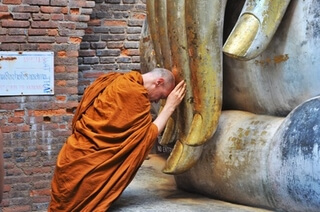
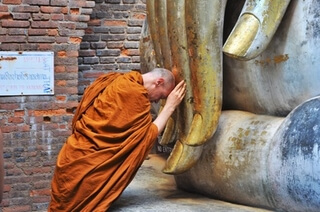
Go and take a slow bow and just affirm,
I really believe Lord Buddha was enlightened here.
I rejoice in that enlightenment and I affirm that I have that same potential and I set the intention I will liberate this mind.
So I offer that pure reflection.
What an amazing mind the Bodhisattva had to be able to recollect 10,
000,
100,
000 past lives.
Can you imagine the incredible.
.
.
It's like this laser like.
.
.
Must have been amazing.
The other thing that's interesting about Bodh Gaya,
Which I'm sure you'll notice,
And I haven't found it in this Sutta-based collection,
But in Thai,
That's probably a commentary on,
But there's the Mara's army coming after the Buddha was enlightened and it said that the Mara's army came in frightening huge numbers.
All of the devas that had just come to rejoice in the Buddha's enlightenment,
Because there was another of these huge flashes of light that filled all of the conditioned universe and all these a lot of devas came to rejoice.
But when Mara's army came and Mara said,
You're not enlightened,
And all of the devas ran away.
And it said that the Buddha called the Earth Goddess and the Earth Goddess had been his mum in a few past lives.
And this actually makes sense to me.
I don't have a problem believing this.
A lot of Westerners might not believe it,
But I don't have a problem believing it.
But I do believe that of course she'd come because she used to be his mum.
And she's proud of him too.
And so he says,
Another thing I love about this,
What they say occurred was the Mara was,
And all of Mara's army was throwing these really scary nasty weapons.
Because of the power of the purified mind and the metta,
The weapons when they hit the aura changed to flowers.
But no weapon could actually touch him.
The mind was purified.
And so the phrase they use in Thai,
Nirjaglok,
It's above the world,
It's transcendent.
So things in the world can't hurt it.
And but even so Mara was causing a lot of problems and all the devas had run away.
So he asked the earth goddess,
You know we have this tradition in Thailand and many Asian countries,
Countries of using water to symbolize merit and dedicating the merit.
So he asked the earth goddess,
Maitorini in Thai,
Please be my witness to all of the merit that I've made in in the past.
And this is interesting too,
The merit that made this enlightenment possible.
So you have the potential to be enlightened,
But you need to purify,
You need to ripen the potential of your mind to be enlightened.
So that's the dana,
Sila,
Bhavana.
You have to be generous.
Merit plays a vitally important function.
Merit plays a function in purifying your mind.
And so we we don't practice generosity to be rich or beautiful,
You practice it to purify your mind.
But there's no way around it.
You have to be generous.
And a lot of some western people don't like the way Asians practice generosity because they think they're doing it out of greed.
But being generous with a little bit of vanity is actually more skillful than being stingy.
Because it does produce merit and being stingy doesn't.
So you make your merit with a little bit of vanity,
But you do have to keep checking that and you do have to purify it and keep reminding yourself,
I make merit because I want to be liberated.
Even if I get born rich and beautiful,
I'm still going to suffer.
Say that to yourself,
Remind yourself.
And if you don't know any rich or beautiful people,
Just ask yourself,
Do they suffer?
I know a few rich and beautiful people who suffer.
It only gets so good.
So setting the aspiration and being determined to lay the causes,
Being generous for the sake of purifying the mind,
Liberating the mind.
So Mehturini,
She wrung out her hair and it's said that this ocean of water that represented the merit that the Bodhisattva had transferred on his path to liberation washed away Mahara's armies.
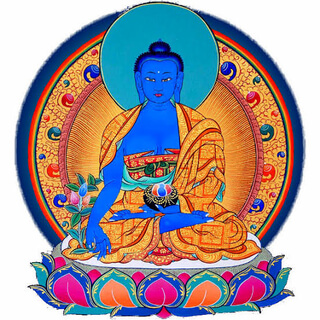
And then he touched the earth,
Which is the mudra of the Buddha statue in the Mahabodhi temple.
Subduing Mahara,
Victory over Mahara is sometimes called.
After the earth goddess came and washed away Mahara's army.
Whether you believe it happened like that or not doesn't matter,
But it has important symbolic meaning.
There is the need to make merit in order to have the power to purify the mind and to be able to push Mahara away or keep him at bay.
Mahara not necessarily as a being,
But there's this other Mahara's they talk about karma Mahara.
So the Mahara of all the bad karmas that we've made,
Well we need to weaken the power of the bad karma by making more and more and more good karma.
So we've all made bad karma,
But when you make good karma,
Help me when you're generous you help people.
And what you'll find is if you're generous when you're in trouble people will help you.
That's the consequence.
So no matter how much bad karma we've made if we make lots and lots of good karma,
When we meet with challenges in a way karma Mahara,
Mahara comes then something else comes to help us through the obstruction to help us to keep practicing.
So accumulating merit consciously and the last thing I'll say about that is what Lord Buddha says the thing that cultivates the most merit is the practice of the four foundations of mindfulness,
Mental cultivation,
Bhavana.
But your mental cultivation goes much easier when you've been generous and when you've been ethical when you've maintained your virtue.
So I was very happy today to see everybody meditating for so long.
I'd said that it was a free time after the period of chanting people could wander around and do what they want what they felt inspired to do and when I turned around and saw that most people were still sitting there sitting I thought very good,
Very good.
And Satu?
Any questions any doubts some of the things we talked about any comments about your experience the places we've been?
I used to be annoyed with all the noise but it came to a point that I was surprised at myself that all the noise didn't bother me at all especially the noise from the birds it was like they're thinking for me.
It was loud.
I remember thinking it was a couple of times I might change posture it's hurting a bit I'm like I just stay and like a half an hour went past and look at my watch oh now I might change another half an hour and it's nice when it's like that isn't it yeah this is one of the reasons I love practicing in Vrgaia.
I find that the challenges are there but the inspiration and the energy to work with them is also there and it becomes interesting and even if you are having a reaction then you can remember well yesterday I didn't and often it's just a matter of just saying a bit longer and you can move through it's very gratifying but it's interesting that after the Buddhist enlightenment Vrgaia seems to be the place where there are two things there's the energy and the blessings of enlightenment and there's Mara's army coming forth forth that's the Vrgaia phenomena so when we leave that temple and you have the beggars around your feet and you have the mask sellers and the CD sellers and the poster sellers and the bead sellers and everybody trying to sell you something and you come out of that lovely spacious experience and then you've got all these friends friend friend friend hello friend remember me so practice of mindfulness knowing Mara and not getting angry not having craving for or not for just mindfully knowing many teachers in Vrgaia and you can learn from them and you can learn from many teachers in Vrgaia