I'm now going to guide us through a couple different postures that you can do to connect in with your pelvic floor and your thoracic diaphragm.
So come along with me.
Find a mat or a comfortable place on the floor to sit.
And it can be really helpful to bring something like a ball or your hands to the area of your pelvic floor just to really feel the area.
It's a very subtle expansion and contraction.
And until you get the nuance of what it feels like,
It might not feel like much is happening.
If I were to do a bicep curl,
For example.
I'm basically just doing something subtle like that.
Not even really perceptible,
That change.
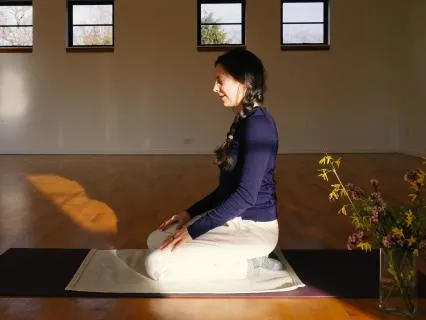
So the first movement is in the posture of the seat.
It's in a child's pose,
A yoga pose,
Where you're sitting on your shins and you can have your knees.
Separate it as wide as you like.
If it's not accessible for you to get your butt onto your heels,
Then you can get some blankets or bolsters to go in between the space.
And then you're just gonna lean forward.
In this case,
I'm going to go all the way down.
And this is where having a ball or a blanket or something is nice to have that tactile experience.
And you can,
If it feels good in your body,
You can surrender your head all the way to the ground or you can just stay up.
And the value of being in this seed pose is that we're trying to breathe wide into our thoracic area.
Feeling the breath in our back body and our side body,
And also down into our pelvic floor.
So inhale here with me.
See if you can feel the response of your pelvic floor relaxing open.
And then as you exhale,
Just letting it curl in a tiny bit and relaxing the thoracic diaphragm.
Relaxing the ribs,
Just letting them soften.
No contracting,
Just feeling them relax naturally.
And then in your own breath cycle,
Doing this five more times.
Inhaling,
Feeling the pelvic floor expand.
Or imagining.
And exhale,
Letting it draw in just a little bit.
And when I say just a little bit,
I mean it.
It's like imagining your pelvic floor is a four-story building.
And if you have the capacity to walk up the first flight,
The second flight,
And the third flight of stairs all the way up to the fourth floor,
We're really only going up a couple steps here.
So we're barely making it up to that first level of contraction.
And just noticing how it feels to have your breath come into your belly and into your side and back body.
Noticing if you can get your breath to come even a little bit more into your mid-back,
Into your upper back.
And taking one more breath here.
And then just taking a few normal breaths,
Coming back up to a comfortable seat.
Noticing.
The next one,
You can either do seated,
Like I am here,
Or you can do it standing,
And it's this rocking motion of the pelvis.
So on the inhale,
You rock the low back and the butt out.
Feeling the belly expand.
The pelvic floor expand out.
And then on the exhale,
You draw the pelvic floor in and the hips back into neutral,
The pelvis into a neutral state.
And you can get at the beginning doing this,
You can really rock.
Really rock to feel it.
Inhale reaching back and exhale drawing up and in And as you begin to relate more and more to this nuance.
Becoming more subtle with your movements.
So taking five breaths here with this rock and seeing how it connects.
Again,
If you're seated,
You might have a ball or a pillow or a blanket underneath you.
And if you're standing,
Just letting yourself drop into the gravity of.
.
.
Your feet.
Inhale.
Rocking the hips back.
Feeling the pelvic floor release,
Open.
And then exhale curling the pelvis into neutral Feeling the spine long and straight and just relaxing the breath out.
Inhale.
Reaching the pelvic floor open.
Feeling the thoracic ribcage expand.
And then exhale,
Curling in.
Spine is long.
Inhale.
Tilting the pelvis,
Opening the pelvic floor.
Bringing in your visualization,
If that's helpful.
And then exhale,
Coming to neutral.
And as you connect more with the nuance of this subtle movement and opening of the pelvic floor,
Just take a note and see if you are.
.
.
Translating that tension anywhere else in the body.
It could be into your shoulders,
Your jaw,
Your tongue,
Your eyes.
Um,
Tension tends to want to move before it fully surrenders.
And those places can typically want to take up and hold that tension.
So as you inhale and let the pelvic floor expand.
Can you also relax your shoulders and your tongue and your jaw and your eyes?
Can you let all this Beautiful musculature and tissues and bone up here also relax.
And then exhale,
Drawing the pelvic floor up and in,
Keeping all of this relaxed.
This balance of Surrender intention.
So important to a healthy singing voice and self-expression.
So that's our breath work for today.
And.
.
.
The best way to bring this into your life is just to do it as you remember it.
So if you're sitting in your car,
If you are laying in bed before you go to sleep or waking up in the morning,
Just integrating it into your daily practices,
Whatever you find yourself doing where you have a bit of free space.
And this is not only helpful for singing,
Like I said,
You will experience benefits throughout your whole body system.
In your life overall.