Hello friends,
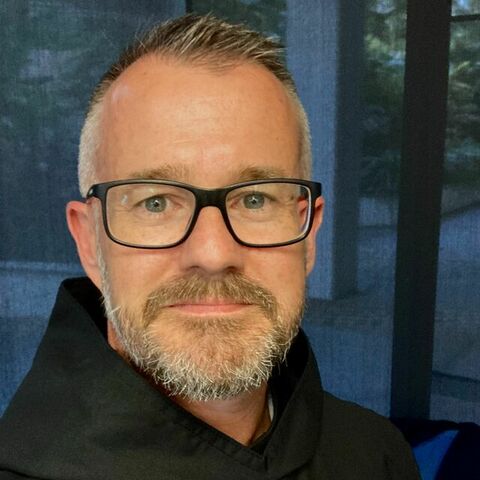
This is Mark Ludman,
Also known as Brother Frederick James,
Your friendly neighbourhood monk in dogs.
Welcome to another session in our series,
Abiding in Colossians,
As we have a look at what abiding looks like through the lens of Paul's letter to the Colossian church.
So over these past days,
We've been learning how to live with increasing awareness.
We began by noticing what's already growing.
We learned to value steadiness over pressure,
To see reality held together from within,
To trust reconciliation,
Even when fragmentation appears.
We recognised that presence isn't distant,
But within.
We learned to trust slow growth.
And yesterday,
We spoke about freedom from false urgency,
About learning to recognise noise and returning to what is essential.
And so today,
As we continue in the letter to the Colossians,
We come to a phrase that's often been misunderstood.
It's in this section that Paul writes,
So we'll spend some time contemplating this and we'll read the passage so that we can get the context as well.
But as we get started,
I invite you just to still yourself,
To allow yourself to come fully into this moment.
Breathing deeply in and out.
Allowing all the worries that have been or may be coming just to fall away for a moment.
As we incline our ear to listen to the voice of the Spirit speaking through us in Colossians chapter 3,
Verses 1 to 11.
Paul writes,
Put to death,
Therefore,
Whatever in you is earthly,
Fornication,
Impurity,
Passion,
Evil desire and greed,
Which is idolatry.
On account of these,
The wrath of God is coming on those who are disobedient.
These are the ways you also once followed when you were living that life,
But now you must get rid of all such things.
Anger,
Wrath,
Malice,
Slander and abusive language from your mouth.
Do not lie to one another,
Seeing that you have stripped off the old self with its practices and have clothed yourself with the new self,
Which is being renewed in knowledge according to the image of its creator.
In that renewal,
There is no longer Greek and Jew,
Circumcised and uncircumcised,
Barbarian,
Scythian,
Slave and free,
But Christ is all and in all.
Now,
For many people,
Let's be honest,
This language has sounded like an invitation to escape the world.
To withdraw from the earth,
To ignore daily life,
To focus only on what's spiritual while neglecting the physical body.
But when read carefully,
This passage isn't about leaving the world behind.
It's about choosing where attention should go.
So not escaping earth,
But actually seeing more deeply within it.
Because while it's easy to think that Paul here is describing physicality and therefore geography,
Rather see that Paul is describing consciousness.
This isn't about movement from one place to another.
It's about movement of our attention.
Where attention rests shapes our perception.
And that shapes our response.
And over time,
That shapes identity itself.
And this is why the phrase set your minds matters so much.
Because it suggests intention,
Orientation,
Choosing where awareness returns again and again.
And perhaps we recognize how powerful this is in daily life.
Because what we attend to consistently becomes what we notice most easily.
If we attend to our worry,
Our worry expands.
Same with fear.
If we attend to our fear,
Our fears often deepen.
When we attend to comparison,
Comparison multiplies.
But if we attend to what is stable,
What's true,
What's life-giving,
What's beautiful and good,
Something different begins to form.
Peace becomes more familiar and patience seems to be a bit more natural.
And having clarity when we see things becomes way more accessible.
It doesn't happen overnight.
But gradually it moves that way because identity follows attention.
And this is why the passage feels less like moral instruction and more like an invitation into awareness.
I mean,
Paul does speak about letting go of certain patterns.
Malice,
Anger,
Deceit.
Ways of living that break relationships and fragment our own identities.
But notice how he frames the change.
He talks about the change as transformation,
As movement from an old pattern into a new pattern.
An old awareness into a new awareness.
Because what we repeatedly attend to shapes who we become.
Awareness forms character.
And this doesn't happen just through decisions.
But it happens through our attention.
That repeated act of returning to what matters time and time again.
Maybe this is one of the most practical insights of the contemplative life.
That the small repeated act of returning actually creates a large difference.
When we return our attention,
When it drifts.
When we return our awareness,
When we're distracted.
When we return our focus,
When the urgent begins to dominate.
If we do this again and again,
Patiently,
We basically train our attention.
And it doesn't have to be harsh.
It's a gentle returning.
Think like the compass needle.
It doesn't remain perfectly still.
If you move the compass or it shifts,
It moves.
But after a moment,
It returns to its true direction.
And that returning is what shapes orientation.
And orientation over time shapes identity.
So when Paul invites us to set our minds on things above,
He's not asking us to reject earthly life.
He's asking us to live from a deeper awareness of it.
To let our attention rest on what's enduring and true and present.
And this is a shift that doesn't require us to withdraw from daily life.
It happens right there in the midst of it.
In the middle of conversations and decisions and moments of stress and uncertainty.
Every moment becomes an opportunity to return.
Gently and patiently again and again.
Just like that compass needle coming back to true north.
So today is a very simple invitation to attention.
As you move through the day,
Notice where your attention rests.
Notice when it drifts towards worry or frustration or impatience or distraction.
Just notice.
And when you do notice,
Just gently return.
Bring your awareness back to what's true and grounded.
To presence itself that's available right beneath the surface of activity.
And we do this time and time again.
Just like every little movement makes that needle point in a different direction.
But time and time again,
It gently comes back around to the orientation of true north.
So today you might ask yourself the question,
What am I becoming through what I constantly attend to?
Because our identity isn't formed just in isolated moments.
It's formed through attention.
The repeated act of noticing where our awareness rests.
And as awareness returns again and again to what's deeper and life-giving and beautiful and true.
Something begins to change.
Our character deepens.
Our perception clarifies and our identity stabilizes.
Simply through attention.
So set your mind,
My friend,
But not by escaping,
But by seeing more deeply within.
Again and again returning to presence until presence becomes the place from where you live.
And may grace,
Peace and love be with you as you come into that place of presence today and every time.
Amen.
Until tomorrow,
Peace be with you.