Hello friends.
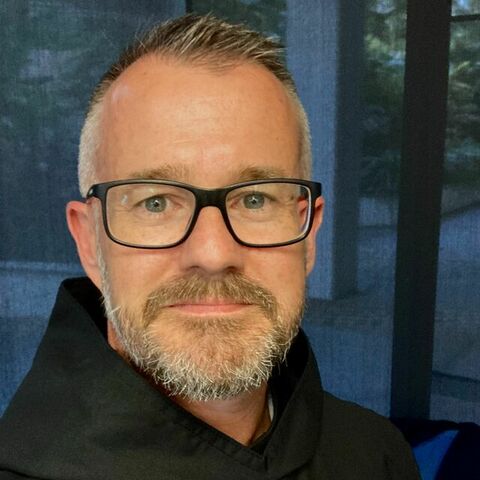
This is Mark Gladman,
Also known as Brother Frederick James,
Your friendly neighborhood monk in docs.
Welcome to another session in our series,
Abiding in Colossians,
Where we are considering what it means to abide through the lens of Paul's letter to the Colossian Church.
So over the past couple of days,
We've been moving slowly into a deeper awareness.
We began by noticing what's already growing,
Learning to recognize grace already at work beneath the surface of our lives.
And then we turn towards stability,
Towards endurance and patience as forms of strength,
Not force and pushing.
Today we continue to widen our view because until now we've been paying attention mostly to what's happening within us,
Our growth,
Our steadiness and our endurance.
But today as we continue in the Colossian letter by Paul,
This is going to extend.
We're going to be invited to look outward,
To look deeper and to see reality itself differently.
So as we prepare to begin,
I invite you to still yourself,
To take a deep breath in and out.
Once again,
In and out,
Allowing your body to come to rest,
Your mind to be still,
Your heart to soften.
As we open our ears to the voice of the Spirit,
As we read from Colossians chapter 1,
Verses 15 to 17.
Still speaking of Christ,
Paul writes,
He is the image of the invisible God,
The firstborn of all creation,
For in him all things in heaven and on earth were created,
Things visible and invisible,
Whether thrones or dominions or rulers or powers,
All things have been created through him and for him.
And he himself is before all things,
And in him all things hold together.
Now this passage is considered one of the great hymns of the Christian scriptures.
It's got beautiful devotional language,
But it's not instructional and it's not moral guidance.
This is a vision,
A cosmic vision,
Speaking of Christ as the image of the invisible God,
The one through whom all things were created and the one in whom all things hold together.
And what's most interesting about this language is how expansive it is.
It doesn't confine Christ to one moment in history,
And it doesn't limit Christ to a single location,
And it doesn't even speak of Christ as distant or removed.
Instead,
It speaks of Christ as foundational,
At the heart of reality itself.
This is not Christ being an addition to life,
Something we discover that we add,
But as the very depth of life itself,
As Paul Tillich once called it,
The ground of all being.
And that should change the way we approach faith.
Often we imagine that spiritual awareness requires us to look around elsewhere,
Somewhere else,
Somewhere beyond this world,
Outside the ordinary surroundings of everyday life,
Somewhere removed from what we go through day by day.
We somehow imagine presence as something distant,
Waiting for us to reach it.
But this hymn,
This hymn changes the perspective and invites us into a very different way of seeing.
Because we could try and believe harder,
But that's not what this hymn is asking us to do.
This is asking us to see more deeply,
To not try and search out there for something,
But to recognize what's already present with and within us.
And this is the sort of language that echoes one of the oldest insights of Christian theology,
The idea of Christ as Logos.
So this changes things because when we understand Christ as Logos,
Christ is no longer just a figure to whom we give our devotion,
But rather Christ as Logos is the living expression of divine presence that's woven into the very fabric of existence itself.
Now the word Logos,
Which literally is translated as the word,
Is the Logos that's talked about in the first verse of the Gospel of John.
In the beginning was the word,
In the Greek that is Logos,
In the beginning was the Logos.
And so we understand from John's Gospel that John sees this Logos as the one through whom all things came into being,
Which means that creation itself isn't separate from presence.
It's not empty or disconnected.
It's actually held,
And held,
Interestingly,
From within.
And the text we read today says,
In him,
The Christ,
All things hold together,
Continually held together,
Which suggests that the unity we experience in life,
The coherence of the world,
The patterns of nature,
The rhythms of growth and decay,
They're not accidental,
But they're a part of this sustaining heldness of all things,
Supported.
And maybe this is where contemplation begins to shift from being inward to being outward.
So it's not about abandoning any awareness that we have within ourselves,
But allowing that awareness to extend into the world around us.
Because if reality itself is held together from within,
Then nothing we encounter is ordinary.
Nothing.
Not the soil,
Or the sky,
Or the breath that we draw,
Or the people that we meet.
Everything becomes,
In some way,
A place to encounter the presence of the Christ,
The Logos.
And it's there because all these things,
All of it,
Is held.
And this is the sort of intersection of theology with contemplation.
Because it's a new way of seeing,
A way of perceiving the depth of what already exists.
And when we begin to see this way,
The world itself becomes way less fragmented,
And random,
And chaotic.
Difficulties are still there,
But meaning gets deeper.
We begin to trust that beneath the surface of what we see,
There has to be some sort of coherence.
That beneath the shifting conditions of life,
There is continuity.
That within our uncertainties,
There's presence holding things together,
Even when we don't fully understand how.
And maybe this is one of the most transformative shifts we can make.
Not trying to learn more information,
But seeing differently.
Moving from distraction to attention.
From surface-level noticing to deep perception.
Because at its heart,
Contemplation is about a deeper engagement with the world.
I know that people look at monastics like Benedictine monks and think what we're trying to do is to hive ourselves off from the rest of the world somehow.
But really,
Contemplative life is about noticing.
Noticing texture,
And form,
And life,
And then engaging with those things.
We recognize that what we see is never merely surface.
That there's always,
Always going to be depth beneath it.
Because everything,
All things are held together in Christ.
So today,
I invite you into a moment of attention.
As you move through the day today,
Take some time to observe what's around you.
And do it slowly.
Look at something ordinary,
Like a tree,
Or a stone,
Or a cup,
Or a doorway.
Or even watch light as it hits the wall.
And look at it as something that exists.
I know that sounds a bit weird.
But look at it as something that exists,
And is held,
And is sustained.
And allow yourself,
As you sit with that,
To ponder this question.
What changes when I begin to see the world as held together from within?
And know that today's invitation isn't to try and believe harder.
But to see more deeply.
To recognize that presence isn't somewhere else waiting to be discovered.
But that presence is actually foundational.
And as a result,
Is already here,
Already holding,
And already sustaining.
And as we learn to see this way,
What I hope you'll notice is something shifting a little within you.
That maybe you'll see the world as a little less fragmented,
And empty,
And disconnected.
And recognize even more fully,
A beautiful awareness that life itself,
At every level,
Is held together from within.
And may grace,
Peace,
And love go with you,
Friend,
Today,
And every day.
Until tomorrow,
May peace be with you.