So welcome to this restorative yoga class.
This class is for rest,
Recovery and recharge.
Restorative yoga is known to be an antidote against stress.
We are activating our parasympathetic nervous system and our body's natural healing system.
We will move from the doing mode to the being mode.
And what you need for this yoga class is a yoga mat or a regular mat to stay on,
A bolster,
A big yoga pillow or some other pillows like pillows from the sofa or from the bed,
One or two blankets,
Two yoga blocks or if you don't have yoga blocks you can also use two thick books.
And also if you want to you can have an eye bag or a shawl to have over your eyes when we are resting.
So now you can come to whichever position you that you prefer to start in for a short introduction.
You can lay down on your mat or just stay seated.
In restorative yoga we are moving into this floating state,
The state between awake and asleep.
And that is called the hypnagogic state.
This is where we are activating our calming nervous system and our body gets a neutering rest.
We know that our organs in our bodies are recovering here.
The blood pressure can sink,
The blood sugars stabilize and we also affect the digestion and improve sleep quality.
So sometimes in restorative yoga you can feel that you are in your own little bubble in this state.
You will still hear my voice and the sounds around you but they might feel very distant and sometimes they might feel very close.
And that is also totally okay to let go of yourself and drift back and forth and maybe even drift into sleep.
Totally okay.
When we are changing and moving into the position we are pretending that we are hens that are incubating eggs.
We want to find our perfect spot for our eggs and that will be our yoga mat.
And then we want it to be absolutely perfect for the eggs and us so we are really really comfortable.
So that is why we use all the bolsters,
Blankets,
Pillows to arrange the position so it's not only okay or nice.
So it's really really comfortable so we can stay there for a long long time.
So the first position we will move into is child's pose or Balasana.
We'll do a supported Balasana.
So please put your bolster or your big pillows in the middle of the mat,
Along the mat and sit in the middle facing the front.
Sit on your knees and let your toes meet behind you and broaden your knees a bit.
You can choose to have your knees more separated for a more hip opening pose or knees more together for a milder opening.
And let's let your buttocks be heavy down against the heels.
Extend the spine and the neck slowly and then start to fold forward and let your stomach and chest move down into the bolster or pillow and rest the stomach and chest heavy down and also rest the cheek down against the bolster and find your way into your child pose and take your time here.
There is no hurry.
We will stay in the restorative poses for between 5 and 15 minutes in each position so we really really want to be comfortable and we want to find a place where we can totally let go of everything.
Extend some breath here in child's pose.
Is it possible to be a bit more heavy?
To come into the position and let go even more you can take one deeper breath in through the nose and exhale,
Sigh it out through the mouth and also explore if you are holding anywhere in the body.
Holding anywhere that you can let go.
In restorative yoga we want the whole body to be relaxed even the fingers,
The eyebrows,
The shoulders,
All the body.
Explore now where you have your tongue and if you have your tongue up in the upper palate in the mouth please let it come down.
Let the tongue relax in the mouth and let yourself just be breathed here.
Feel the breath moving in and out here.
Feel the breath moving in and out in your body.
If you want to you can imagine that the air is moving in and out through your shoulder blades or the place between your shoulder blades.
You're breathing in through your shoulder blades and out through your shoulder blade.
And while we are here in child pose I also want you to explore if you have any intention or wish for this yoga class.
Maybe if there is something that you that you are longing for or wishing for with this class and if there is you can repeat it for yourself.
It could be something like I want rest,
I want energy,
I need to stress down,
I'm cared for,
I'm at ease or anything that you wish for right now.
Repeat it for yourself three times and now we will slowly change side of the head.
So slowly let your hands come under your shoulders and slowly lift the upper body and the head.
And pretend that the head is like a heavy raindrop hanging down and just lift up so that you can change the side of the head turning down in the bolster.
So you now put the other cheek down if you had the right cheek down before you put the left and if you have the left you put the right down now.
Just finding back to your child pose be heavy again let your chest and stomach rest and just let yourself again melt down into the pillows into the yoga mat and come back again to focus on the breath.
The deep breath is moving like a wave and let every exhalation help you to let go,
To release and also explore where in the body you can feel the breath the most in this child pose.
Maybe it is close to the shoulder blades,
The back or maybe it is in the stomach,
Maybe into the bolster or is it in the mouth or the nose or maybe it's deeper down,
Deeper down inside the chest,
The belly.
Just explore where you feel the breath the most right now in this child pose and just stay at this place for a while,
Just often,
Just be.
We are letting go of everything else except for this moment,
This right now.
So we will let go of everything that will happen after this class,
Later today or tomorrow or next week or the summer.
We're also letting go of everything that has been,
That has been earlier today,
This morning,
This week,
The last years and we will only try to be right here,
Right now,
Nowhere else and we will notice that the mind will move back and forth finding some moment that has been or that will come and what we do is just to thank ourself that we noticed that our mind is somewhere else and then we gently bring it back,
Bring it back to right now,
Right here,
Our body,
This breath in this child pose.
This is where we are now and in restorative yoga when we are changing the positions,
Moving from pose to pose we do it very,
Very mindfully.
We are moving as if we have a sleeping person next to us that we don't want to wake up.
So the transitions between the poses is also a part of the yoga.
So we want to do it with full awareness and really mindfully.
So we're gonna invite three deep breaths here now in child pose.
Three deep breaths into the nose and out of the mouth.
We will slowly start to move out from this child pose.
So spread your fingers and let your hands come under your shoulders again and slowly get your way back up to all four to tabletop position where you have your hands right under the shoulders and your knees right under the hips.
The bolster and pillows can stay on the mat you just need to come up to tabletop position and when we are on all fours we're gonna start to move slowly into cat and cow.
We want to move the spine a bit after this child pose.
So we're gonna inhale and come to cow pose.
Arch the lower back,
Let the chest and face turn up against the sun and when we exhale we're coming to cat pose.
We're rounding the back like a cat,
Separating the shoulder blades,
Putting the chin in against the chest bone.
Inhaling again back to cow pose,
Arching the back,
Let the sun touch the face and the chest and if we had a tail we are turning the tail up like a happy tail.
Exhaling back to cat pose,
Rounding the back,
Chin against the chest and if we had a tail we are taking the tail in between our legs.
So just move in cat and cow with your own breath a few more times.
Inhaling arching,
Exhaling rounding.
Let your breath lead the pace,
Lead the movement a few more times.
Just notice how it feels to move your spine like this,
Arching and rounding.
And we can start to make the movement smaller and smaller and then just let the cat and cow movement stop.
Finding back to neutral position,
Our tabletop,
Standing on all fours.
From here we will move into our next restorative pose and that will be Viparita Karami or the legs up on the wall.
So we can do this pose with a chair if we want to or we can put the legs up against the wall.
So if you have a chair close by you can put it on the yoga mat,
On the lower part of the yoga mat.
And before we start to enter the pose we will make sure that we have everything that we need close by.
So we want to have the blanket next to us and also a pillow and if we have an eye bag or shawl we put it close to our hands so we can reach them.
And if we choose to do it with a chair we put the chair now on the mat,
On the lower part of the mat.
If we want to do it against the wall we will sit close to the wall and we want our hip to be right against the wall or the chair.
So sit facing the side in front of the chair or the wall and to come into this position we want to swing our legs up against the chair or against the wall.
So you are seated now with the chair next to your hip and then you are swinging up the legs putting them on the chair almost in like 90 degrees so the the knees are facing you and the lower legs can be rested.
And if you are putting the legs up against the wall they are straight up against the wall and make sure that your buttocks is close also to the wall so that you can relax the legs.
And if you want you can have a smaller pillow under your head to fill up the space under your neck.
And also if you want you can have a pillow resting on your eyes or the forehead.
Make sure that the whole body is relaxed and that you can be really really heavy against the floor.
Your back is resting broadening into the floor.
And explore how you want to place your arms and hands.
Maybe you want to face the palms up letting the shoulder blades meet behind you,
Behind your heart.
Or maybe you just want to relax the arms letting them rest in whichever position that feels okay for you.
So when you found your Viparita Karani or legs up against the wall or chair just let yourself soften and be really heavy into the pose.
This pose is very beneficial for stress management.
It's a calming yoga pose.
And the pose also has a waterfall effect on our circulation system.
The position increase the venus return in our body.
And it's perfect to do like after a hard day's work or after a flight or after some hard physical practice to restore the body.
This pose is also activating our parasympathetic nervous system and calms both the body and the mind.
It's also special beneficial if we have edema or lots of water in our bodies.
We will stay a while here in this pose.
So explore now if there is something that you need to change or need to fix in the position.
Nothing should bother you.
Remember we are the hands that are fixing the perfect place to lay on our eggs.
So make sure that your hair is okay.
There is nothing in your clothes that is bothering you.
The blanket is perfectly covering you.
And if you want to the eye bag is on the right position over your forehead or over your eyes.
Nothing shall bother us.
We want to let go totally of the surroundings.
And in this pose we will explore the full yogic breath.
So first I want you to come to your neutral breath lying like this.
Just let the breath move freely.
Move like it wants to flow.
Don't need to change anything,
Do anything.
If you can feel any tensions anywhere in the body just let it go.
Especially investigate your shoulders,
Your neck,
Your jaws and your face.
Maybe you can soften a bit further.
Smooth the forehead,
Soften the eyelids.
If you find somewhere that you can feel any tension at all,
Draw the attention of the breath to this part of the body.
And let your breath help you to just let go and just be.
So now we will introduce the yogic breath or the full breath.
And that breath is starting deep down in the bottom of our stomach.
We can imagine that the breath starts down there.
So when we are filling the breath we are starting to fill first the stomach,
Then the chest,
All the way up to our collarbones.
Then we will be holding the breath for a moment before we exhale from the collarbones,
Chest,
All the way down to the bottom of the stomach again.
Where we're holding the breath out for a moment,
Letting the inhale come again,
Filling the whole stomach,
The whole chest,
All the way to the collarbones.
Holding it again,
Exhaling from the top,
From collarbones,
Chest,
All the way down into the stomach.
So just continue this full yogic breath in your own pace,
Filling both the stomach,
Both the chest with each inhalation and letting it go with each exhalation.
And really let your chest and your belly move with the breath.
So let your belly be almost like a balloon when you're inhaling,
Filling up.
And also the chest is rising with each inhalation.
And then the first chest is sinking down and the belly.
And if you notice that your mind again is somewhere else,
You just gently bring it back.
Bring it back to this breath,
To your full yogic breath.
The breath is like the bridge between our body and mind,
Helping us to let go,
To soften.
And deep breath also give our organs inner massage.
We now give our diaphragm massage,
Our breathing muscle that is located between the belly and the chest.
And when the diaphragm is stimulated like this,
We also stimulate our thoracic duct where the lymphatic system drain also gets stimulated.
So deep breath can increase our lymphatic flow in the body,
Help us to eliminate toxins.
So we're keeping this deep breath a bit longer.
Inhale,
Expanding,
Exhale,
Letting go.
Inhaling new oxygen,
New energy to the body.
Exhale,
Eliminating,
Softening.
Just stay with the breath.
When we are bringing our awareness back to this very moment,
We are using our mindfulness muscle.
We are taking us back again and again to this moment,
To this restorative yoga,
To our body,
To our breath,
To this actual breath that never comes back again.
It is right now.
We will now invite three long three longer,
Deeper breath with a sighing out on the exhalation here in this Viparita Karani,
Or legs against the chair or wall.
So take three deep breath into the nose and sigh it out through the mouth.
We will now slowly start to move our way out from this pose,
From this Viparita Karani.
So start to move your toes,
Move your fingers,
Hands and feet.
Maybe you want to do circles in the ankles.
And slowly,
Gently put your legs down from the chair or from the wall and rest for a while in side rests on your left side.
This pose is called the heart resting position.
So just rest on your left side for a few breaths.
Take a moment here to just feel the effect after this pose,
Coming down again.
Feel the effect in the body after having the legs rise like this for a quite long time.
Maybe you can feel some warm,
Maybe something else.
And from this side rest with the help of your right hand.
Slowly get back to seated.
Push yourself back up to sitting position.
And when you come up to seated,
Let your hands come behind you.
Open the chest a bit,
Leaning backwards and stretch the legs and feet in front of you.
And maybe you want to move the legs a bit up and down.
Just shake it out and then let your feet come down into the floor close to your buttocks.
The knees pointing up against the ceiling.
We will here move into the seated windshield wiper.
So let your knees fall from side to side with your breath.
So inhale,
Let them fall to right.
Exhale,
Let them both fall to left.
The breath is leading this pose.
And just let the knees fall from right to left side in this windshield wiper.
This pose helps to release tensions in the lower back and the hips.
You can,
If you want to,
Have your eyes closed when you do it or have them open.
Whatever you prefer.
You can actually do almost this whole class with the eyes closed if you want to.
Sometimes it's easier just to open them when we are moving between the poses.
But you can almost have them closed during the whole time to keep your focus inward.
So we're going to let the windshield wiper stop.
The movement will stop.
And from here we're going to move into our next restorative pose that will be the mermaid's pose.
So move the chair away from your mat and take a seat on the middle of the mat.
For this position we will use the bolster or the bigger pillows.
And I want to put them alongside the mat.
So they are laying alongside the mat in the middle of the mat.
We also want to make sure that we have the blanket close to us.
And we will now be seated in the middle of the mat like a mermaid with our legs turned.
So turn both your knees to the left and let the left foot rest against the right thigh.
If it feels okay for you sitting like a mermaid fin here.
You can also just let the knees fall down to the left side.
And now make sure that your bolster is touching your left hip.
The bolster or the pillows is touching your left hip.
And you can already here put your blanket over you.
And we will come into this mermaid's pose.
But before we will do that we will extend the spine.
So we'll put the hands on each side of the bolster and extend the whole spine from the sitting bone alongside the spine and to the top of the head,
The crown of our head.
And when we are feeling like we have a long spine we will slowly walk the hands forward.
And we want to let the stomach and chest face down into the bolster.
So we will not be facing the side down.
We want to lay on our stomach and chest.
So facing down.
And if you want to here you can put some more pillows,
Blankets under you if you want to come up higher,
Have more support under you.
So just let your stomach and chest be heavy down against the mat,
Against the bolster.
And you can choose also here to have your nose pointing the same way as the knees for a milder rotation in the back.
Or if you want to face your nose away from the knees for a deeper rotation in the back.
So this is a rotation pose,
Mermaid's pose.
And this pose helps us to let go of tensions and give our spine massage from the inside.
Rotations are very good for our spine.
So just take a few deeper breaths here again to really really get into your mermaid's pose.
In through the nose,
Out through the mouth to soften,
To sink down into the bolster.
And explore if you can let go a bit more of the shoulders.
Let the shoulders sink down from your ears.
Make the distance between the ears and shoulders as long as possible.
Is it possible to relax the face,
The forehead,
The cheeks,
The jaws,
The eyebrows.
Is it possible to soften a bit more?
Maybe release the neck and throat.
Rotations are known as the cleaning poses in yoga.
So they can help us let go of tensions,
Both physical but also mental tensions.
We can imagine that the breath and oxygen is massaging our spine and each vertebra from the inside.
So let the breath and oxygen just move alongside your spine.
And if you want to you can stay with a full yogic breath.
The breath starts in the bottom of the stomach,
Moving all the way up to the chest,
To the collarbones,
Holding and turn.
Exhaling from the chest all the way down to the stomach and holding it out for a moment.
Or if you want to you can just let your breath move freely,
Exactly as you want to.
We will here in Mermaid's Pose do a body scan together.
So we'll move our awareness to different parts of the body.
And we'll start at the bottom of our feet,
Both feet.
So just feel the toes,
The ankles,
The lower legs,
Both right and left,
Lower leg,
Both the knees,
Thighs,
The whole pelvic area and the hips,
The lower part of the belly,
The higher part of the belly,
The chest and the whole spine.
From the lower spine,
Middle spine,
Shoulder blades,
Our side bodies,
Right and left side of the body.
Moving up to our shoulders,
Right and left shoulder,
And all the way out through the arms to the fingertips,
Right and left fingertips.
Exploring the hands,
The lower arms,
The upper arms and back to the shoulders.
Exploring the neck and the throat,
The back of the head.
Feel the heaviness of your head,
The face,
Eyebrows,
Eyes,
Nostrils,
Your jaws,
Mouth.
Now imagine that your teeth is loose in your mouth.
And now feel the whole body from the bottom of your feet all the way up to the top of your head,
The whole body.
And we just let ourselves be here for a moment.
Let our body be breathed for us in this rotation.
We're just staying here for a bit longer,
Breathing.
And now very slowly,
Very mindfully,
We will change side of this rotation.
So we are imagining that we have a sleeping person next to us that we don't want to wake up.
So from here we will let our hands come down under our shoulders.
And with the help from our arms and hands,
Come back to all four,
To tabletop position.
Let your hands stay under the shoulders and the knees under your hips.
And this time we will move again the spine a bit.
We'll move into the bear's pose.
Listen to how your spine wants to move.
And imagine that we are a bear that just woke up from our winter rest.
We have been sleeping for a long time and we are waking the body again after a long time of rest.
Maybe you want to do the cat and cow arching and rounding.
Maybe you want to do some circles in the hip.
Maybe you want to come to child's pose.
So just move your spine and your hips the way that you want to move right now.
The way that your body tells you to move.
Moving together with the breath.
Explore your spine.
Explore your hips.
And now we just let the movement stop,
Become smaller and smaller.
Finding the stillness again.
We're going to come to the mermaid's pose the other way.
So come down to seated and keep the bolster or pillow in the middle of the mat.
And now let your knees point right.
We are changing the mermaid's pose to the other way.
So right foot rests against your left thigh this time.
And the legs are like mermaid fins.
Or if you want to just rest them down to the side.
So now bring the bolster close to your right hip.
And before we're starting to fold,
Make sure that you have the blanket on top of you.
And also start to extend the spine.
Extend the spine from the sitting bone all the way to the top of the head.
Your spine is really really long.
And then slowly start to walk with one hand on each side of the bolster.
Walk forward until the stomach and chest lands down into the bolster.
Finding your mermaid's pose again.
Let the stomach be soft.
Let the chest soften into the bolster.
And explore if you want to keep your nose the same direction as the knees for a softer rotation.
Or if you want to point your nose away from the knees for a bit of a deeper rotation.
Extend a few breaths here just to soften a bit more.
If you want to sigh the breath out through the mouth.
So just let yourself be here.
Let yourself drift.
And if you want to,
We're gonna imagine that we are breathing in and out through our feet.
Taking each breath in from under our feet,
From under our feet,
Through our legs,
Pelvis,
Our chest and heart.
Holding it for a moment.
And then breathe out from our heart,
Stomach,
Pelvic area,
Legs and out through the feet again.
You can also just let your breath move freely in and out,
Back and forth.
Or if you want to stay with this feet and heart breath.
Inhaling through the feet.
Let the breath move up against your legs,
Pelvis,
Stomach,
Chest,
All the way to the heart.
Turning from the heart down,
Chest,
Stomach,
Pelvis,
Legs,
Feet.
So let every breath fill you.
Give you more oxygen,
Energy.
And let each exhalation help you to let go of what no longer serves you.
So we're gonna stay with the focus on the breath for a bit longer.
And again,
If you notice that your mind or your thoughts are somewhere else than the breath,
Like it's totally normal that it's going away.
So there's nothing you need to judge or value.
Just thank yourself that you noticed.
And then gently bring it back to your body and to this pose,
Mermaid's Pose,
And to your breath.
Sometimes we need to bring our attention back many,
Many times during one minute.
Sometimes we have periods of more stillness.
Nothing of it is good or bad,
Right or wrong.
It is what it is.
Our mind is moving.
You can also let your breath move like a wave,
Back and forth,
In and out.
Feel the moveness of the breath,
Of the wave,
The breath that is with us from the day we are born until the last day we are alive,
The day that we die.
Like a lifeline.
We can use the breath as a safe space for us,
Where we always can come back when we need it,
Like our safe haven.
So now we will slowly start to awaken this mermaid.
Slowly move the fingers again.
Take three deeper,
Longer breaths.
Move the toes,
Move the hands and the ankles.
Let your hands come down into under your shoulders and gently bring ourselves back to all fours,
To the tabletop position again.
Make it in your own pace.
Make sure that your knees are under your hips and that your hands are under your shoulders.
And now standing on tabletop position on all fours,
We will move together with the breath between the child pose and the tabletop.
So we're going to inhale when we are up here in tabletop on all fours.
And we'll exhale,
Let our buttocks come down against the heels into the child pose,
Stretching the arms in front of us.
Inhaling,
Coming back to tabletop,
All four.
And exhale,
Back to child's pose again.
Extend the spine,
Extend the arms,
Sit down back against your heels and move like this with your breath.
Inhaling,
Coming up to all fours,
Tabletop.
Exhaling,
Back to child's pose.
So your breath is deciding the pace,
Deciding the movement.
The breath is like our compass telling us how fast we will move,
How deep we will move.
We just follow the breath.
So a few more times.
Inhaling,
Coming up to tabletop.
Exhaling,
Coming down to child's pose.
And next time we are up on all fours,
Tabletop,
We'll stop the movement.
And from here we will now move into our final resting pose,
Our Shavasana.
Shavasana is usually done without bolster or pillows or anything under your body.
So if you want to,
You can just rest with nothing under you on your mat.
Or if you prefer,
You can have a bolster under the knees to let go a bit easier of your back.
And also if you want to,
You can have a smaller pillow under your neck and head.
And make sure that you have the blanket over you if you want to have your eye bag or shawl over your eyes or forehead.
And just let your arms rest alongside the body.
If you want,
You can face the palms up against the ceiling,
Finding into your Shavasana.
Take your time.
There is no hurry.
Let yourself rest on your back and let yourself be heavy down against the floor.
So now in the Shavasana,
I want you to flex the feet,
Push the heels away from you,
Activate the back of the legs.
So the toes are pointing up against the ceiling and we are activating the back of our legs.
And now we'll do the ballerina toes.
We are stretching the top of the feet,
Activate the front of the legs.
So the legs muscles are about to work a little bit here.
And now again,
Flex the feet,
Push the heels away from you,
Activate the back of the legs,
Toes pointing up.
And then just relax.
Relax the legs.
Let them be really,
Really smooth,
Heavy.
And just let the feet and toes fall out to the sides.
Let your thighs melt out into the mat.
And now I want you to activate your hands and fingers.
Curl your hands together as two small balls for a few seconds.
Activate hands,
Arms,
Hold it,
Hold it really tense.
Stimulate the arms,
The hands,
The fingers,
And then just let it go.
Relax the arms,
The hands,
The fingers,
And let your shoulder blades meet behind your heart.
And if you want to again face the palms up against the ceiling.
And now feel how heavy your head is.
Move the head a bit slowly from side to side,
As if you're saying no,
Really,
Really slowly.
Move it back and forth,
Massaging the back of the head.
And we are moving it really mindfully,
Really slowly.
And we are moving it just to find the place where it rests the most.
So just stop and feel where your head is resting perfectly down into the pillow or the mat.
And now make sure that you have the eye bag or something over your head if you want to,
Or over your eyes or forehead.
We will now invite total stillness.
In Shavasana we are absorbing the yoga class and we just get what we need from the yoga.
So we will just let the body be totally soft.
And if there are any place in your body where you feel right now that you're holding,
Just try to let it go.
Imagine that your whole body is softening and melting in the sun,
Like an ice cream in the sun,
Melting out into the mat.
Is it possible to broaden the back a bit more?
Maybe loosen the face a bit more.
Relax the jaws totally.
Let the tongue come down from the palate.
Maybe also open the lips a bit,
So there is a tiny opening between the lips.
So just let go of the breath.
Your body is breathing for you.
And I will leave you here in a few minutes in healing silence.
So just let yourself drift for a moment.
I will be here the whole time and I will come back to you when it's time to get back.
So we will now slowly make ourselves back.
Invite three deeper,
Longer breaths here,
Into the nose,
Out through the mouth.
Sigh it out.
Deep breath.
Slowly start to move the fingers,
The toes,
Circle the ankles and the wrists.
And slowly make yourself way over to your left side,
To the heart rest.
Rest on your left side.
And if you want to just continue to rest,
Maybe to go asleep,
You just stay laying down.
Or if you want to come up to seated,
With the help of your hand,
Make yourself way back up to seated.
Maybe you want to sit on a bolster or a blanket.
When you're coming up to seated,
Feel the sitting position.
Feel the sitting bones dragging you down against the earth.
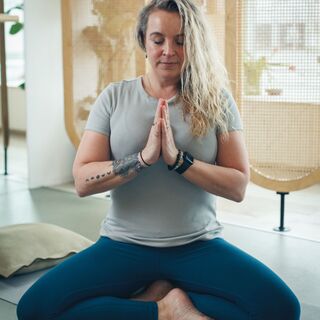
And let your hands meet in front of your heart,
In Anjali mudra.
Let your thumbs rest against the chest bones,
Elongating the spine.
Feel the crown of the top of your head.
Just notice how the body feels right now.
What's going on in the mind.
And also if you had an intention in the beginning of the class,
Come back to your intention.
Let your head softly bend down and take a moment here to thank yourself.
Thank yourself for showing up for yoga.
And thank you so much for joining me in this restorative yoga class.
Thank you.
Namaste.