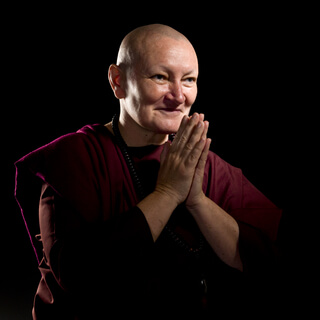
Eden and Warhead.
So it's the truth of suffering,
That absolutely everything we experience outside or inside is not really satisfying.
It's so-called suffering,
It's tukka in Bali.
And the second truth says that there is always a cause for suffering.
Everything has a cause.
It's always just cause and effect,
Whatever we live,
Whatever we experience.
So the second truth is the truth about the cause of suffering.
What is the cause of suffering?
And the cause of suffering is always the same.
It's very simple.
It's attachment.
We are holding on,
We are grasping,
We are holding on to things.
We hold on to,
In a positive or in a wanting way,
There is liking,
There is desire.
We want things the way we like it.
And there is attachment to aversion,
That means we dislike things.
Both are attachment.
Wanting them or not wanting them.
Trying to get things and trying to avoid or destroy things.
So that's the second noble truth.
First suffering,
Second the cause of suffering,
Which is always attachment,
Holding on,
Graving.
Then the third noble truth is the truth of the cessation of suffering.
Suffering also ceases.
And you can also say it's nibbana,
End of suffering.
Yeah,
And this cessation of suffering also has a cause,
Because everything is cause and effect.
And that is the fourth noble truth and that's the truth of the so-called Eightfold Path.
That's this dhamma wheel you sometimes see.
It's a wheel with eight spokes.
And these eight spokes,
Each of them is one part of the Eightfold Path.
But to say it's simple,
As I already mentioned some days ago,
For me the simple way to say it is just,
There is,
Every day in our life we have two ways we can choose,
Two paths we can choose.
Every moment.
One path is the path that leads to suffering.
If we choose that,
We just need the cause for it.
We need to do as much as we can creating the cause that leads to suffering.
So it means attachment.
So if your goal in life is to suffer,
Be as attached as you can.
It's very simple.
Just hold on.
Hold on to everything you find and you will have a lot of suffering.
Enjoy it.
And there is a second.
And that is the path that leads to cessation of suffering.
And there it's the same.
You always have to just follow the right cause.
If you want suffering to cease,
You need to go the other path.
And the cause for the cessation of suffering?
As I said,
Attachment,
Holding on is the cause for suffering.
So what is the cause for the cessation of suffering?
Let it go.
Not holding.
So very simple.
There are only these two things and that happens a thousand times a day.
We can choose with little things.
Hold on to that.
Want it.
Cannot get it.
Of course I suffer.
I don't want it to change.
Of course I suffer.
I don't want things to happen this way.
I will suffer.
Buddha said,
Being connected with those we don't like is suffering.
Being separated from those we love is suffering.
Not getting what we want is suffering.
And getting what we don't want is suffering.
So all these attachments,
Wanting it different than it is right now,
Leads to suffering.
So having acceptance with what is now,
Not wanting it different,
Or maybe there is a wanting it different but we can accept it,
It will reduce our suffering.
The acceptance,
The tolerance and letting go leads to cessation of suffering.
So very simple.
Very simple formula.
But to do it is another question.
How easy is it for you to let go?
And that's what we try to train with the practice we have.
Yeah?
Yeah,
Yeah,
But I can only do one after the other.
So,
Okay,
Now German.
Yes,
So we have the four different ways.
This is to get from Buddhism.
The first is to get the way of life,
That things are not too free.
And the second way is to get from the outside.
In Buddhism we are talking about the outside and the outward.
So when the light is,
And that is not the light,
But the light is the light.
And the outside is the outer self,
The outer self,
The outer self.
If I have to,
In my life,
To light,
Then I have to get from the outside,
The outer self,
And then from the outside,
And then from the outside,
And this result 100% lightens.
And the third way is to get from the outside,
From the outside.
And that also helps us to get from the outside.
And that is the second and the fourth way.
Or the simple result is the lightens.
When I light,
I have to get from the outside,
The lightens to the outside,
In the same way.
That is the fourth way.
And that is the third of Buddhism.
I can't speak to it.
So,
Two halves.
What?
You have to get from the outside,
From the outside,
From the outside.
And what is the right way to get from the outside?
From the outside.
And the outside is the outside.
What is the right way to get from the outside?
What is the right way to lighten the outside?
What is the right way to lighten the outside?
What is the right way to get from the outside?
Is it clear?
Yes.
If you look to that cause of cessation of suffering,
As I say,
It's the eightfold path,
Eight spokes.
And these eight spokes are the damar ved.
So it's eight things that come together.
You can put it simpler.
You have three things,
Sin,
Samadhi,
Panya.
Sila is morality or ethic principles.
Samadhi is concentration and panya is wisdom.
So these three are again these eight factors.
And under the first thing,
Morality,
Fall three things.
And that is right deed,
Doing the right things.
Not avoiding to steal,
Avoiding to kill,
Avoiding to.
.
.
What else?
Sexual misconduct,
Avoiding sexual misconduct.
So these three are morality,
This right deed.
And there is right speech,
Keeping your speech clean,
Also a part of morality.
And the third is right livelihood,
Trying to have a job to make your life,
Your living,
With a job that doesn't create suffering.
In this case,
No selling of weapons or humans or drugs or so,
Which cause suffering for others or yourself.
So try to avoid these three.
So that is the part of morality.
And these eight factors,
They are the only factors that are important to us.
And I'm not saying that they are simply useless.
But these eight factors are important.
And the first step of these eight factors is morality or ethic principles.
And these three are really tools.
So not to,
Not to be,
Not to be,
Not to be sexually relationship with someone and to be a sexual misconduct.
The third is really speech.
Not to be,
But to be able to.
.
.
To be a part of the human right.
And to be able to be a part of the human right.
And the third is really the language.
That you can't have a language that is able to be a part of a self or a part of others.
Waffenwackeufen or the drug or the person or so.
Badger,
Butcher.
Not a good job.
Metzger is an edumbe dink,
The best job.
Okay,
So this is moral.
That's the first part,
Morality.
Then there is.
.
.
Samati,
As in the concentration part.
That is right mindfulness,
Right concentration,
And right effort.
Right mindfulness,
You know,
Sometimes we think mindfulness,
Especially in the beginning,
Mindfulness is just to focus,
You know,
Stretching,
You know,
Pulling,
You know,
Right step and left step.
You are really focused on that.
There is a very good story I can tell you.
I was teaching in the Netherlands near Amsterdam in Narden.
And it's a theosophical institute in Narden.
Very beautiful place,
Old place,
Old tree.
So I was teaching a Vipassana retreat.
And then there were these Dutch guys doing Vipassana and some are very serious,
You know.
And it was lunchtime.
And after meal,
I had a tray with many plates they brought to me and I wanted to bring it back to the kitchen.
And this was a small way I had to walk.
And there was this mindful Dutch guy in front of me.
He was walking the sixth step,
Like lifting the heel,
Lifting the foot,
Moving forward,
Lowering,
Touching,
Placing,
Lifting the heel,
Lifting the foot,
Moving forward,
Lowering,
Touching,
Placing.
And I had this heavy tray.
And then this guy came to the door,
To the kitchen.
And he was stretching,
Touching,
Pulling,
Whatever,
Pressing,
Opening,
And then turning,
Touching,
Closing the door.
And I stand in front of the door.
He closed the door just in front of me.
So he got a real good Dhamma talk.
Just to tell that example,
This is not mindfulness.
This is concentration,
Pure concentration on what you do.
And the mind gets narrow like that.
That's not at all right mindfulness.
That is not right concentration.
That's not Vibhasana.
The Samatha mind,
The concentration mind is like that.
Only one thing,
Everything else we cut off.
The Vibhasana mind is like that.
It's all embracing.
It knows whatever is there in the present.
So if you feel your mind is like that,
It's more Samatha.
But if you feel,
Okay,
There is knowing,
There is openness for the present object,
Whatever rises,
There is knowing.
It's not going to read,
Not getting attached to it,
But there is openness and knowing.
That's the Vibhasana mind.
And this guy didn't understand it yet.
It can happen.
But it cannot happen that he closes the door in front of me with this heavy tray.
So he got a big dump.
That's not right concentration.
Right concentration is focusing,
But also knowing what is going on,
Not cutting off everything else.
So it's not right concentration,
Right mindfulness.
Mindfulness is the same.
We know there is the knowing of the present moment and there is the understanding of the present moment.
So we call it sati sampachana,
Mindfulness and understanding.
That would be right mindfulness.
And the third part of concentration is right effort,
Right effort,
Putting the right energy in.
And that is described in a way,
Right effort should be the effort to do wholesome things,
The effort to support wholesome things who have already arisen in your mind,
The effort to avoid doing unwholesome things,
Creating suffering,
And to sustain that,
The effort to sustain that and try not to let them come up again,
And the effort to purify the mind.
So actually three things,
Effort do wholesome,
Effort avoid unwholesome,
And the effort to purify the mind.
The meaning is we are still on the path.
No one of us is enlightened yet,
As far as I can see that.
So as long as we are on the way,
We need still to do wholesome things.
All the good things,
The wholesome things we do support our mind.
They help us to be a better being and they make us more happy.
If you do good,
You feel happy,
The happiness is very important for you to practice.
You must cheer yourself up.
And all the wholesome things you do help you with them.
The unwholesome things,
They drag you down,
They put you down,
They get you to be depressed,
To be angry,
To be sad,
The mind gets muddy and murky.
So unwholesome things we try to avoid because they bring us down.
That's the reason.
But finally,
An absolute is the purification of the mind.
That means we purify the mind from both because good and bad doesn't exist in an absolute reality anymore.
That's what Ajahn sometimes says,
It's the value you give it.
So actually,
In the absolute reality,
We stand above both.
There is no attachment to good or attachment not to do bad.
The attachment is all gone.
But that's absolute and you cannot start with that.
We are still in a normal reality,
In a worldly reality and then we need to work with that.
And all positive supports us,
All negative brings hindrances.
That's why we try to do good.
So that's right effort.
The second part of this act is moral.
The second part is concentration.
And concentration is a very important part of this act.
Part of this dharma.
And the first part is concentration.
Concentration is,
We say,
A very important concentration.
It's the most important.
It's not just one.
It's not just one person and it's all the same person.
There is all of them.
All of them concentrate,
But all of them.
Then the third part is the third part.
So we must know what the next moment is after and the rest is after.
Because when the next moment is the object of the body,
But not the state,
Then it's the next concentration.
It can be okay,
Okay,
Right.
However,
The person who is thinking about the body,
Not what they are going to do.
That's why it's a very important moment.
That's why we need to focus on this.
So we need to focus on the combination of the two.
And the third part of the concentration group is really the one who is thinking about the next moment.
And the third part is the last part.
The last part is the last.
And the third part is the next moment.
That's why it's important.
The last part is the next moment.
And the next part is the next moment.
Then the third part of this Eightfold Path is the wisdom part.
And there are two spokes.
And that is Right Thought and Right View.
Right Thought is always telling you that whatever you experience,
It is impermanent,
Suffering and no-self.
That's what we call Right Thought.
Thinking in combination,
Okay,
It's impermanent,
Not satisfying and no-self,
Not under my control.
These three characteristics are very important.
We see them at all times.
So whenever we think about or contemplate about things,
We know these three.
They call in Bali Anicca,
Anatta and Dukkha.
These three always have to be clear.
And the Right View,
The last part of these two wisdom parts,
Is having a view that you see these four noble truths at all times.
There is suffering and its cause,
And there is cessation of suffering and its cause.
That's the correct view of things.
The last part of this Eightfold Path is the wisdom part.
That is Right Thought.
Right Thought is in combination with the wisdom of the three characteristics.
The three characteristics are lightness,
Understandingness and self-love.
So this is not self-love.
Uncontrollable.
When one thinks about what these three are,
That's why these three are important.
I have a full control and this is the freedom of the three.
And the last part is the Rightness.
And the Rightness is in combination with the four different ways.
The Rightness says,
There is one way to be light and that is the right way.
The other is the right way.
And the two ways are in combination with the right way.
And the other is the right way.
That's where we are right now.
So,
So far to that four noble truths.
Clear?
Yeah,
That's actually the hardwood of Buddhism.
That's the teaching the Buddha gave when he gave his first sermon in Varanasi in Benares on the Ganges River.
He gave this teaching,
Four noble truths,
That everything that arises is impermanent,
Non-self and suffering.
And many got really a clear understanding through that.
One human was enlightened and lots of angels got to reach the first level of enlightenment.
Also the human was Kondanyu,
He reached the first level of enlightenment.
So he was the first one in the Sangha,
He was the first one who understand the teaching of the Buddha.
Good.
Then I would say let's meditate a little bit on this and yeah.
I think we can sit now,
No?
Not too tired and then we do some more standing in the afternoon.