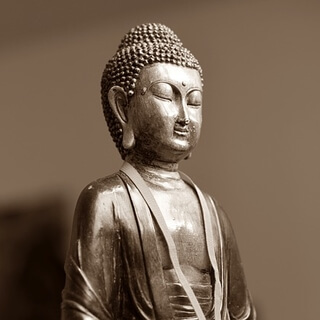
This will be a 20 minute meditation.
Sit on the floor or in a chair wearing loose and comfortable clothing.
Try to find a room or a place where you won't be bothered for 20 minutes,
Where you can not hear the phone or any other disturbances and where no one will interrupt you during this time.
If you're sitting on the floor,
Arrange some pillows to support you so that you're higher in the back and your upper legs angle down to your knees and if you're limber enough your knees might actually touch the floor,
Giving you a three prong base of your rear end and your two knees,
Making you nice and stable.
If you're sitting on a chair,
You also want to establish this three point base with your rear end on the chair and your two feet firmly and flat on the floor.
Don't have your ankles crossed or anything like that.
So now you can close your eyes.
Our meditation practice is always done with eyes closed.
Take three deep breaths now,
Just arriving.
Make sure that your spine is straight.
In meditation it's very important to have a straight spine so that your energy can flow up and down unimpeded.
That's the really most important thing about your posture.
We also want to sit in a posture that is alert and upright and even noble.
A posture that says that we are awake and interested and curious and present.
We also want this posture to be very relaxed.
So feel your body now and make sure that you're not holding anything too tight.
Nothing military.
Just a relaxed yet awake and alert posture.
So really come into your body and experience it and listen to how it all feels.
Your head,
Your chest,
Your arms,
Your torso,
Your belly,
Your rear end,
Your hips,
Your legs,
Your feet,
Your toes.
Just be in your body and see how it's all doing in there.
Just be present to your body for a moment.
Our meditation is a very embodied practice.
And now extend your awareness out into the room or wherever you are,
Whatever setting.
Just become very aware of the air around you.
Feel the air brushing your skin.
Take a deep breath and just feel the circumstances,
If there's any fragrances or odors or smells coming by,
Any wind or breezes or anything about your environment.
Just take it all in,
Even with your eyes closed.
Just feeling the space that you're in so that you're very present in this room and you're very present in your body.
And now come right into this present moment and just feel this moment,
This unique moment that only comes once in your life.
Just be very present for it.
And let go of any concerns or things that you may be thinking about that are going to be coming up in the future.
Anything on your mind that's happening later after you do the meditation or tomorrow or in the upcoming days or weeks,
Just let go of that now.
There will be plenty of time to work with that later and maybe think about it if you want to think about it.
But for now just let go of the future and be in this moment.
Similarly,
Anything that's happened in the past that may be on your mind,
Anything that happened today or yesterday or in the past weeks that you may have concerns about,
Just let go of that now and put it aside for the moment and just be right here,
Right now,
Without the past,
Without the future.
Just you here on your own in this meditation.
And now we're going to bring attention to the breath,
However it is.
There's no right way to breathe and we're going to not change how we're breathing at all.
We're just going to notice it without any judgment whatsoever.
The breath is very smart and it doesn't need any help from us.
So we want to relinquish control and let the breath do what it wants and just trust that it knows how to do it.
So we're just going to notice how the breath is right now.
Just pay attention to your breath and notice.
We're going to bring a lot of curiosity and interest and investigation to the breath.
What is my breath like?
Is it long?
Is each breath long or do they seem more short and choppy?
Are my breaths deep right now or would I say they're more shallow?
Is the breath smooth and regular or is it irregular and choppy?
And no judgment on that.
The breath can be however it wants.
If it wants to be shallow and choppy and short,
That's just fine.
So we've got kind of a notion.
Just experience the breath without any description at all for a moment.
Just take it in.
Just have a felt sense of what your breath is like right now.
Noticing it,
Letting it breathe itself however it wants to be and just receiving it into your awareness.
Now notice where in your body have you been noticing your breath.
The breath takes place in various areas around the body.
So were you noticing your breath at the tip of your nose?
Did you notice the cool air coming in your nostril and the slightly warmer air going back out?
Try that now.
Do notice that.
Put your attention on the tip of your nose.
Notice cool air coming in and slightly warmer air going back out.
Or were you noticing your breath in your chest area?
Were you noticing the chest rising on the in-breath and then falling on the out-breath?
And whether you were or not,
Try that now.
Bring your attention to your chest,
Very focused.
And notice the in-breath,
Your chest rising and the out-breath with your chest falling.
And the third place that many people observe their breath is in the belly.
Were you observing your breath in the belly,
With the belly expanding on the in-breath and contracting on the out-breath?
Try that now.
Try the belly breathing.
Notice your belly getting bigger,
Expanding on the in-breath and then contracting on the out-breath.
One of these three methods or locations of observing the breath may be easier for you to keep your attention focused at.
So try to figure out right now,
Snap judgment,
Which one of those three areas it is and stay in that area for the rest of this meditation.
The next time you meditate you can pick a different area and experiment for a little while until you find which of these three works best for you and then we recommend you stay with that for some time,
Maybe a few months of meditation in that one area to really get focused with it.
So right now either pick the tip of your nose or your chest or your belly and that's where you're going to keep your attention.
Understand that in this form of meditation we don't follow the breath as it moves through the body in the nose,
Down the esophagus,
Into the belly,
Back out again.
That's not what we're doing.
We're going to pick one single location in the body and keep our attention focused right at that physical point and watch the breath as it travels by that point.
So we're not floating down the river,
It's more like we're sitting on the bank and watch the water go by.
So keep your attention focused right in that area and I want you to watch three or four inhalations and exhalations now.
Can you notice whether your in-breath is longer than your out-breath or is your out-breath longer than your in-breath?
How are the two different?
Take two or three breaths now and notice the difference between the in and the out-breath.
If your mind wanders while you're trying to watch your breath,
Don't judge yourself.
We want to maintain an attitude of kindness and gentleness and just delight with ourselves for taking up this very beneficial practice and making the effort and being in this moment and really being alive right now.
What more could we ask of ourselves?
So whatever happens during the meditation is what happens in the meditation and none of it is bad.
All of it is just great.
So establishing this very accepting tone,
Inner tone is very important to meditation.
You want to enjoy this,
You want it to be a great experience so you'll come back and do it again.
So if you forget to watch the breath and you suddenly find yourself thinking about the ball game or the plans you have for later tomorrow or the presentation that you have due or what's for dinner and you suddenly find yourself off on this track,
That is completely normal and it will happen a million times.
So when you notice that's a great moment because that is a moment of awakening.
So with a spirit of being happy with yourself for having awakened,
Gently bring the attention back to the breath again and again.
Don't judge the wandering mind.
You just notice that yes,
The mind has wandered and bring back to the breath without judging.
There are several techniques to use to help keep the attention focused on the breath.
The first one is called noting.
And in noting we very softly whisper in the mind a label for the in breath and for the out breath which encourages the awareness to stay with the breath.
So if you're keeping your attention focused on your nostrils,
When you feel the cool air coming in,
You can very softly just say the word in.
And then as you feel the slightly warmer air going back out,
Very softly in your mind you say the word out.
We don't want to let these words become the object of our attention.
We want to really pay attention to the breath.
But these little words quietly under the little subtitles help us to keep the attention focused.
If you're concentrating on the chest or the belly,
You may want to use different words.
You may want to use rising and falling or expanding and contracting.
Whatever words work for you,
Very quietly,
Very gently,
As a little helper,
Try this technique now in maybe we'll do ten breaths and you'll very quietly say the word in and then the word out to match the in breath and the out breath and see if it helps you keep your attention or whatever words work for you.
So try that.
Another technique that can be very useful in watching the breath is to count the breaths.
Really the instructions for doing that are to count only the in breaths and count up to ten and on the eleventh in breath start over with one.
And if you forget and find yourself all the way up to twenty-eight,
Just come back and start to one again.
You'll be happy with yourself for having noticed that you've wandered.
So go ahead and try that for about ten breaths.
Just count very softly,
One and two for the second in breath and I'll be quiet while you try it.
Okay?
The important thing with both of these techniques,
The noting and the counting of the breaths,
Is not to let them become the focus of your attention.
You really want to be noticing your breath with curiosity and interest and just letting these little techniques be a helper and not the focus of your attention.
Another final technique that can be really helpful is to notice the in-breath and then notice the out-breath separately and also notice the spaces in between them.
The space between the in-breath and the out-breath and then that other space after the out-breath before the next breath starts.
So it's a lot to do.
So in the space of a breath you would very quietly notice the in-breath,
Notice the space before the out-breath,
Notice the out-breath and notice the next space before the breath starts again.
So try that.
You don't have to say anything.
Just try to keep your mind tracking closely with the breath on all four of those little pieces.
So all of those techniques can be very helpful when watching the breath.
We only have a few more minutes to this meditation so I'd like you to look now at your breath or ask if over this 20-minute period has the quality of my breath changed.
So just speak silently with your breath noticing what it's like without words again and compare,
Remember how the breath was 20 minutes ago and has it changed.
We always end our meditation with a bell.
So when the bell rings you can open your eyes and come back into normal awareness.
I'll let you watch your breath for a few more moments.