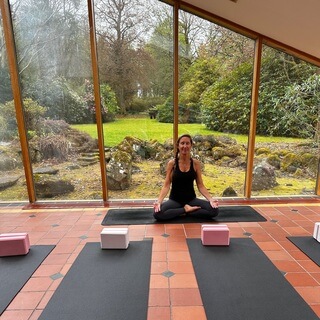
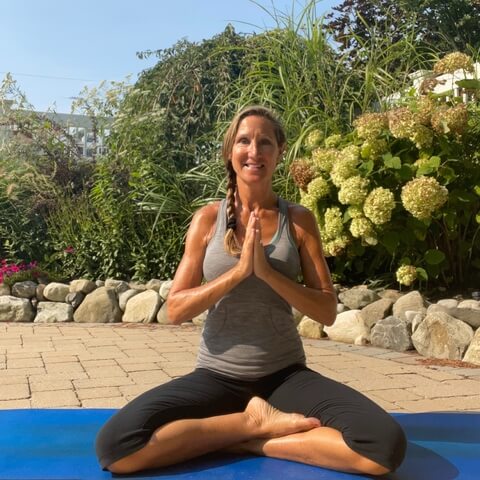
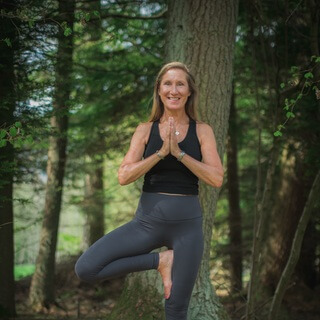
When you feel your body,
Mind,
And spirit needs to slow down,
Yin yoga is a practice that is quiet.
It's a gentle style of yoga where we hold poses for longer periods of time,
Usually two to five minutes each.
Rather than building heat or strengthening the muscles,
Yin works gently and deeply into the connective tissue of the body,
Your fascia,
Ligaments,
And your joints.
The goal isn't to push,
It's to soften,
Settle,
And allow.
We'll explore a couple poses together right now.
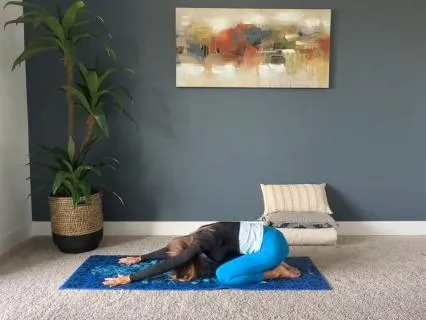
So come down onto your hands and knees.
And slowly sink your hips back towards your heels.
Let your arms rest either in front of you or alongside your body.
Your forehead settles into the mat.
And you allow yourself to relax into the breath.
In yin,
You're not pressing into the shape.
You're relaxing into it,
Allowing gravity to do the work.
Notice how your body is holding on.
Allow the breath to release the tension and the tightness.
With long,
Deep breathing,
Let go.
Relax.
And release.
Begin to release your child's pose.
And gently come to a seated.
Position.
Bring the soles of your feet together and let your knees fall open.
Tuck your chin into your chest and fold forward.
Let your spine round gently.
And allow gravity to support you.
Relax into the breath.
This is what makes yin yoga different.
In other styles,
You might be asked to lengthen your spine.
But here,
You're welcome.
To allow the natural curve of the spine.
So that you relax and neck.
The shoulders and the back.
Allow your body.
To be exactly as it is.
Relax into the breath.
And release any tension and tightness.
And when you're ready,
Release.
We're going to move into legs up the wall.
You have a few options here,
So lay down on your mat.
You can take a pillow or a block and place it under your sit bones and lift the legs high up to the sky and rest there with the arms out or your hands on your belly.
You can also take a strap,
A belt,
Or a towel and wrap it around the soles of your feet.
Holding.
The posture.
You can also bend your knees if you want to rest them on the edge of a chair or your bed.
And then the final option,
If you desire.
Is to scoot your way over to a wall.
And gently rolling over to one side and then place your legs up as close against the wall as possible.
Let your legs straighten.
Relax your arms wherever they want to be at your side or on your belly.
And just simply breathe.
This pose is deeply restorative.
The nervous system begins to shift from doing into being.
This is the heart of yin yoga,
Learning to rest fully without needing to fix or change anything at all.
Stay here as long as you desire.
Yin yoga is a practice of patience and presence.
You don't need flexibility,
Experience,
Or the perfect body.
All you need is willingness.
Willingness to be still,
To breathe,
And to trust to release into the quiet.