Yeah,
I'm really looking forward to this and I'm going to pass it to Lisa now.
Thanks,
Lara.
It's so good to be introduced by someone that I love so much.
And it's great to see some good faces here and also not faces,
But just know that you're here.
It's great that we can choose to be on camera or off camera.
So thanks for taking care of yourself and the way that feels right for you.
I'm going to have us begin by lighting a candle.
If you have one,
You can light one for yourself or you can just connect with mine.
And slowing down is a radical act in this culture.
So we are already engaging in rebelliousness in this moment by slowing down in place and in space.
So eyes open or closed,
Moving or still,
However you want to be,
Noticing your place in space in this moment.
And letting your attention drop to what is here for you.
The room that you're in,
The house that you're in or the home that you're in or the space that you're in,
The walls that you're within or without.
And the land that is holding all of that,
Holding all of you,
Holding all of me.
In your own way,
It feels right for you acknowledging that land,
This land that we are interdependent with.
That is holding us.
As is the elements of water flowing through us,
Air moving through us,
Fire moving through us and the earth of form moving through us as us.
And our independence relies on these elements.
So let's see,
Let's go to the next slide if I can.
There we go.
Today we're going to be slowing down together and communing and slowing down doesn't mean doing nothing.
Slowing down doesn't mean sitting perfectly still.
What we're really going to do is this rebellious act of harnessing our attention with our engaged attention and reclaim it back from a culture that wants all of our attention and our focus so that we miss the dependency of life in a co-creation.
So we're going to be doing that today to regulate our brains,
Our nervous systems,
To be in conscious embodied relationship.
Then we're going to move into some creating,
Some writing.
I'm going to have some prompts that will elicit some writing.
You may already have things that you want to write about and if writing is not your thing,
You can do art,
You can do dance,
You can do music,
Something that's being inspired through you at this time with the prompts that I offer forward.
Then we're going to have about a 10 minute break to really let your bodies move and release and replenish.
It'll be about 10 past the hour and then we'll go into some small group breakouts where we're going to share what we have created in the way that we want and I'll set this up later for us.
And then we'll come back together and have some communal sharing.
Let's see if I have any notes I wanted to add to that.
Yeah,
And our communal sharing will also have some time for some questions and I'm happy to stay after my allotted time to answer questions as well if we run out of time.
I wanted to just make a note of languaging.
I don't know if any of you got to be here with the last speaker.
Shee-hee-lo.
I hope I got her name okay.
But if you were here for her presentation,
Yes to everything that she said.
Everything that she shared and moved into and explored is very much in alignment with the work that I'll be doing.
And if you didn't get to see it,
I hope you get to go back into YouTube and rediscover her presentation.
It was really powerful and important.
Something that I wanted to lift up that she alluded to is languaging is really limited.
So I'll be using languaging that you may not be familiar with but you might get a sense of it.
I'll be doing the best that I can to use language that's accessible and my intent is always for us to be in co-creation together and to be in the resonance of allowance and generosity in a way that's generative.
If you can,
Position yourself here for the next bit of time in a place that's close to nature and even that languaging is funny,
Isn't it?
But what I mean by that is for me it's trees.
I live with a lot of acres behind me so I'm facing acreage of trees.
I'm facing plants and birds that are coming in and out of my attention.
If you have something like that,
Great.
If you don't have anything like that,
Completely understandable.
I'm going to be having some slides that you can connect with because our senses communicate and even when we just see a still frame,
Our brains are so wise and our systems are so wise that we can pick up what we're seeing,
The life and the resonances of what we're seeing even in a picture.
And then as Laura said,
If you can be in a comfortable spot,
That's fine.
But even if you're in a crowded airport right now,
That's fine too.
We'll make it work.
I'll be doing a rest meditation that's really adaptable to pretty much any time and space or space and place,
I should say.
We don't do perfect in this time,
The next two hours.
There's nothing of perfection in this because perfection is something that white supremacy wants us to believe in.
But it is not an actuality.
So we will be in true discovery and awkwardness sometimes and stumbling sometimes and we'll be in it together in our learning.
Alright,
So yeah,
This is my first slide.
I'll be going through some slides because our eyes may be opening and closing at different moments.
And so if your eyes are closed during this,
That's great.
If your eyes want to stay open and you want a picture to connect to at any time,
You can open your eyes.
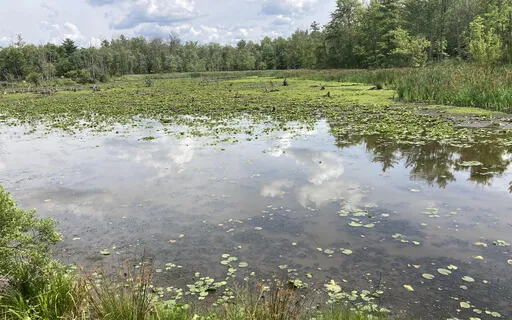
There will be pictures of peatlands or what we say in North America sometimes,
Bogs or wetlands.
So I have some pictures of some of my favorite peatlands,
Some in the state that I live in,
In different locations and some from the West Coast that I brought in from a trip a couple years ago.
So we'll just start together with eyes open and I'm just going to acknowledge I have chosen to be in this spot which is a beautiful spot but the birds are coming and going and I find myself distracted but in a beautiful way.
And Chihilo talked about relationship.
Everything is,
Everything is relationship.
So the birds will be in relationship with me and you may hear the sounds of them coming and going.
So I left,
I didn't put my earbuds in on purpose because I want you to hear the sounds of life and I hope it's not too distracting.
If it is distracting,
Please just message Lara or Irene and they will let me know.
I also just remembered I didn't give you my name and pronouns.
I'm Lisa but I also go by Lee and I prefer they but I also respond to she.
So sorry about that.
Let's now connect consciously and I will walk us through what that means.
So we're going to take a moment here to do something that your personality or some part of you might think is really silly.
But we're actually going to take a moment to very slowly look down at where we're standing or sitting or laying or walking.
Wherever you are in space and place,
Just take a look with your eyes open.
We're inviting cognitive attention to notice that there is solid ground under you,
At least under your feet.
Maybe solid ground under your sit bones,
Under the thighs,
Maybe solid ground you can kind of see behind you maybe a little bit.
We're letting cognition map this moment.
This helps with brain regulation.
And we're just observing.
We're really inviting ourselves to simply observe the factual of this moment,
The actual factual of feet on floor for me and hands on knees for me.
Your context will be your own.
And then letting your attention continue to do that,
To engage in the room that you're in.
So the mind loves to judge and criticize and analyze and we're going to acknowledge that's going to come in but we're really going to use effort to go underneath that to just look at the facts of this room,
Of the room that you're in or the space that you're in.
I'm noticing like the texture of the ceiling,
Just noticing it.
I'm also noticing the texture of the floor in my context.
There's just grains of wood and I'm just observing those grains.
I'm not trying to change them or have them be different or argue with the dirt on my floor.
I'm just noticing,
Oh there's dirt there,
There's grains of wood on my wooden floor.
I can look at the space behind me very gently that allows the vagus nerve to come in which connects to our limbic system and our brain regulation.
It also lets our reptilian brain know that there's no danger behind us which is important for the limbic system.
So we just verify that,
Yeah,
No danger behind us.
I can feel the psoas engaging just connected to that vagus nerve.
And I continue just to observe the actual factual,
What I'm seeing.
You notice the judging mind come in,
Just acknowledge that's a part of how we think and then we're just inviting our attention to come under that to the actual factual.
And we do this slowly.
You might be also using the actual factual perception with sound or scent,
Smell.
Sensing of feeling will come next.
We'll come back to looking at ourselves sitting or standing or whatnot.
And then we're going to let the eyes,
If it feels right for you to gently close to come to what is actual factual from your sitting body's perspective.
But very simply,
So when we had been seeing the feet on the floor before,
Now we're going to feel what it's like for the feet to be on the floor.
The first thing I notice is kind of a stickiness.
Like my feet are kind of sticking to the floor.
Not in a good way,
Not in a bad way.
It's just what it is.
Actual factual.
I notice some sweatiness under my armpits.
That's actual factual.
So you'll notice your own actual factual in this moment.
Maybe you'll notice hardness or softness under you.
Maybe you'll notice if there's a pillow behind you,
That I don't have anything behind my back.
I just notice a sense of space.
It's an actual factual.
I can feel a sense of space behind my back.
I'm just observing my sitting body in place in space in this moment as actually factually as I can.
Then you might notice temperatures,
Even different temperatures.
I notice some warmth in some areas but coolness in other areas.
If you need to make an adjustment,
You can do that.
If it's too warm,
Too cool,
If your pillow is too hard,
You can get a softer one.
If your chair is too hard,
You can get a softer space to sit in.
So sometimes when we observe the actual factual,
That gives us good information about how to make adjustments that will support us in the slowing down.
So we're still observing how our body is meeting what we're sitting on,
How our bodies are meeting the air around us.
Maybe you notice the air on your face.
Maybe you notice the temperature of your hands or the palms or the back of the hands.
If possible,
Really invite your attention to come to what's simple.
This is not always easy.
It may require effort.
If you're noticing that there's effort needed,
That just means that you're using neuroplasticity.
You're coming into paving new neural pathways into the now.
If it is okay for you,
You might bring your attention more into the insides of you,
Perhaps where breath lives.
But this is not necessary.
So for you,
If connecting into the breath is not comfortable,
Then you don't have to do that.
You can stay observing your relationship with the outside,
The air,
The chair.
Or you might gently open your eyes and just watch your body breathe and just watch how the body fills and how the body empties.
There's lots of choices that you get to make here.
Maybe you would like to choose to just notice how air is moving in and out of the nostrils only.
What is it like to bring attention,
Engaged attention,
To notice air coming in the nostrils and leaving the nostrils?
At whatever pace the breath already is,
So you don't have to change the breath or make the breath be different in this time that we're together.
You can just notice that the air comes in and out of the nostrils in a certain way.
And you might notice temperatures of that air coming in and out.
And this will depend on context.
It will depend on the temperature of the air that is in your room.
Maybe the air in the room is really cool or maybe it's really warm.
So depending on that,
Your nostrils will,
Or the insides of your nostrils will feel it in according to that.
Often for me,
The inhalation will have a little cooler temperature.
And when I exhale,
That air that's exhaling out of the nostrils will be a little bit warmer.
Today it's just a tiny bit warmer.
That air that's moving out of the nostril,
I call them channels,
The nostril channels,
Is a little warmer.
A little cooler going in.
So we're inviting our attention to stay slow and observing.
There's nothing to change here with the nostrils or fix or even understand.
And yet the mind might be engaging in that way and that's okay.
You can come under those thoughts to just notice that the actual factual,
Which is simply is warm or cold or words that I sometimes discover are dry or moist.
And then as we keep observing breath,
We might notice that breath is,
Is breathing us.
We can observe the mechanism of breath that we were born with.
We can observe it just happening.
We're not,
We're not actually in,
In charge or in control of breath.
We can be,
But when we go to sleep,
We are breathed all night long.
And so in the waking day,
We can play around with being breathed and just observing what it's like for the nostrils to be breathed.
And if it feels right to let more of your attention go to more of the breathing mechanism,
What is it like for more of you to be breathed?
And again,
This is if you choose to do this,
There's no expectation or agenda,
But in some way that is simple for you to notice that we are all in this moment being breathed.
We are all within a design of being breathed.
Our design is to breathe in what has a moment ago been outside of us.
So I am literally breathing in the woods that are right outside my door.
And then I am releasing,
I am communing with those woods outside my door with my exhalation.
And now we are in deep relationship.
And even if your doors or your windows are closed,
That air,
That cellular makeup makes its way through the cracks of your dwelling because nothing can limit intelligence.
Every breath that you take,
Every breath that we take,
We are breathing in our kin in the simplest of ways.
And we are releasing our kin with every exhalation in the simplest of ways.
And we are communing in every moment,
Always.
And as we're slowed down a little bit right now,
We might feel that viscerally or we might feel the experience of that in some way that maybe doesn't even make sense.
Some part of our cellular network knows the cellular network of kin,
Of kinship,
Of co-creation,
Of interdependency,
Of interdynamicism,
Of life.
Let it not make sense.
And let it be known by you in this moment.
Maybe you're in an environment that is very quiet and you can hear your kin anyway.
You can hear your ancestors of wind and water and fire and earth,
Even in the quiet.
And letting whatever that word means for you,
Ancestors,
Letting it speak to you in the way that is true for you.
Maybe it does tap into bloodlines or peoples or plants or animals or cellular wisdom.
Maybe you hear it in the silence.
Maybe you hear it in the non-silence.
If you have your windows open or you hear things,
Maybe it's coming in that way.
If visuals are helpful for you,
Maybe you imagine seeing or you let the eyes gently open to your space or to the screen that's bringing to you a rich kinship of ancestry through this visual of St.
Pete Lynn's in northern Indiana.
In North America.
Maybe if you are indeed choosing and wanting to look at the imagery on the computer,
Maybe you can somehow feel that water that you are seeing or smell the bounty of abundance of what you're seeing.
Or hear the sounds.
The sounds of beautiful ancestral insects and wildlife that live in the Pete Lynn's that depend on the Pete Lynn's that are in co-creation in the Pete Lynn's areas.
And even maybe outside your window or door.
With eyes open or closed,
Letting your attention connect using imagination if it's useful,
Using breath if it's useful,
Or any of the senses to tap into the immense bounty and preciousness of the Pete Lynn's.
Way below what we can see,
But we know has been created through deep time,
Deep formation,
Deep cellular connectivity and relationship.
Let your cellular network of this moment remember our connection with the ancientness of our Pete Lynn ancestors.
Maybe we're being oxygenated together.
Maybe you can imagine your last visit where you saw the bubbles coming up.
So much information in those bubbles.
Can we somehow breathe in that information?
Can we somehow tap into the deep,
Deep well of wisdom below the surface that we can see,
But we know is there?
We're offering our respect,
Our gratitude,
Our desire to foster,
Reclaim,
Rebuild,
Remember our relationship with Pete Lynn's bounty.
I'm going to be quiet for a few moments.
If your mind is wandering,
If you need to move,
That's okay.
Let yourself be in movement.
Maybe you need to walk or stretch as you dream.
We can dream and commune and be in relationship with deep wisdom in lots of ways.
So utilizing your full human capacities to commune with the sacred cellular ancestry,
Bringing your attention to stabilize in any moment you need to,
To the actual factual.
If your thoughts are getting caught in analyzing or figuring out or judgment,
That's okay.
Just keep dropping back down into the actual factual.
Keep dropping down,
Letting your exhalation perhaps help you breathing out anything that's sticky,
Offering it over and deepening into this communal nature with Pete Moss,
However Pete Moss is showing up for you or with you.
And now I will be quiet so you can commune.
Okay.
Be breathed by this Pete Moss.
Breathe with Pete Moss.
What is the Pete Moss and all of Pete Moss's friends,
The animals,
The plants,
The elements that are here?
What are they whispering to you in this moment?
The sounds,
The smells,
The tastes,
The touches,
The visuals.
What's being whispered?
What are you whispering back?
If you're noticing some tender places in you,
See if you can stay slow and simple.
If there's emotions,
See if you can welcome them in as your kin.
Yes,
You're welcome here to sensation X.
You too can be breathed.
Yes,
You too emotion X.
You are welcome here.
You too are being breathed.
We're here together.
We're here together.
Continuing to invite yourself to receive and release.
You too can be breathed.
You too can be breathed.
You too can be breathed.
Consciously acknowledging our ancestral fire that's here.
You may feel that directly.
It's here directly.
Maybe through the warmth that you feel.
Maybe through the heart beating.
Oh,
There's fire in the heart.
Maybe in other ways,
Experientially honoring that fire,
Experientially honoring water,
The water that's in our blood that's moving throughout our whole being.
The pulse is moved by water through our bodies.
We might feel that in this moment.
It's fire and water together.
The oxygenization brings in air.
The element of air is here in this moment,
Breathing us and allowing us to be here in every way.
In the form of our bones,
Our muscles,
Our tissue,
The form that is here in this moment through our sit bones or our feet bones that make contact,
That we can feel in the field of gravity on the earth plane,
On the earth surface.
Giving gratitude to these elements that are always alive in us and sometimes we have some amnesia,
What I call amnesia.
We just get a little disconnected from this bounty and we are remembering in this moment that we can slow down.
We can practice orienting in a way that allows our brains to slow down,
Our nervous systems to regulate so that we can be in right relationship with our kin and ancestral co-creators.
We're going to be moving into writing in a moment.
I'm going to be reading into some prompts in a moment.
Before we do that,
Just letting yourself have this last moment or two to honor and acknowledge whatever spoke to you.
Giving thanks and acknowledgement to what you have heard and received and to what you have offered back or whispered back or released out.
That in itself could be a writing prompt,
But I'm going to read you some writing prompts that you can listen to with your eyes closed if you'd like.
Or they're also on the screen.
First prompt is what are you learning about yourself,
Life,
Interdependency?
What have you been learning from our communal rest today or from another session today or this week that you'd like to write about?
What are you learning about your relationship with Peatlands?
What are they teaching you or what might Peatlands be learning from you?
Third prompt,
What discoveries,
Teachings,
Learnings do you want to deepen into and or share with others?
Maybe you want to write about that.
The last prompt,
Is there something you're learning this week or today that will impact how you participate with life moving forward?
Maybe you want to use our writing time on that.
You can also just follow your own muse or the muse that speaks to you.
And at this time if you have found something that has spoken to you,
Let yourself begin to write and maybe turn off your mute me for a moment because I'm going to read a quote from Robin Wall Kilmer in case somebody just needs a little bit more.
But if you're already going,
Inspire,
Just either mute me or ignore me.
If you want to hear this quote from Robin Wall Kilmer from her book,
Breeding Sweet Grass,
I'll read this to you.
Sometimes I wish I could photosynthesize so that just by being,
Just by shimmering at the meadow's edge or floating lazily on a pond,
I could be doing the work of the world while standing silent in the sun.
The shadowy hemlocks and the waving grasses are spinning out sugar molecules and passing them on to hungry mouths and mandibles,
All the while listening to the wobblers and watching the light dance on the water.
Instead,
I live vicariously through the photosynthesis of others.
I am not the vibrant leaves on the forest floor.
I am the woman with the basket and how I feel it is a question that matters.
If we are fully awake,
A moral question arises as we extinguish the other lives around us on behalf of our own.
Whether we are digging wild leeks or going to the mall,
How do we consume in a way that doesn't exist?