This is Everything is Workable,
A series of podcasts and blog posts that examine how every experience,
Every situation,
Every moment is an opportunity to work with our mind.
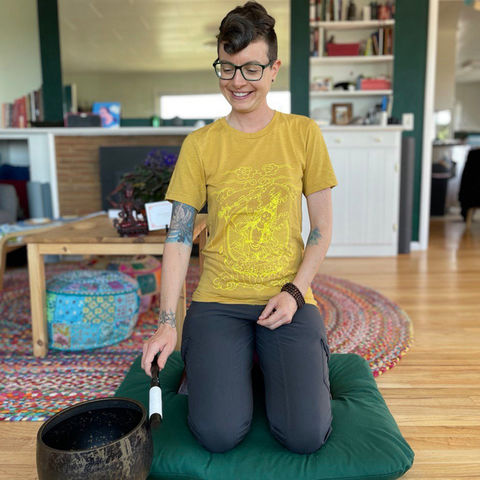
My name is Caitlin Hatch and I'm a creative polymath,
Which is a nice short way of saying I'm a designer,
Artist,
Animator,
And published author.
My purpose in life is to inspire curiosity,
To inspire people to let go of the limited ideas that they have about themselves and their experience.
Through the posts and podcasts of Everything is Workable,
I hope to share some insight into what this means and give you some ideas of how to make your world so much bigger.
I'll have various different guests to share their stories,
As well as sharing my own,
All with the aim of saying everything as workable,
Even the most uncomfortable situations.
Hi,
Thanks for tuning into this,
The very first episode of Everything is Workable.
So I'm going to jump right in with a very bold statement.
There is not a single human being on the planet who would not benefit from meditation.
What do I mean by this?
To really examine this statement,
We should probably establish what I mean by meditation because I know that there are a lot of misconceptions about what meditation is as a practice,
And then also what the result or outcome of meditation is meant to be.
I did write about some of the myths of meditation in my former blog,
Which is called She Smiled the Whitest Smile and can be found at katlanschhatch.
Com.
And I also included a section on meditation in my book,
Why Is It Any Age?
And I did all this with the aim to dispel some of the misconceptions that have developed in the West around meditation.
So I've been meditating for seven years,
And I would say until about three years ago,
I held a lot of the common misconceptions and my practice of meditation was a real struggle for me.
But I'm digressing a bit here.
So back to this question.
First one is,
What is meditation?
Well,
Meditation is two things,
Really.
There's the technique of meditation,
And then the actual practice.
The technique of meditation can vary depending on what you're doing,
And what the result is that you're looking for.
But for the purpose of this particular podcast,
I'm going to look at basic sitting meditation,
Which is also commonly called mindfulness meditation outside of spiritual circles.
And within Buddhism,
It's often called shamatha or calm abiding,
It depends on what school of Buddhism you're in.
For example,
In Zen,
It would be called zazen.
Regardless,
This form of meditation involves a particular posture and a simple set of instructions.
And it's a really basic form of meditation that we're doing here.
Which is not to say,
This is one thing where I should clarify,
I do find this comes up a lot in the West.
It's not to say it's beginner,
When I say basic.
I mean,
It's the most simple form of meditation.
But that doesn't mean it's easy.
So anyway,
Getting into the actual technique,
Right,
So there's the posture and the simple set of instructions.
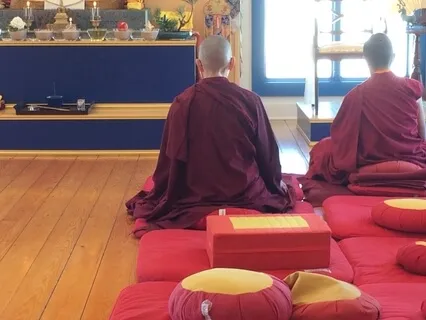
So the posture is described in various ways,
But generally one is seated on a cushion,
Or a meditation bench,
Which is something that I use.
So either your legs are crossed,
Or they're folded beneath the bench.
It's crossed if you're sitting on a cushion,
The knees and thighs should be lower than the hips.
And this is just because it's more comfortable for most people when you're sitting in meditation,
You're sitting for a long time,
You probably shouldn't have anything crossed,
Because that tends to make limbs go numb,
Can be very uncomfortable.
The back should be straight,
But not stiff,
With your head upright,
Shoulders relaxed,
With hands resting on thighs or held in the lap.
So one thing that's commonly used to describe how meditation posture works for the back is it said,
Pretend that you have a string being held up from the top of your head,
Sort of pulling you up,
But not tugging in any way,
Just sort of keeping you nice and straight.
So that's it's a comfortable,
Relaxed position,
It's not really stiff or rigid.
And depending on your level of comfort,
Or who's teaching you,
How long you've been meditating,
What form of meditation specifically you're learning,
Your eyes could be open or closed.
Certain schools of Buddhism teach eyes open,
Others eyes closed.
When you're learning mindfulness meditation outside the context of Buddhism,
Very often it's taught with eyes closed just to sort of simplify things even more so.
If your eyes are open,
It's recommended that they are cast down about four to six feet in front of you,
And that your focus is really softened.
For me personally,
I wear glasses,
So I just take my glasses off.
That's great.
Instantly softens the focus.
The actual instruction of meditation at that point is once you've got your posture in place,
Is to follow the breath.
So this is taught in various different ways.
One could count the out breath or count the in breath up to 10.
So you just,
You know,
You breathe out and you just touch it lightly like one and then breathe out two,
Three.
And if you lose track,
Which will happen when your thoughts come in,
It's commonly taught,
Just come back to one and start counting over again.
Or it could be described as you just simply touch the out breath or the in breath gently with your mind.
So you just notice.
Thich Nhat Hanh teaches it as saying,
I am breathing in and now I am breathing out.
Now I am breathing in and now I am breathing out.
But the focus is always the breath and the instruction is always to return to the breath,
Which brings me to the final instruction within the technique,
Which is to notice thoughts.
Noticing thoughts is another thing where I think people get really,
Really jumbled.
You're noticing the thoughts,
You're labeling them as thoughts and then you're letting them go.
So the instruction when you let it go is generally come back to the breath.
But it's not about not thinking.
It is about just seeing the thoughts and then coming back to the breath.
So you're going to be,
For the example of if you're meditating and using counting to follow the breath,
When you go breathing out,
One and then suddenly you're thinking and all you do is come back to the breath and start counting again.
One and two and then you're thinking and you just,
So it's that,
That's the technique.
This is what's meant as the technique.
Good posture,
The breath as the object of your attention and letting go of thoughts.
So from the technique,
We come to the actual practice of meditation.
The practice is possible because of the technique.
So they go hand in hand,
But they're not the same thing.
The actual practice of meditation is more challenging to describe and I want to extend my deep gratitude to my psychologist,
Christine Corll,
And to Ani Pamachodran and Sharon Salzberg for their initial instructions when I was first beginning to meditate.
They all helped me immensely with my understanding and my intention with this podcast is to share that as best as I can with you.
To understand what the practice of meditation is,
I'm going to point out some of the things that it most certainly isn't.
I think that can really,
Really help.
So meditation is not a way for us to transcend our experience.
It's not about being comfortable.
It's not about getting rid of any aspect of ourselves.
It's not a way to numb out or feel blissful.
It's not about suppressing or ignoring anything.
When I first began to meditate,
I was in the process of recovering from mental breakdown due to severe anxiety and regular bouts of depression.
So I didn't have very good coping skills,
Started seeing a psychologist,
And she recommended that I meditate.
And I very easily latched onto the technique as a way to feel better about things.
This is very common.
And unfortunately,
With mainstream mindfulness teachings,
It's often assumed that meditation is all about relaxation.
And,
Well,
Okay,
In a way it is about relaxation,
But not how most people think.
I know I didn't get this for the longest time.
So what is the practice of meditation?
The practice of meditation is to sit with our experience,
To become familiar with it,
To make friends with it,
As Pema Chodron says.
And ultimately,
The more we sit with our experience,
The more relaxed we will become with it.
So not because we're just being all calm and like floaty with our breath,
But because we're becoming familiar with our discomfort.
We're becoming familiar with intense emotions,
With things that we usually try to avoid or run away from.
So ultimately,
It's not because it's not uncomfortable,
But we're beginning to get to know it and not be so afraid of it.
The actual practice of meditation is a cultivation.
It's a cultivation of gentleness,
Kindness,
And awareness.
I came to really understand what it meant to sit with my experience when I decided to sit while I was having an anxiety attack.
For years,
I'd meditated when I'd felt anxiety building up,
But when it was really intense,
I refused to sit.
I refused because I was so uncomfortable with being in my own skin.
Like the very thought of sitting there and experiencing my anxiety really made me shut down.
I just felt like I'd be too overwhelmed.
But I'd reached a point where I was out of options.
I'd absolutely exhausted all of the coping skills and meditation was the only thing that seemed to work.
Not that it made me feel better,
But when I was meditating,
I was becoming aware of the way the anxiety felt in a different way.
I wasn't quite sure what it was and I started to get really curious and I just wanted to crack it.
So coming back or going back to the final instruction in the technique to notice the thoughts and let them go,
That is generally the most difficult for people.
I know it's always been the most difficult for me.
And one of the misconceptions there is that we're meant to not think when we're meditating,
But that's not what the instruction is.
It's impossible to not think,
Which is something we will learn very quickly when we start to meditate.
I mean,
Even right now,
If I just tell you,
You know,
Take three conscious breaths and don't think,
You're probably actually going to start thinking really intensely.
It's sort of like that thing where you say,
Don't think about a pink elephant.
You can't help it.
It just happens.
Your brain naturally generates thoughts.
The instruction in meditation isn't to not think.
The instruction is to notice the thoughts and the practice is the result of noticing because as we notice our thoughts,
We begin to see that they're not real.
The more we chase a storyline,
The more real it feels.
But what meditation is asking us to do is not chase the storyline.
So for example,
A thought comes up like,
What if I sounded dumb when I made that comment at dinner?
The habitual response to it,
A thought like that for some people,
Would be to consider how you said what you said,
If your tone of voice was as you'd intended it to be,
What the faces the other diners had looked like,
Did one of them smirk,
Being like,
Oh,
I'm sure that they did.
Why did they do that?
And then this can totally spiral out until we've decided that we were a social failure at the dinner party and everyone else who was present now thinks we're really naff and will never be invited anywhere ever again.
So quite an intense escalation.
But in meditation,
We can label that first thought gently.
So what if I sounded dumb when I made a comment at dinner?
Well,
It's just thinking,
Or call it what it is,
Having a thought about a comment I made,
And then come back to the breath.
No big deal.
So to bring it back to my experience of sitting with an anxiety attack,
I felt it building up and I knew I had gone beyond a tipping point with it.
So I sat,
I sat and I labeled the thoughts which were coming thick and fast.
Labeling them really gently is so important.
Meditation is not something that's meant to be done harshly.
We're just noticing,
Not labeling anything good or bad.
So I noticed the thoughts and came back to my breath,
And also became very aware of other sensations going on in my body,
Like my heartbeat,
Or the way that different muscles were clenching,
The way that my stomach was kind of fizzing.
I sat there and the thoughts became less frequent and also easier to let go the more I was letting them go.
And I also began to feel a lot more of that curiosity that I've been starting to get from meditating so much.
So I began to really wonder about what anxiety felt like when I looked at it free from the thoughts that usually accompanied it.
And as I examined it,
The rush of adrenaline,
The tightness in my solar plexus,
The shallowness of my breathing,
I started to see that it wasn't the giant monster my thoughts liked to turn it into.
It was a physiological response to stressful triggers that began to ebb as soon as I began really letting go of the storyline.
So bringing it full circle,
There is not a single human being on the planet who would not benefit from meditation.
As with anything,
Meditation isn't worth doing if you're not ready.
I came up with so many excuses not to meditate for years,
And that's fine,
Because before then I wasn't ready and it wouldn't have been much benefit to me.
That being said,
When other people meditate,
That is of benefit to everyone around them.
If it wasn't for the people who have meditated in the past,
Teaching it to others,
It wouldn't be available as a tool today.
And also,
If you hang out with people who meditate regularly,
You'll notice that they are very calm in intense situations.
A lot of the time they can be,
Not always,
But they can be.
They seem to be more skillful when stuff goes down,
You know.
I know that I knew some people who meditated when I was in high school,
And it wasn't that stuff didn't phase them,
It was just that they were really,
Really capable in difficult situations.
That's sort of,
It creates a skillful state of mind.
It's really nice to have someone around who can remain calm in a difficult situation.
So when we are ready personally to meditate,
The actual practice of meditation itself is entirely transformative,
Because it allows us to see the fullness of our experience,
And it allows us to see things like our discomfort and pain that we have in a very different way.
It teaches us how to be present with ourselves,
No matter what is going on,
Which ultimately makes it easier for us to be there for others,
Which is why other people who meditate can show up for us.
It is a huge practice of compassion,
Because the more you get to know yourself,
The more you see that sometimes you do some really messed up stuff,
But because of the whole gentleness of the practice,
You can sort of go,
Yeah,
But I do it because I'm human.
It doesn't excuse bad behavior,
But you start to see that as human beings,
We do a lot of silly things sometimes to try to make ourselves feel comfortable.
And this is largely because we confuse being comfortable with being happy,
Which is going to be a whole future episode of Everything is Workable.
I promise you that.
But for this one,
I'm just saying that this practice,
As we examine our mind and body through meditation,
We begin to see the relationship that they have.
We begin to see how they're interconnected.
And we also then see how we can work with them both.
And in doing so we start to recognize these things and other people because we see that familiarity,
The more familiar we are with ourselves,
The more we recognize these patterns of behavior,
We can see it in others.
And we can really develop a lot of compassion and empathy for people.
And then we can start to create some incredible changes in our life.
So in short,
Meditation is a way for us to see everything as workable.
It's a practice in order to incorporate that into our lives.
You see what I did there.
Thank you so much for listening.
Thank you for listening to Everything is Workable,
A Fun Wolf Creations production.
If you have a question you'd like to ask,
A topic that you'd like me to tackle,
Or if you'd like to become a contributor,
You can get in touch with me through www.
Vast-skythinking.
Com by visiting the Everything is Workable blog.
Thank you to the very talented Dexter Brittain for sharing his music with the world.
The music used in this podcast is from his Creative Commons Volume 5 album available on www.
Dextabritton.
Co.
Uk.
You