Welcome.
This Yin practice is designed to release deep tension within the fascia.
Let's begin in butterfly.
From a seated position,
Bring the soles of your feet together and allow your knees to gently fall open.
You might slide your heels further away from you creating a diamond shape.
Especially if your inner hips feel sensitive today,
Take a moment to sit up on a folded blanket or bolster so that your pelvis can gently tip forward.
This small elevation helps us begin to access the fascial layers of the back body rather than collapsing into the joints or compressing the low spine.
And when you're ready,
Begin to slowly hinge forward from the pelvis.
Let the spine round naturally.
You might rest your elbows onto blocks or stack your fists or support your forehead with a bolster or cushion.
Once you arrive at your edge,
The place where sensation is present but sustainable,
Allow the weight of your upper body to pour down toward the earth.
And then become still.
In this shape,
We begin to gently traction the superficial back line,
Continuous fascial sheath that runs from the soles of the feet through the calves and hamstrings into the sacrum,
Up the length of the spine,
All the way to the scalp.
As the tissues of the back body are placed under this slow steady load,
We're not stretching muscle fibers in the traditional sense.
We're creating a subtle shearing effect between the layers of fascia that may have become adhered through habit,
Stress,
Or repetition.
This also influences the fascial membrane that surrounds the brain and spinal cord,
Which connects directly into the sacrum.
Through this forward folded shape,
We create a decompressive pull.
Over time,
And with stillness,
This traction reduces tension,
Hydrates connective tissues,
And calms the nervous system.
You might imagine the fascia of the back body like a dense,
Fibrous sponge.
As you settle into the posture,
The tissues are slowly wrung out.
Stagnant fluid gently squeezed from areas of holding.
And in the stillness that follows,
Fresh hydration begins to seep back in,
Improving glide between fascial layers.
Let your breath remain steady.
And we'll stay here for another minute.
And from your butterfly,
Begin to slowly walk your hands back toward you.
Take your time as you rise,
Letting your head be the last thing to lift.
Notice the rebound.
Subtle echo of sensation along your spine.
And then gently draw your knees together and transition onto your hands and knees.
As you arrive in tabletop,
Begin to move slowly through cat and cow.
As you inhale,
Allow the belly to soften towards the floor.
Collarbones broaden and sit bones widen behind you.
As you exhale,
Begin to round through the back body,
Pressing the earth away.
As the front ribs soften inward and tailbone curls down,
Move slowly here.
This gentle oscillation,
Hydrating the fascial layers surrounding the spine and abdomen.
As we alternate between flexion and extension,
We're encouraging fluid exchange along the spinal fascia and restoring glide in the spine.
And then gently return to a neutral spine.
From here,
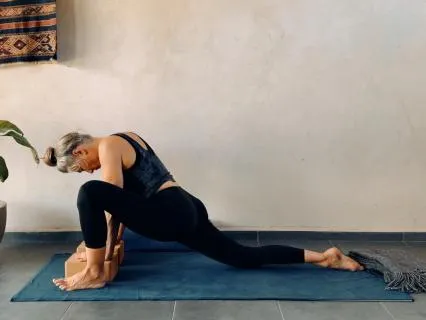
Step your right foot forward between your hands.
You might slide the back knee further behind you,
Coming into dragon.
Take a moment to make any adjustments.
You may choose to keep your hands on the earth or bring them onto blocks,
Allowing the torso to rise upright,
If that feels more sustainable.
Or lower yourself all the way down onto your forearms,
If the body invites a deeper opening.
We're not looking for depth,
But for a slow,
Steady release through the front body and hip.
As you begin to settle,
Notice the line of sensation that travels through the front of the left thigh into the groin and deep into the ball of the pelvis.
In this shape,
We begin to influence the fascia surrounding the psoas,
A deep postural muscle that lies within the front line of fascia.
The psoas is wrapped in a dense fascial sheath that connects upward into the diaphragm and downward into the inner thigh.
Through time and stillness in dragon,
We apply a gentle tensile load to the fascia net that surrounds the hip flexors and quadriceps.
As you rest here,
Begin to soften.
Space gradually returning between the layers.
Allow the pelvis to feel heavy.
Let gravity slowly draw the back thigh toward the earth.
We'll stay here for a little longer.
And slowly begin to prepare to transition.
When you're ready,
Gently shift your hips back,
Drawing the front foot toward the back of your mat and returning to hands and knees.
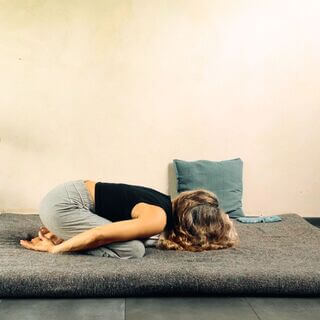
And sit back towards your heels in child's pose for a counter pose.
Notice the rebound.
You may feel warmth or a subtle spreading sensation through the front of the hip and thigh.
This is the rehydration phase.
As a tensile load is released,
Fresh fluid begins to move back into the fascial matrix.
Allow the front of the pelvis to feel spacious.
And when you are ready,
Begin to make your way back to tabletop.
And from here,
Step the left foot forward between your hands,
Sliding the back knee further behind you as you begin to arrive in dragon on the second side.
Take your time to organize your foundation.
You might place blocks beneath your hands or allow the torso to rise,
Stacking shoulders over hips so that the load can be received more passively through the fascial tissue of the back thigh and hip or lower yourself all the way down.
As you settle,
Notice again the line of sensation that travels through the front of the right thigh into the inner groin.
And deep into the ball of the pelvis.
We are once again placing a slow,
Steady load through the fascial net that surrounds the psoas and quadriceps.
Allow the pelvis to feel heavy.
And let the back thigh gently descend.
And invite the breath to move naturally through your low belly.
And we will be here for another minute or so.
From your dragon,
Slowly shift your hips back,
Drawing the front knee toward the back of your mouth and returning once again to hands and knees.
From here,
Begin to swing both legs out in front of you.
Take a moment to arrive.
You may choose to stay seated for your rebound or to sit down.
And gently fold forward into Caterpillar.
Choosing to be still here or gently swaying your body from side to side if some movement feels good.
And when this feels complete,
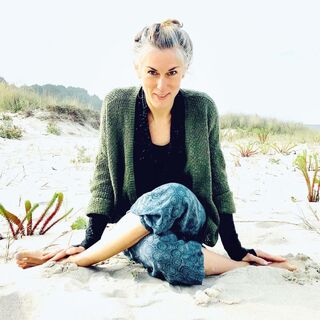
Make your way into shoelace.
Bend your right knee and bring the right heel toward the outer edge of the left hip.
And then cross the left knee over the right,
Stacking your knees as best you can,
Allowing the left foot to come toward the outer right hip.
If your sit bones feel uneven,
You might sit up on a folded blanket to support the pelvis in a more neutral position.
There's no need to force the knees to stack.
Instead,
Allow gravity to begin to organize the shape.
You may choose to remain upright or begin to slowly fold forward,
Resting your forearms onto a bolster or block or the ground.
And once you arrive in your shape,
In shoelace,
We begin to access the dense fascial tissues along the outer hips,
Thighs,
And glutes.
These structures are part of the lateral line,
A fascial pathway that travels from the outer ankle up the side of the leg,
Through the hips and waist,
And into the ribcage.
Over time,
Through repetitive load or postural habit,
The fascia along the lateral thigh can become thick and less pliable as we settle into this asymmetrical shape.
We apply a gentle sustained stress through the outer hip and into the fibrous sheath of the IT band.
Allow the weight of the pelvis to descend naturally towards the earth.
The breath remains unforced.
Stay here for a few more moments.
And slowly begin to rise,
Letting the head be the very last thing to lift.
Gently begin to unwind your legs and prepare to move to the other side.
Begin to bend your left knee this time,
Drawing the left heel toward the outer right hip.
Then gently cross the right knee over the left,
Allowing the thigh to be a little bit wider.
To stack in the opposite configuration.
You may remain upright or slowly hinge forward,
Resting your forearms onto props if available.
As you settle into stillness,
Notice the line of sensation through the outer right hip and down the lateral edge of your thigh.
You might imagine the outer hip like a tightly wrapped spiral of fabric.
That spiral begins to soften.
Allow your pelvis to feel heavy.
Let gravity do the work.
Invite the breath to move naturally through the side body.
I will let you know when it's time to transition.
Taking your time,
Slowly rise back up and unwind your legs.
You might extend both legs out in front of you,
Now allowing your heels to rest heavy on the mat and come to lie down.
Pause here.
Notice the rebound.
Perhaps a warmth,
A tingling,
Or a subtle spreading sensation through the outer hip and along the side of the thigh.
This is the moment where fluid begins to return to areas that have just experienced a slow,
Steady stress.
As the pressure is released,
Fresh hydration seeps back into the connective tissue,
Restoring elasticity within the fascial web.
Simply notice what sensations arise.
And when you're ready,
Hug both knees in toward your chest,
Allowing the low back to broaden across the mat.
Remain still here,
Or sway from side to side,
Massaging the low back.
Now,
Cross your right thigh over the left,
Wrapping the legs as though you were tying a knot.
You might hook your right foot behind the left calf,
Or simply allow the thighs to rest,
One on top of the other.
From here,
Shift your hips slightly to the right,
And allow both legs to fall over towards the left.
Extend your arms out in a soft T-shape,
Or it may feel good to reach them overhead,
Or even let them land on your body,
One hand resting on your heart,
The other on your thigh.
You might place a bolster or cushion between your knees,
Or beneath your thighs,
To reduce any strain,
And make the shape sweeter.
And once you arrive,
Become still.
In this twist,
We begin to access the spiral line,
A fascial pathway that wraps around the body in an opposing diagonal sling,
Connecting one shoulder to the opposite hip.
As gravity draws the legs down,
A gentle rotational load is applied through the obliques,
The intercostals,
And into the spinal fascia.
This creates a subtle ringing effect through the connective tissue of the trunk,
Encouraging decompression along the sacroiliac joints,
And restoring glide between fascial layers.
You might imagine the fascia of the torso like the fibers of a woven cloth,
Through this slow twist.
A cloth is spiraled,
Ringing out areas of stagnation,
And inviting space between the threads,
Let the weight of the legs be heavy,
And invite your breath to move into the side ribs and low belly.
And when you feel ready,
Gently draw your top knee back towards center,
Unravel your legs,
And return to a neutral position.
You might pause here,
With the soles of the feet resting on the mat,
Or draw your knees back in toward the chest.
Notice the rebound.
Perhaps a sense of spaciousness across the low back,
Or a subtle wave of sensation moving through the waist and ribcage.
As the rotational load is released,
The fascial tissue of the trunk begins to rehydrate.
This quiet pause allows the connective matrix to reorganize.
Simply receive.
And when you're ready,
Cross your left thigh over the right,
Wrapping your legs in the opposite direction,
Shifting your hips slightly to the left,
Before allowing both legs to fall gently toward the right.
You might place support between your knees or beneath the thighs.
Explore the position of your arms,
Finding the sweetest place for them to land.
As you settle,
Notice the spiral line of sensation that travels from the outer hip,
Across the waist,
And into your ribcage and shoulder.
Allow the back body to feel heavy.
The jaw is soft,
And the breath natural and unforced.
Rest here for another minute or so.
Slowly begin to draw your legs back to center.
Unravel the lower body and make your way into Shavasana.
You might place a bolster beneath your knees or a rolled blanket under your ankles,
Allowing the back of the pelvis to feel spacious and supported.
Let your arms rest beside you,
With the palms turned softly upward,
And allow your eyes to close.
After the slow,
Sustained stress on the fascial tissues,
This is where the integration begins,
In stillness.
The fascial system moves into its rehydration phase.
Without any effort,
Fluid begins to return to the connective tissues.
That have just been gently compressed and wrung out.
You might imagine your body now like a sponge placed back into water.
It begins to expand.
Allow the weight of your bones to be received by the earth.
The skin softening.
The breath natural.
With each breath,
Letting go of any residual holding.
We'll remain here for another minute.
Begin to deepen your breath.
Inviting a small amount of movement back into your fingers and toes.
And when you feel ready,
Gently bend your knees and roll to one side.
Take your time.
As you press the earth away,
And slowly make your way up to a comfortable seated position.
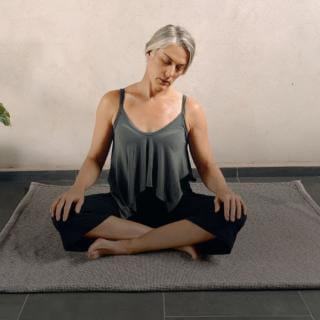
Let your hands come to rest on your thighs or knees.
And allow the spine to rise naturally,
Without rigidity,
Without effort.
Closing your eyes or softening your gaze.
Notice now,
The subtle internal landscape of your body.
Perhaps a sense of spaciousness.
Or a quiet warmth,
Moving through the hips,
The spine,
The side body.
After this slow dialogue with the fascial web,
The nervous system has settled.
The body reorganized around a new sense of support.
Take a moment to simply observe.
Just sitting and noticing.
You might become aware of the gentle rhythm of your breath.
Moving through the low belly,
The ribs,
The chest.
Or the quiet tug of gravity between the hands.
Or the light energy beneath you.
Allow yourself to be still here,
For a few final breaths.
And when you feel ready,
Gently blinking the eyes open.
Thank you for practicing with me today.