Welcome.
I'm so glad you're here.
Restorative yoga is not about stretching,
Building strength or flexibility.
Rather,
We support the poses with props so the nervous system can shift into rest and the body can recover.
You'll need one bolster or a firm,
Long pillow,
Two blankets,
One folded and one to cover yourself.
Two yoga blocks or thick books if you don't have blocks,
And optionally an eye pillow.
Take a moment now to gather everything you'll need.
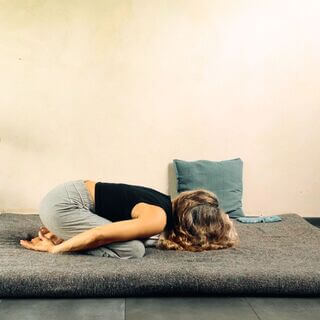
And let's begin in a supported child's pose.
Place your bolster lengthwise on the mat in front of you.
Bring your big toes to touch and let your knees open to about the width of the bolster.
Now lower your torso along the length of the bolster.
Your belly,
Your ribs,
Your chest resting down.
Turn your head to one side.
And let your arms drape naturally alongside the bolster.
If your ankles feel any pressure,
Take your blanket and tuck it underneath them.
If your hips don't reach your heels,
Slide a folded blanket between them.
There should be little to no stretch or strain.
And when you feel completely supported by the props.
He comes still.
With your belly resting on the bolster.
Feel each breath moving through you.
Like a gentle wave.
I don't need to do anything here.
To stay with your breath.
If thoughts come,
Just let them pass.
Like clouds in a vast sky.
Very gently turn your head to the other side.
When you are ready,
Press your palms down and slowly walk yourself back up to a kneeling position.
No rush.
Now slide the bolster behind you so it lies about a foot away from your lower back,
Perpendicular to you.
Bring your two blocks within reach,
One for each knee.
The bolster should be snug behind your low back.
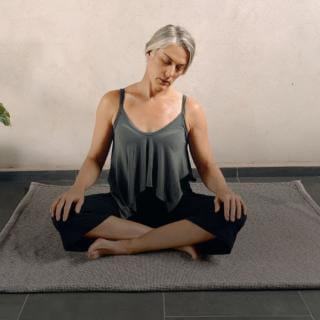
Bring the soles of your feet together and let your knees fall wide.
Before you lay back into supported reclined butterfly,
Place one block under each knee.
Without support here,
The inner legs will feel stressed and a deep stretch.
Muscles to relax.
Now lower your back down onto the bolster.
Let it support your spine.
From the lower back all the way up through the shoulders.
Your head should also be supported.
And it may feel better to prop it a little higher with a folded blanket.
Your arms may rest on the floor at your sides.
Several things begin to unfold in this shape.
The bolster creates a very gentle backbend.
Which opens the front of the chest.
Reversing hours of forward rounding.
As your chest broadens,
Your breath naturally deepens.
Without any effort on your part.
At the same time,
Your psoas,
The deep hip flexors that tighten with chronic stress.
Are being given permission to release.
That muscle holds tension like a fist.
This pose asks it to open.
This combination,
Chest open,
Hips released,
Body fully supported.
Is one of the most reliable ways to activate your parasympathetic nervous system.
The rest and digest response.
You may feel warmth spreading into the inner groin and belly.
You may feel almost nothing.
It's also perfect.
Begin to bring your knees back together.
Feet flat on the floor.
When you are ready,
Roll slowly to one side.
And press yourself up to seating.
Take your bolster or folded blanket and bring it close to a wall,
About a foot away,
Parallel to the baseboard.
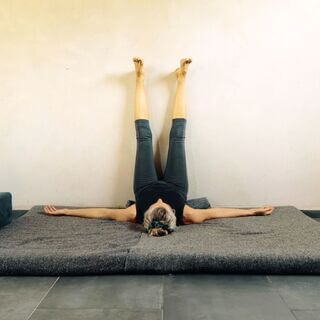
We're going to set up for a supported inversion.
Your support needs to be just close enough to the wall that your sacrum will rest on it once you swing up.
Sit sideways and then in one smooth movement swing your legs up the wall.
The bolster should sit underneath your sacrum,
That flat triangle bone at the base of your spine.
If you feel sensation in your low back,
Slide slightly away from the wall or reduce the height of your support.
Feet can be hip width apart or together.
Whatever feels most natural.
You may want to place a folded blanket under your head if there's any tension in the neck.
Let your arms rest alongside of your body.
Or on your belly.
Settling into the natural rhythm of your breath.
Legs above the heart is one of the most nourishing things we can do in a restorative practice.
When your legs are elevated,
The blood and lymph that pools in tired ankles and feet begins to flow and drain.
And the change in blood pressure from this position sends a parasympathetic signal to the brain.
Your heart rate slows.
Your breath slows.
Your body receives the message.
All is well.
I can rest.
This is the practice.
Has your legs become empty of effort?
Notice how the muscles relax.
If the backs of your knees feel tight,
Soften them slightly.
Or we go a little further away from the wall.
Slowly prepare to come out of the shape.
Bend your knees.
Plant your feet on the wall.
And gently roll off the bolster to one side.
Pause on your side for a few breaths.
And when you are ready.
Press up to a seated position.
Take a moment here to notice.
By taking this time to do nothing.
Something has happened.
How does that shift feel in your body?
A deeper breath.
Less tension in the body.
A quieter mind.
Restorative yoga works quietly.
You may not feel dramatically different.
But your nervous system is carving out new pathways.
And over time.
The body learns to return here.
A little faster.
Thank you so much for practicing with me.
If this was useful,
I'd love to see you in the next one.
Take good care.