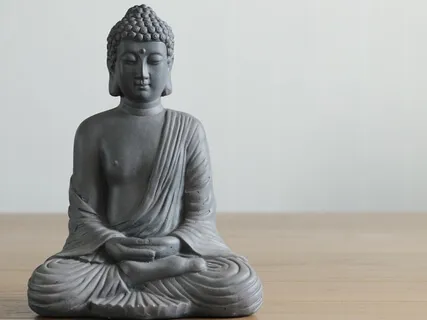
Those who practice meditation seriously inevitably experience that this practice has nothing esoteric or romantic about it.
On the contrary,
From time to time it may prove extraordinarily difficult.
Already more than 2500 years ago,
Buddha stated that in the course of meditation practice,
One can become acquainted with different unhealthy states of mind.
In daily life as well as during meditation,
We are inevitably confronted with some states of mind which in Buddhist psychology are called the five obstacles,
Also called inhibitions.
They prevent a successful meditation by distorting or even preventing the insight into the true nature of things according to Buddhism.
5 Obstacles in Buddhist Psychology Doubt is shown in meditation in inner sentences like I don't know if I'm doing it right.
Is it really something for me?
How is that supposed to help me with my problems in everyday life?
2.
Unrest.
Also impatience,
Restlessness,
Agitation,
Excessive interest in something or someone else.
Sentences like hopefully the children don't make a mess at home or my colleagues have to do all the work this week without me actually show the unrest within you.
3.
Letagy.
Also fatigue,
Sleepiness,
Dullness or boredom.
That could lead to sentences like I could fall asleep on a spot or man that's boring.
4.
Resistance.
Also alternatively you could say rejection,
Dissatisfaction,
Irretelibility,
Refusal and hatred.
That could lead to sentences like the instructor has an annoying voice.
5.
Desire.
Also want,
Longing or greed.
That could lead to sentences like I'm hungry.
I'd like to be in town shopping now.
I need a coffee,
A cigarette now.
And similar sentences.
Exploring the 5 obstacles of Buddhist psychology is all about not feeding the obstacle by building resistance to it.
On the other hand we shouldn't give in to it either.
Instead it is recommended to explore the obstacle in all its physical,
Emotional,
Cognitive and driving aspects.
The principle of dealing with difficulties is recognize,
Name,
Balance and let go.
Recognition means not suppressing anything and building up no resistance against the things you cannot directly change,
The inevitable,
By recognizing with a clear mind what is happening in the present moment.
Naming means to give a name to the experience and to classify which obstacle it is about.
Balancing means returning to the balance of natural harmony and avoiding extremes.
Letting go means not getting into a problem but accepting that reality at the present moment is different than one would like it to be.
And on a final note,
Overall you can say it makes sense to act with wisdom.
That means to develop a solitary way of dealing with these difficulties in order to grow from them.
The more we get used to this way of dealing with difficulties,
The more we use this ability to cope with our everyday problems.