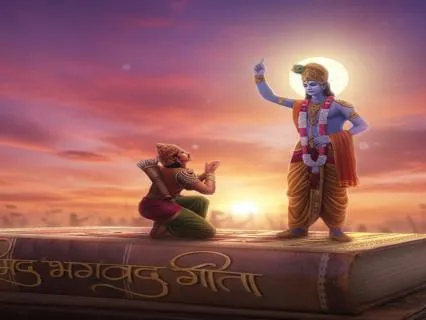
So we are reading from the Bhagavad Gita.
And the Bhagavad Gita is a beautiful story of each of ours journey of truly understanding who we really are.
We've lived in a world where we've sort of been taught all kinds of limited truths,
Philosophies,
Ideas by society,
By culture,
By our families,
By the church.
And almost all of these beliefs are very limiting.
Some were created in order to control us.
Some were created maybe even to try to keep us safe,
Say things from our parents.
Yet they went inside and became truths.
They became rules inside of us.
And now all of a sudden all of these little rules and structures and frameworks are all inside of our hearts.
They're all inside of our minds.
And we're walking through life and things happen and we suffer.
It could be even something as simple as you were raised in a family that believed that you took one job and you did that job until you retired and you got your pension.
And now this teaching was likely because it created stability.
You know maybe in a post-depression time that it's like if you can get a good job,
Hold on to that job,
You are good to go in your old age because maybe they saw people suffer in their old age.
But all of a sudden this can become a rigid idea that even if you're in a job that you don't like,
You're afraid to leave.
Oh but the security of this job and I've already put in 12 years here.
How could I leave it now?
Like this is so important.
You could have the same idea about relationships.
That the best thing you can do,
You know,
It's like going to all these 65th wedding anniversaries and the people are miserable.
And like the couple,
They've been miserable for 40 years.
But we celebrate the longevity of the relationship.
And then here you find yourself in a relationship that isn't going anywhere.
And for whatever reason,
Communication is broken down.
And you're faced with this situation that says,
Well,
Like it or lump it,
This is your lot.
You're not going anywhere.
And then you just quietly die inside.
But you've been raised with this idea that you cannot leave.
And a lot of this part of the Gita is about the fear of death,
The fear of the end of things.
And at this point in the story,
Krishna and Arjuna are our main characters.
And Arjuna is a hero.
You are Arjuna.
Krishna is God,
But also Krishna is your highest self.
And you are in the middle of a battlefield.
And the Bhagavad Gita lives within the great Mahabharata epic of India,
Where there are battling families within a kingdom.
And if you're new,
We have a playlist called the Bhagavad Gita under my profile.
And the very first talk,
The introduction,
I go into a lot of detail about that family feud.
So even if you want to listen to all of them that come up to this,
That's great.
But that first one might be really helpful to kind of understand the context of this great battle.
But of course,
The battle is within us.
The battle is within all the parts of us that struggle to let go of our culture or our family traditions,
Or what we learned through church or what we learned through pain.
Sometimes what we've learned didn't come from other people.
But maybe if we've had a hard enough go,
We start to develop opinions about things.
I got married when I was 23.
My husband was 24.
And we were married for 20 years.
We had two children,
We bought a farm,
All the things.
And I developed a lot of opinions about men in those 20 years.
I had a little book written in the back of my heart.
Ah,
Well,
Men always do this.
And men always do this.
And in-laws always do this.
And farming is like this.
And why wouldn't I?
Why wouldn't I have these opinions?
And then 20 years later,
We separated,
Divorced.
And I started dating other men.
And I started to realize that those truths that I had developed weren't true.
They were true,
Not only of the man I was with,
But more importantly,
That was true in the relationship between me and the man I was with.
I was a player in how he acted,
Responded,
And all those things.
Some things were just him.
Some things were a function of us.
So we develop these ideas about life.
And then there comes a point where we hit a dark night of the soul.
That all the things that we have accumulated,
That we believe to be truths,
Suddenly come crashing down around us.
They don't work.
Everything we thought was right isn't right.
And we have no idea what to do.
And that's where Arjuna is.
He's on the battlefield.
He's looking around.
And he's like,
I don't want to fight.
I'm done.
I'm sick of it.
I don't want to fight you.
I don't want to fight you.
I'm just going to slump down here in my chariot and give up and watch Netflix,
Essentially.
So we are now in a discussion between Krishna and Arjuna,
Where Krishna is saying,
There's another way to look at things.
Try this vantage point.
Try this idea.
Maybe these things that you're coming from,
These ideas you're coming from,
Really don't suit you.
And they're really not true.
So for the last few stanzas,
Krishna has been really talking about the nature of the Self.
And if you take Self with a capital S,
This is you.
This is your highest Self.
To be clear that your personality,
Your human self is not a lower self.
In Tantra,
They see reality like,
Let's say you begin with oneness,
Shiva Shakti.
And Shiva Shakti,
For some reason,
Who knows why,
Separates.
Shakti becomes manifest divinity,
And Shiva remains up here in unmanifest divinity.
This is us.
We are Shakti.
Shakti is all things.
Shakti is us.
Shakti is the trees.
Shakti is health,
Sickness,
Sunshine,
Rain,
Snow,
Catastrophe,
Joy,
All the things.
Shakti is pure manifestation.
Shiva is pure potential.
So if you were to imagine,
They'll often say things like,
Manifestation is the grossest version of reality.
Now in no mean do they mean disgusting.
Grossest means most manifest.
That's what it means.
It means there is more divinity per inch than you can fit into a bottle.
You know what I mean?
Like this is pure divinity walking around.
This is us.
We are pure manifest divinity in the most physical manifest form.
We are all a miracle.
Every one of us,
Every cell of our body is a miracle.
That's who we are.
That's our Juna.
And yet,
Each of us also has access to Shiva,
Pure unmanifest potential.
And Shiva energy is not all involved in the world.
Shiva energy doesn't get a cold.
Shiva is pure unmanifest divinity.
Now there is some interesting insight there.
It's like talking to a friend and you're really lost in the weeds of whatever you're going through.
And you talk to a friend that's sort of objective about what you're going through.
It's not that they don't care.
And it's not that they don't think you shouldn't care.
But they're objective enough to be able to say,
I see what you're going through.
But let's try to turn this table around a little.
That's what Krishna is doing for our Juna.
And that's what our highest self,
Our least manifest self,
Our most spiritual self versus our most physical self does for us.
Every time we sit down and we meditate,
Every time we sit down and journal,
Every time we do yoga or do some kind of spiritual practice,
It helps us connect with that pure unmanifest self.
So that hopefully we can see some insight to help us in our physical world.
Because this world that we're in,
This is where we're meant to be.
We are manifest,
We are here.
We're meant to get caught up in the weeds and feel the emotions.
That's why we're here.
If you really care about this thing,
And are really passionate about that thing,
And you are healthy,
And then you're sick,
And then it's sunny,
And all the things,
Then you are exactly right on track as a human.
And yet,
Sometimes we get caught because some idea has come into our mind that isn't right.
It's like a little bit of poison,
Or a little bit of something that needs to be rooted out so that we can continue on with our journey.
So today we are focusing on chapter two,
Verse 29.
And I'm going to back up a little bit to get to the one we're looking at.
It,
And when he says it,
He means the Self,
The capital S Self.
It is called the inconceivable,
The unmanifest,
The unchanging.
If you understand it in this way,
You have no reason for your sorrow.
Even if you think that the Self is perpetually born and perpetually dies,
Even then,
Arjuna,
You have no reason for your sorrow.
Death is certain for the born.
For the dead,
Rebirth is certain.
Since both cannot be avoided,
You have no reason for your sorrow.
Before birth,
Beings are unmanifest.
Between birth and death,
Manifest.
At death,
Unmanifest again.
What cause for grief in all of this?
So at this point,
He changes his tune a little,
Because Arjuna is just still struggling.
And this is the verse we're going to look at.
Some perceive it directly in all of its awesomeness.
Others speak of it with wonder.
Others hear of it and never know it.
I'm going to read a couple other versions.
One sees him as a wonder.
Another likewise speaks of him as a wonder.
And as a wonder,
Another hears of him.
Yet even on seeing,
Speaking,
And hearing,
Some do not understand him.
Now that's from Maharishi Mahesh Yogi,
And in his interpretation,
He's always speaking of the Lord,
However you interpret that.
That's why he's saying him.
And then we've got Paramahansa Yogananda's version.
Some behold the soul in amazement.
Similarly,
Others describe it as marvelous.
Still others listen about the soul as wondrous.
And there are others who,
Even after hearing all about the soul,
Do not comprehend it at all.
What comes to you when you hear that?
Or if there are certain words that stand out for you?
Relief.
That it's okay to not know the entirety of it all.
That it is a mystery.
Not knowing the soul,
Does that mean not knowing the self?
That's a great question.
We'll talk about that.
The smallness of me cannot comprehend the greatest of it all.
No need for sorrow.
Seeing,
But not really seeing.
Listening,
But not really hearing.
Can't comprehend the mystery.
To be here now.
Seeing is believing.
Didn't Wayne Dyer have a book that played on that?
Something like,
You'll see it once you believe it,
Or something like that?
Believing is seeing.
This is a very interesting stanza,
Because what he's basically saying is,
Very often we see divinity,
But we don't see it.
Sometimes we can listen to a teacher talk about divinity,
But we still don't,
It doesn't change us.
You know,
We can listen all we want.
We can read all the books.
We can listen to someone who's had like a near-death experience,
Or someone who's touched God in some way that's sort of this miraculous thing,
And yet we walk away unchanged.
Unchanged.
And this is the common experience.
But what's interesting is it's a problem of syntax,
That in grammar you can say,
I see a dog.
I am the subject.
The dog is the object.
I see the dog.
I throw the ball.
The ball is an object.
So when we're trying to understand the soul,
The self,
The divine being within,
Within,
Our language trips us up.
Because I'm trying to understand the soul.
I'm trying to understand the self.
And the self,
In this instance,
Is an object.
It's something out there.
But the problem is,
It's not an object.
It's the subject.
I am the self.
I am Atman.
I am the thing I'm trying to observe.
That's where our brain gets kind of screwy.
It's like an eye trying to see itself.
Or your teeth trying to chew your teeth.
You can't do it.
And that's where we get in trouble.
That's why,
No matter what we read or hear,
As long as we perceive it outside of me,
I'm already wrong.
This is why a true spiritual path isn't about learning information.
It's about recognition of the self.
It's about realizing that you are all the things.
The observer becomes the observed.
Exactly.
Exactly.
And there's a few challenges with this.
First,
The brain just can't sort it.
And we're very accustomed to the brain trying to sort things.
Which is why we practice meditation.
Because as soon as we meditate,
We close our eyes.
But this is also the challenge to not have an object in your meditation.
And I understand there's lots of meditation processes that you stare at a rose or stare at a candle.
You know,
I get it.
But if you just close your eyes,
And you breathe deeply,
The goal is to release all the thoughts that are trying to make all this subject,
Object,
Grammar,
Trying to get the world to make sense.
And actually just rest in the breath.
And not just rest in the breath.
Rest in the one breathing.
And so someone asked,
Robin asked,
Not knowing the soul,
Does that mean not knowing the self?
Now,
What the soul is,
Is an interesting question.
And I'm not sure it's answerable.
But some would say that the self is observing the soul.
We know the soul.
Like if I think of Katrina Boss,
I might think that I am,
This is the current incarnation of this soul's journey.
You know,
That this soul is limited in some way.
Like that my soul isn't necessarily your soul,
That your soul also is on an interesting journey.
But the self,
The big S self,
That lies beneath all of us,
Is the same.
And that's the interesting shift to understanding that.
But one of the great challenges of knowing the self in this way,
One of the great challenges with this,
Is that through religion,
For over 5000 years,
We've been taught that there was something wrong with us.
That we were not one with God.
That God was something out there that the priests could connect with,
Or that the gurus could connect with,
Or that some enlightened beings could connect with.
But the common person was just here to suffer and toil away.
And in our modern day,
We see it in education,
That,
Oh,
Well,
Those people,
They've studied a lot.
Like they're like Sanskrit scholars,
And they've been to India.
And they've been practicing yoga for 30 years.
Like,
Who am I to experience Atman,
Compared to all these people?
This is a huge challenge.
And the truth is,
All of those experiences,
And all of that education,
And all of that reading,
Often becomes a real barrier to the experience that Krishna is describing here.
That education can actually get in the way,
Because it's strengthening the mind.
It's strengthening the stories.
It's strengthening the constructs.
I remember one time,
I was doing a course over Zoom.
And everybody there,
They were all pretty high intellectuals.
They all were coming out of the David Bohm world,
You know.
And the guy teaching it,
Who I thought was fascinating,
He said,
Okay,
We're going to have a conversation about this,
Whatever the topic was.
He says,
But I don't want us to use any constructs.
Constructs.
So we're not going to talk about how this shows up in astrology,
Or the chakras,
Or samskaras,
Or epigenetics,
Or whatever structure we have adopted in order to understand the world.
We're going to leave those all at the side.
And we're just going to talk from our center.
Fascinating shift in discussion.
Because suddenly,
You have to let all of those limitations aside.
The structures can be helpful.
God knows I'm a super head,
You know,
I'm kind of an egghead.
I like all that.
But if we want to experience the divine,
If we want to experience the all encompassing oneness that we are a part of,
Our mind is not only our most limiting factor.
Well,
It's our most limited factor,
And our most limiting.
Because we will try to understand it.
So the reality is,
Even if you are brand new to spirituality,
You don't know a single word of Sanskrit.
And you are like,
Yeah,
Well,
It's going to take me a long time to really be able to figure this out.
100% not true.
Because what we are studying,
What we are trying to connect with,
Runs through every single one of us.
Every single one of us is this supreme greatness.
The key is to simply release anything that makes us think we're less than that.
So what are the ways we can do this?
It's funny,
I got together with my teacher.
So when I was 29,
I was sick.
I had breast lumps,
And a man came into my life,
And I wrote books all about our journey together.
And I had a miraculous healing and all that.
And he was who I consider my very first teacher,
My real spiritual teacher.
Because you would sit with him,
And he really was not looking at the same world that you were looking at.
He was really something else.
And we went out for lunch a few months ago.
And he said to me,
And normally we just sort of chit-chat about life and whatever,
Unless there's something juicy going on,
Which there was.
I was talking about a health issue I was having.
And he said,
Katrina,
You have to remember that you are oneness.
You don't have to return to oneness.
You are oneness.
But the challenge with that,
With a lot of us,
Is we were taught that God is good.
The divine is only beautiful sunrises,
And miraculous babies being born,
And springtime.
That it's not everything.
And this is extremely limiting.
So one of the practices we can do to truly open ourselves to the expansiveness of oneness is to close our eyes.
Let's close our eyes for a moment,
Wherever you are.
And I want you to imagine a difficult situation.
Maybe a difficult argument with someone,
Or a difficult family dynamic.
And I want you to see yourself,
And see the emotions that you have in that moment,
And the thoughts and everything.
But then I want you to back up a little.
Almost like allow your soul body to just back up.
And observe the whole situation.
Notice the person you're struggling with.
Maybe notice other people in the room.
Notice the house that you're in,
Or the yard that you're in.
Notice the pictures on the walls.
Notice everything.
This is reality.
Reality is all the things.
It's all the neutral things,
The challenging things.
It's your response.
It's their response.
It's your belief systems.
It's their belief systems.
It's all a oneness.
And when we can hold that,
And actually observe it all for what it is,
We get to start to experience more.
More.
You can open your eyes if your eyes are still closed.
We limit ourselves when we only can see our position.
And again,
In no way am I talking about putting up with bad behavior,
Or not having boundaries,
Or anything like that.
But life changes when you start seeing all the people in your life also as confused souls trying to do the best job they can.
I could be sitting here with my partner,
And be really frustrated with him.
If I'm frustrated,
I've probably been triggered.
Or I'm angry because he's done something that I don't think is okay.
But it's a fascinating thing to kind of just close your eyes and take a few breaths,
And notice the home that I'm sitting in.
Notice the weather outside.
Notice the picture on the wall that he bought me.
Notice the plants that I'm taking care of.
Just to slow down and feel ourselves in the wholeness.
And what it does is it brings clarity.
It brings clarity to the moment.
Because we're not so limited.
And again,
It doesn't mean you're gonna,
I don't know,
Give up the fight or whatever you want to call it.
But there's something about broadening your eyes to allow for all the things.
But it's very overwhelming.
It's very overwhelming to do that.
Imagine you're sitting in a,
If you've ever sat in a very difficult family discussion.
You know,
I've certainly had it in my own family.
Mostly,
I think,
Because my mom died when I was young,
When I was 25.
And my dad's had a couple of wives who were lovely in their own right,
But they were different,
And they weren't my mom.
And so that caused strife over time.
You know,
And eventually,
There were always moments with both of them,
That the family came to blows.
Because I have two sisters,
We all have children,
We all have,
There's a lot of personalities.
So it's interesting sometimes,
When all tensions are high,
And everybody's freaking out,
To be able to stop and look around and see all the people and the surroundings and everything that's going on.
But you can feel your brain kind of exploding,
Like,
Oh,
I don't even think I could function if I was going to take all that in.
This is the oneness.
And it's fascinating to be able to release enough of our own perception to expand and expand and expand.
And so this brings us to the last point.
The only way,
Or at least one way,
To really allow ourselves to be super expansive,
To include all the things,
Good,
The bad and the ugly,
Is really cultivating wonder in our lives.
What if you don't have to understand everything?
What if you don't have to map it?
What if you don't have to have names for it,
And labels and all the things?
What if we walk around,
And we just spend any amount of time,
Today even,
And you look around the world,
And you see a tree,
And you realize,
You have no idea how that tree was made.
You don't understand the first thing about the journey of the seed to the tree.
We can observe it.
It's the same thing,
Right?
You can see a tree growing.
You can hear people talk about how a tree grows.
You can listen with all your might about the intricacies of the biology and all of the labels we've given all those pieces of the tree.
But if we really want to understand the tree,
We have to sit beside it,
Quiet our mind,
And experience something.
There's no words to describe the miracle of that tree.
And let's imagine that today's not a sitting with the tree thing,
But you walk along,
And then you see a house.
And inside this house are all these lives,
People trying to connect with God,
Trying to pay the bills,
Trying to find love,
Trying to know what they want to do in life,
And interacting with each other.
And then you see the grass growing,
And then you see a bench,
And then you see a dog,
And then you see a person,
And you realize that you are absolutely surrounded by miracles.
Surrounded by them.
They are like just coming at you.
And even if you just sit on your porch and don't even move,
Because that's too much,
Then a hummingbird is just going to fly up and sit there in front of you to just say,
Look at you and say,
No idea about me either.
I like no idea.
The greatest thing we can cultivate is this childlike wonder inside,
Where we're like,
Whoa,
A hummingbird.
Whoa,
That's the most beautiful tree ever.
Whoa,
Look at this human in front of me.
Wow.
Isn't this crazy that we came to earth,
And we got to meet each other?
Isn't this crazy?
Can you imagine living with that kind of miracle?
That kind of wonder all the time?
And so this is why they always say that when we study deep practices like this,
This is where humility comes.
And humility isn't a weak state.
Humility is this awareness.
It's like at the beginning of class,
I talked about how in Shiva Shakti reality,
Shiva is unmanifest potential.
And Shakti is pure manifest divinity.
Every dog,
Every tree,
All of us,
We are pure manifest divinity.
Humility is like resting in that,
Resting in the fact that we are the result of a miracle.
It is so beautiful,
All the things that have become manifest here.
And that should touch us deeply.
That's humility.
We don't even pretend that we can know everything,
Can know everything.
We can learn all kinds of fun things.
But the deep stuff,
The really deep stuff,
And by deep,
I don't necessarily just mean spiritual studies.
I mean anything to do with ecology,
Humanity.
If you look at the earth,
The ecosystems,
A forest,
An ocean,
These are all filled with manifest divinity.
No matter how we label the fish and try to figure out what that tree does after a forest,
Fire,
We have no idea.
A forest is a miracle.
The oceans are a miracle.
And there is such great joy inside being able to say,
Well,
I know that we call that creature a puffer fish,
But I know nothing about a puffer fish.
I can even tell you what I observe at eating,
But I have no idea how it fits into the grand scheme of creation.
Deep topics could be anything to do with humanity.
Imagine if for some miracle,
All of us here all got together.
Some miracle just dropped us all in a little village because there's 160 people.
So we need a village.
That would be complex.
Even though we're all friends,
We're all chit-chatting,
We've all come together to explore the Gita,
Every single person here is a unique being on a fascinating journey.
We have quirks and hangups and joys and skills and all the things.
Can you imagine what that would be like?
But imagine all of it.
Don't imagine the good.
Imagine all of it.
Now we're holding reality.
All the things,
The wonder,
The challenges,
All the things.
The best thing we could do in our little village is to embrace our own humility,
Embrace our own place in it and say,
I have no idea what's going to come of all of this,
But what a thrill to get to be a part of it.
Isn't this exciting?
And someone over there is like,
Yeah,
Well,
You know,
And someone over there is like,
I don't know if I can do this,
But that's all of it.
But all you can do is be you.
So it's a fascinating thing,
Cultivating humility to be able to say,
Yeah,
I know these are just labels.
I'll keep searching.
I'll keep looking.
It's like even another person.
It's one of the things that,
You know,
I've been with my partner now for four years,
Just over four years.
And we're both real pleasers,
Right?
We're both always trying to be nice and optimistic and everything,
Which is awesome.
But what happens is sometimes we start to adapt too much to the other person.
And we both sort of stop each other and say,
Hey,
I don't want you to change for me.
I want you to be you because I want to keep discovering you.
I want to keep discovering who you really are.
I don't want to know who you are after you've adapted to me.
I already know me.
Well,
Actually,
I don't even know me.
I'm still discovering me.
I want the opportunity.
This intimacy we have is an opportunity to deeply discover you and you are an infinite well.
That's what I want to do.
So I will reread our original piece.
Actually,
I want to reread Paramahansa Yogananda's.
I like his the best.
Some behold the soul in amazement.
Similarly,
Others describe it as marvelous.
Still others listen about the soul as wondrous.
And there are others who,
Even after hearing all about the soul,
Do not comprehend it at all.
Well,
Thank you,
Everybody,
For being here.
This has been great.
We'll see you guys later.