So today we are reading from the Bhagavad Gita and I am specifically reading from Stephen Mitchell's version.
Today we're reading chapter 2 verses 18 and 19.
So I'm going to back up and read a little bit ahead of time.
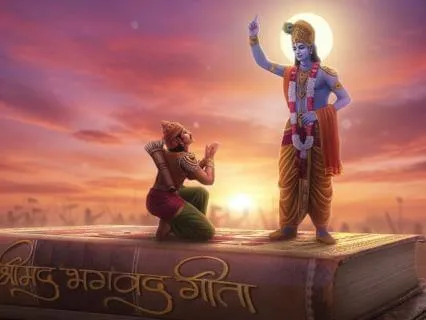
So the context is that Krishna and Arjuna are in the chariot on the battlefield.
Time has kind of stood still while Arjuna listens to Krishna as Krishna helps him,
Giving him guidance and really teaching him about the true essence of living.
Arjuna feels very lost because in the battle there are the Kauravas,
His cousins,
His hundred evil cousins,
And then the Pandavas,
His family,
Or his brothers.
And the side that Arjuna is on is what you could have imagined as the side of you,
Your highest self,
Your courage,
Your hope,
Your dreams,
Your gifts,
And your clearest thought.
And not in a negative way,
Like not in an intellectual way,
But in a,
Where does your soul really want to go?
You might even call it your Dharma,
Your true life's path.
And the other side,
The Kauravas,
His evil cousins,
They represent all the aspects of us that kind of drag us down.
They could be teachings that we received over our lifetime that taught us that maybe we weren't good enough,
Or that life was horrible,
Or that people can't be trusted.
Maybe there are our addictions or attachments to our senses,
You know,
The things that we want,
The food that we can't get away from,
The booze,
The drugs,
The cigarettes,
The gambling,
The,
I don't know,
Endless hours on Netflix.
Who knows?
Whatever it is that we are lost in the sensory world.
And Arjuna is feeling lost.
And sometimes,
Like,
We all feel like that.
Like,
Why,
Why am I so caught up in my addictions?
Why am I so caught up in my,
The dramas of my life?
You know what,
It's easier just to not fight at all.
I'm just gonna stop arguing and fighting and doing all the things.
I'm just gonna flow in life,
Because you know what,
Forget about it.
It's not worth it.
And that's kind of where Arjuna is.
And it's kind of where we can often find ourselves.
So at this point,
Arjuna has argued all he wants to argue.
He has given up.
And he has said to Krishna,
Please help me.
I need a new way of understanding the world.
So I'm just,
I'm going to back up to about verse 13.
And Krishna says,
Just as in this body,
The self passes through childhood,
Youth,
And old age,
So after death,
It passes to another body.
Physical sensations,
Cold and heat,
Pleasure and pain are transient.
They come and go.
So bear them patiently,
Arjuna.
Only the man who is unmoved by any sensations,
The wise man,
Indifferent to pleasure,
To pain,
Is fit for becoming deathless.
Non-being can never be,
And being can never not be.
Both these statements are obvious to those who have seen the truth.
The presence that pervades the universe is imperishable,
Unchanging,
Beyond both is and is not.
How could it ever vanish?
So here are the two verses that we're going to look at today.
These bodies come to an end.
But that vast embodied self is ageless,
Fathomless,
Eternal.
Therefore,
You must fight,
Arjuna.
If you think that this self can kill,
Or think that it can be killed,
You do not well understand reality's subtle ways.
All right,
I'm just going to reread the two verses again that we're looking at today.
If you want to go back,
We have classes on all the previous ones that you can listen to.
These bodies come to an end.
But that vast embodied self is ageless,
Fathomless,
Eternal.
Therefore,
You must fight,
Arjuna.
If you think that this self can kill,
Or think that it can be killed,
You do not well understand reality's subtle ways.
And to know that self,
When he's mentioned it twice here,
Are both capitalized.
So it's not the small self,
It's the big self.
I'm going to read the Maharishi Mahesh Yogi's version as well.
So beginning verse 18.
These bodies are known to have an end.
The dweller in the body is eternal,
Imperishable,
Infinite.
Therefore,
O Bharata,
Fight.
He who understands him to be the slayer,
And he who takes him to be the slain,
Both fail to perceive the truth.
He neither slays nor is slain.
So we're going to look first at the first one.
We're going to look at verse 18.
These bodies are known to have an end.
The dweller in the body is eternal,
Imperishable,
Infinite.
Therefore,
O Bharata,
Fight.
Bharata is just another name for Arjuna.
So this is really interesting.
On the surface,
When you think of our physical bodies,
We know that our physical bodies change.
You know,
When you think of your body when you were five years old,
Then think of your body when you were 14 years old.
And then think of your body when you were 30.
Think of it as how old you are right now.
And then imagine it 30 years from now.
There's an anxiety in there.
As I say it,
And I think of myself of my body in 30 years,
And I'm like,
There's this,
What's that gonna feel like?
Oh,
Is it going to be painful?
Is it going to be hard?
Am I going to be okay?
There's a fear caught up in change.
And it's interesting because when we think of the body,
Say up until this point,
We know that change is normal.
And all change doesn't necessarily mean bad.
I may be in the best shape of my life by the time I'm 80.
Like,
Who knows?
Maybe I've finally given up all my addictions to the foods that harm me.
Who knows?
But it's interesting how we've been almost trained to be afraid of change.
Why?
Why are we so afraid of change?
Well,
There's a lot of reasons.
You know,
And we've talked about this in the last couple classes.
For example,
Our world puts a lot of emphasis on the world we can see,
Hear,
Touch,
Smell,
Taste,
To the point that we think that the physical world around us is what's real.
In last week's class,
We talked a lot about how the changing world has no reality at all.
It's always changing.
What's real is what's inside.
It's like,
I remember reading a story and there was a teacher and he had a piece of paper.
And he asked the students,
You know,
What is this?
And they said,
Well,
It's a piece of paper.
And he said,
Is it?
And he folded it into an airplane and then he sent it across the room as a paper airplane.
He says,
What is it now?
He says,
Well,
It's an airplane.
He said,
Is it?
And then he took the piece of paper and he folded it into a box.
He says,
What is it now?
Well,
It's a box.
I thought it was an airplane.
Well,
No.
And then he took the box and he crumpled it into a piece of paper,
Into a ball and chucked it into the waste bin.
He said,
Now what is it?
And they just like stared at him.
In the end,
It's just paper being formed into all these different aspects.
So in that example,
What's reality is the paper.
So if you imagine us and you think of what is reality and what is all the constant changes.
So when you even think of your own body,
We have these neurons,
We have blood,
We have lymph,
We have thoughts,
We have skin,
We have a heart,
We have all these things.
They're always changing.
But the cosmic wisdom that formed this body right from the get-go is always here.
One of the things that blows my mind is the idea that a sperm and an egg come together and they create an embryo.
And that embryo begins as one cell or two cells.
And now all of a sudden they start to replicate.
They replicate into identical neurons.
And then all those neurons start to form in different ways.
These ones start to become liver cells.
And these ones start to become brain cells.
And these ones start to become hair.
And these ones start to become this.
These were identical cells replicating,
Taking on different roles in our body.
What?
We can't fathom the intelligence of how we were formed in utero.
And then we were born.
That same wisdom,
That same intelligence keeps our heart pumping,
Keeps our mind flowing,
Allows us to grow and change and age and experience all the things in the world.
It never changes.
That same wisdom,
That same cosmic intelligence is still moving us when we're 90 as when we were 9.
This is so mind-blowing.
I can't just,
I can't fathom it.
But this is us,
Inside of us.
There is a,
As the Maharishi Mahesh Yogi says,
There is a dweller within that is unchanging.
In Sanskrit,
In these teachings,
They talk about how there is the Atman.
And the Atman is our eternal,
Unchanging self.
Our Atman is like the cosmic god living within our individual self.
It's like our own part of that whole,
The Atman.
But it never changes.
This is this indwelling.
Who you are is Atman.
It's not an external god that's taken up residence.
It is the essence of who you are.
And then there is the Jiva.
And the Jiva is essentially you as an entire being.
So Katrina as an entire being,
You know,
Body,
Mind and spirit,
Soul,
That is the Jiva.
It is my current incarnation.
It is my current temporal existence here on earth,
Is the Jiva.
Now the ego is sort of what holds the Jiva together.
It's my specific thoughts,
It's my traits,
It's my characteristics,
It's all the things.
But the ego is what lets me believe that I am separate from everyone else.
That I don't think I'm Bonnie.
I don't think I'm Benjamin.
I don't think I'm that chair.
I am Katrina.
I am.
I am me.
I am different.
So on the one hand,
It's a really important part of being human.
Like if I walk around thinking that I am every single person I see,
What's the purpose of being here?
Then I'm walking around kind of playing god or being all things and all that kind of thing.
It's like,
No,
I am Katrina and I like to do jigsaw puzzles and I like to study the Bhagavad Gita and I like to come and hang out with all of you guys.
And that actually is me.
There's another person that lives down the street that probably wouldn't want to do any of those things.
You know,
If I'm going to have the experience I'm supposed to have,
I have to be separate.
But the problem is,
Is we forget that we are actually also eternal.
It's like we can remember both.
I can remember that I am Katrina,
Who has a particular role to play here on earth and a series of experiences to have.
But what if I could also remember that I am also eternal?
You know,
One way of understanding it is,
Imagine that the Atman is the ocean.
The Jiva is the wave.
I am a wave above,
I'm a wave of the ocean.
The ego makes me think that the wave is separate than the ocean.
The Atman is the ocean.
The Jiva,
Who you are,
Is a wave,
Part of the ocean.
The ego makes me think that the wave is separate from the ocean.
So in this verse,
It's like the wave is building,
Building,
Building,
Building,
Building,
Building,
And it's going to crash.
And now we have this fear as a human that,
But it's going to end,
It's going to end,
It's going to end,
I don't want to end,
I don't want to end.
Because we don't understand that when the wave crashes,
We're still just the ocean.
And this is a really important thing for us to grasp.
Because a lot of our fears are based in our fear of change,
Our fear of death,
Our fear of,
What if I don't find my right path in this lifetime?
What if I don't figure it out?
What if I don't solve this problem?
What if I don't fix my health problems?
What if I don't achieve the success that I'm supposed to achieve?
What if I do achieve it,
And then I lose it?
Or what if I find my perfect person,
And I mess it up?
Or something happens to them?
Like,
We have so much anxiety about change.
You know,
And I teach Kundalini Yoga.
And in Kundalini Yoga,
There's a mantra that we chant,
And it goes,
Sa-ta-na-ma.
And sometimes we do it with our fingers,
Like we put our index and thumb tips together for sa.
And then we go to the middle for ta,
And then the ring for na,
And the pinky for ma.
And we go sa-ta-na-ma,
Sa-ta-na-ma.
And it's a very,
Very common meditation.
Sa means the eternal energy of the universe.
Ta is birth.
Na is change or death.
And ma is rebirth.
This is the cycle of life.
Birth,
Or rather,
Eternity,
Birth,
Change or death,
And rebirth.
But because we have been so focused on the outside world,
And we've been taught that this is everything,
Especially in a materialistic culture.
There may be cultures out there who deeply cultivate the inner world.
But in a world where we're taught,
You have to have this kind of relationship,
You have to have this kind of job,
You have to make this kind of money,
You have to have this kind of community,
You have to have achieved all these things,
You have to do.
.
.
Well,
Of course we have attachment to the outside world.
Of course we have attachment to change and death.
Because we've been taught that this is everything.
I remember Wayne Dyer used to tell this story.
Wayne Dyer was a huge part of my life when my mom was sick,
Like 30 years ago.
And he used to tell this story about this.
I think it was his brother-in-law.
And I may tell the details of the story wrong.
But his brother-in-law had a near-death experience.
And of course Wayne Dyer was fascinated by this.
So he goes over to his sister's house.
Again,
It could have been friends,
I can't remember the story.
But he goes over to his sister's house,
And the house is wild.
Like the kids are just climbing the walls,
And there's music playing,
And those people over there are fighting,
And those kids are laughing,
And everybody,
It's just like all the things,
And the dogs,
And the cats,
And it was just wild mayhem.
And he looks over in the corner,
And the brother-in-law who had the near-death experience is sitting in the corner on the easy chair,
And his legs are kicked up,
And he's just watching it all.
And Wayne Dyer says to his sister,
Wow,
You know,
What's with Bill?
And she just looked at him and kind of smiled,
And she says,
Ever since his near-death experience,
He has the big picture.
What if we walked around always knowing the big picture?
What if we walked around knowing,
I really am an eternal being.
We all are.
We're all here having an experience.
We're all here playing specific roles,
But we're all essentially the same.
Everybody here in this class right now,
We're listening later.
We're all the same.
I remember the first time I ever went to a naked beach down in Jamaica,
And I was terrified,
You know,
Because of all the same weird attachments we have to our bodies and things.
And once I got over myself and I looked around,
Everybody kind of looked all naked.
I realized that everyone just sort of looked like plasticine people.
Like if you just took a blob of plasticine and squished them into all these different shapes.
Some were tall and skinny.
Some were round.
Some had big boobs or little boobs or big butts or little butts.
Some people were shaped like pears.
Some were hourglasses.
Some were triangles.
And I just kept looking at all these bodies.
They were all beautiful.
I love naturist places because you see the beauty in everybody.
But we're all made of the same stuff.
You know,
There's just something about it.
So imagine how different life would be if we deeply connected to that inner self.
And this is where I think meditation is a beautiful way to do it.
You sit down,
You close your eyes.
And one of the parts of the eight limbs of yoga is pratyahara.
And pratyahara says,
Withdraw from the senses.
This is why we close our eyes.
Pull in.
Don't think about what you can hear,
What you can feel or what you can see or anything like that.
Go within.
Feel the quiet inside.
Connect with your eternal self.
Can you imagine,
Let's just say,
I'm not saying we should do this.
I'm just saying what if you spent an hour every day in pratyahara in some way.
Maybe it's lying in the tub with your eyes closed.
No music,
No podcasts,
No video games,
No nothing.
You're just lying there.
And then maybe later you spend 20 minutes in silent meditation.
Again,
No music,
No talking,
No nothing.
Just quiet.
It's fascinating how hard this is.
This is why,
You know,
Insight Timer is brilliant for having all of the guided meditations.
You know,
I have guided meditations on here.
Because we need to slowly learn how to quiet our mind and feel that inner quiet.
And even while you're listening to a guided meditation,
Listen to the words and at the same time feel your inner quiet.
It's like listen to the words while you feel the depth of your ocean.
The more we feel the depth of the ocean,
The less emphasis we put on the waves.
And it isn't that we aren't supposed to live.
We are.
But we need to cultivate the connection to the ocean.
This is the real thing.
So just to imagine that in your own mind right now.
To feel inside that eternal self.
That that eternal self will still be here later.
It'll be here beyond this life.
In the next life.
We don't have to be afraid of change.
The next part of this teaching,
I'm just going to re-read this one because I know that some people have just joined.
So verse 18.
These bodies are known to have an end.
The dweller in the body is eternal,
Imperishable,
Infinite.
Therefore,
Oh Bharata,
Oh Arjuna,
Fight.
So this is really interesting.
Because sometimes when we go on a spiritual path,
And we start to feel like this disconnection to the world.
Like we are all eternal.
All is well.
I don't have to do anything.
I don't have to get a job.
I don't have to face those demons inside.
Because you know what?
I am an eternal being.
We kind of get lost in this weird spiritual apathy.
And it's like,
No,
That's not true.
That's spiritual bypassing.
The reality is every single one of us has stuff inside.
Fight.
And again,
Not in a mean way.
But what he's really saying is engage.
Take part in this.
If there are things,
If there are aspects of your thoughts that are dragging you down,
You know,
If there are,
They call them downward pulling aspects of the ego.
If there are aspects of you that kind of make your life a living hell.
Because your mind is swirling and twirling on this one thing over and over and over again.
It can't let it go.
Engage with that.
Look at it.
Go deeper.
Heal.
Sort it out.
That's what he's saying.
Don't let the senses override you.
This is the other side of the battlefield that he's afraid to fight with.
He's afraid to fight because he saw his relatives there.
Specifically,
He looked at Bhishma.
Bhishma was his grandfather.
And the grandfather represents tradition,
Memory,
All the ways that it's always been.
Engage with those things.
Ask yourself,
Do these things suit me?
Do they serve me today?
Do they take me to the places that I want to go?
And if they don't,
Battle.
Engage.
Do not lie passively.
Because if we lie passively,
They will just take over.
And we will not end up living the life we want to live.
We will not live our dharma.
We will live this weird life of our ancestors,
And we'll get lost in it.
So we must engage.
Another person he saw on the other side of the battlefield was Drona.
And Drona was his teacher,
His martial arts teacher,
His weapons teacher,
Whatever.
And these are all the teachers we've ever had in our life,
Positive or negative.
The teachers that we want to show that we are good students.
We did a good job.
We're successful.
We made the money.
We got fit.
We got the perfect family,
Right?
We did it.
We did it.
Are we still trying to impress them?
Or what about the teachers that hurt us?
What about the ones that taught us that maybe life isn't fair,
And you can't trust people,
And you know,
Nothing good ever happens to me.
I am doomed to this life of pain and misery.
It's just the way it is.
And their voices are deep in our minds.
If we are apathetic with these voices,
Guess who wins?
Guess who just steamrolls right over us?
We must engage.
We must battle.
And I know the word fight and battle.
We don't like them.
I don't like them.
It's like,
No,
It's too violent.
I don't like it.
But that's how all of these ideas in our mind win.
We have to.
And what's wrong with it?
We have to get over the things that we have in our head that says,
No,
No,
No,
I'm a peaceful person.
I'm not like that.
It's like,
Stop it.
Or else these tanks of the past are going to roll right over the life you want.
This is what happens.
All of these weird attachments of our ego,
They just take over like a plague.
So it's okay to muster ourselves.
It's okay to gather and say,
You know what?
I want to make a change.
I want to turn my life around.
I want to think differently.
I don't want to relive that again.
That was your life.
I'm going to live something different.
But there's something in us that has to wake up and just say,
I'm willing to fight this.
You know,
If we've ever tried to create a new fitness routine or eat differently,
Or I don't know,
Meditate every day.
If we say I'm going to meditate for 10 minutes every day,
There is something in us that actually has to fight against inertia or fight against our patterning to make it happen.
And if we are in denial about that,
Guess who doesn't meditate every day?
We have to wake up to the power of these hundred evil cousins.
There's a reason that in the battle,
There's a hundred evil cousins and five brothers of the good.
Because that's what it feels like in us.
So it's really,
Really interesting to engage.
And it's okay.
We don't have to be afraid.
If we let go of that old tradition,
If we let go of what that teacher taught us,
We'll be fine.
That cosmic wisdom,
That cosmic intelligence that created us is always here.
And it is us.
We just get to walk forward in whatever is coming.
So that's verse 18.
Brothers versus cousins.
Yeah.
The whole other world.
And so then the next one is interesting.
And we're just going to take all that.
So we're engaging.
But we're going to take it,
Or do I want to?
No,
We're going to leave it there.
We're going to change gears here.
I was going to do 18 and 19.
But I think we're going to save 19 for next week.
Let's just stay with 18.
These bodies come to an end,
But that vast embodied self,
Capital S,
Is ageless,
Fathomless,
And eternal.
Therefore,
You must fight Arjuna.
I would love to hear what you guys think.
I would love to hear what that feels like inside,
The struggles that come up,
How you want to take this forward.
I think it's so important.
But I would love to hear what you think.
Or even how you feel.
What does that feel like?
Does it feel scary?
Does it feel impossible?
It feels like the truth.
Yeah.
It's empowering.
Be your conscious creator.
I feel optimistic.
Yes,
Fight,
Fight,
Fight.
We can all do it.
Nothing is permanent.
It feels enlightening.
I get this image of shaking someone by the shoulders saying,
Wake up,
Remember who you are.
Totally.
Rage against the dying of the light.
Yes.
That is what has kept me going these last seven years of drastic change.
I don't want to lose that fight.
There is freedom in the fight.
It feels like permission to let go.
The door is open,
Not closing.
I must fight inertia.
The older I get,
The harder it is.
So ever since we started this Gita journey,
And I really dove into all of the different aspects of this,
Oh man,
This idea of fight,
The word just kept rubbing me the wrong way.
I can understand in the world there's all kinds of endless war and fighting.
I get it.
I get why we don't like the word.
But at the same time,
Deep inside,
Don't you ever just want to have the freedom to just,
I don't know,
Be in one of those boxing classes and get one of those big nerf swords and just hit stuff and people?
There's this warrior inside of us that we've been taught to push down.
Don't fight with your brother.
Don't fight with your sister.
Don't do that.
Don't argue with people.
And I get it.
I'm the first person to say we have to be kind to each other.
If you want to have a deep connection,
You have to be kind.
But what if there are things that we need to engage with?
In life,
Do I want to fight with my partner?
Absolutely not.
I want to find the peaceful path.
But inside,
If there's aspects of me that are harming me,
Then I get to play with that warrior,
Lady,
Trying to work out a balance between wu wei and the fight.
Isn't that the truth?
I feel like I'm much bigger than the stuff.
There is really nothing to worry about.
I love kickboxing.
I'm tired of fighting.
I prefer acceptance at this point.
I've done fighting for decades.
I think of tilt versus fight.
Oftentimes,
A tiny tilt can get the rocket to go to a completely different space.
That's beautiful.
Let's do it.
Have so much fun.
I love to jump on the trampoline.
It feels like a challenge that I can win,
But it's going to be hard to fight for yourself.
I feel strange.
Fight sticks in a hard way.
Words like impossible feel like where I've been at for months.
I prefer wrestle.
It seems more personal.
See,
This is why it's good to have everybody's perspectives.
It rounds it out and makes it real.
I feel like I need help with this.
I get stuck in the spiritual apathy,
Like everything's okay no matter what,
Versus nothing really matters.
Explain it to my friend who is about to have eyelid surgery because he thinks it'll make him more attractive.
How to disengage from physical aspects and see that he is completely beautiful already,
But I can't do it for myself.
Isn't that true?
The key is to fight towards,
Not against.
For me,
Fighting is more about determination.
There's so much fighting going on in the world right now,
It's exhausting the people.
I hear that.
Fight against versus fight for.
I've done two peaceful protests this week.
I felt love and peace and joy and empowered.
Beautiful.
Makes me think of Aikido,
The way of the harmonious spirit.
Maybe building instead of fighting.
Tired,
Exhaustion,
Dizziness,
Bleeding,
Fighting feels impossible.
Fighting others while protecting them from injury.
We are the light just by being in gatherings.
It's so interesting.
Isn't this interesting?
The diverse experiences here.
This is so important.
Everybody's perspectives is so important here.
In the research that I'm doing for my book,
I'm really into the prefrontal cortex,
Part of our brain.
The prefrontal cortex is interesting because it is where stories live.
It's where the unreal lives.
It's where imagination lives.
It's where teachings live.
It's where everything,
It's where language maybe on some level lives,
Not all.
But what's interesting is,
So for example,
One guy says that this is where the mythologies of our life live.
So the ideas of nationalism,
Of religion,
Of the family stories,
All that kind of thing,
They all live in our prefrontal cortex.
They aren't real.
They're an idea that collectively we all agree on and then we live within it.
This idea of fight or battle is a concept.
It's something in our mind.
Sure,
If someone comes up to me and they punch me,
That's a real thing.
But the truth is they punched me.
How we interpret that,
We don't want to get into all that.
But what we're talking about here is this curious word fight.
And so for some people,
They have had to fight their whole life against others,
Against whatever.
And they're tired,
Tired of fighting.
For others,
There's a deep belief in there is a peaceful way.
There is the Wu Wei space of doing,
Not doing,
Doing.
These are all real.
There are also ways,
And so what I can tell you from my own experience and why I think it touches me personally,
And I'm only telling you this because every single one of us has a unique experience with the idea of fight,
The idea of peace,
The idea of conflict,
The idea,
Every single one of us.
So what I'm going to say isn't true.
It's just my experience.
And every single person here has your experience in your prefrontal cortex in your life.
So for me,
I will fight for people.
I will fight for others.
I genuinely generally don't fight for me.
And when I say fight,
I don't mean fisticuffs and being mean to people and all that.
I'm saying I don't defend me.
I don't protect me.
I will you,
I'll protect you till the end of the world,
But I won't protect me.
And what's interesting is that pattern that I have out in the world is the same inside of me.
And so if there are aspects of me that maybe come from my ancestors,
That come from the world around me,
That come from my own,
I don't know,
Desires or whatever,
I won't fight for me.
I'll let them win.
I'll let the world win.
And I'll just sort of roll over because it doesn't matter.
You,
I'll fight for.
Me,
Not so much.
And this is how I take this teaching.
How you take it is important that it's perhaps very different than me.
But for me,
I'm like,
You're worth fighting for,
Katrina.
You're worth letting these old ways go.
And to me,
That's what Krishna's saying.
Keep trying.
Find a way.
Maybe there's another option.
Because the challenge with apathy,
Or not just apathy,
But the feeling of being defeated,
That I've already been defeated.
And sometimes that's why we don't fight,
Why we don't engage.
Because I don't think I can do it.
Well,
Krishna would say,
There's always another way.
Ask for more help.
You don't have to fight warp speed and baby steps,
100%.
My daughter and I were talking yesterday,
And she was reading the book,
Atomic Habits,
By James Clear.
And he was talking about how,
If you have a ice cube,
And I am paraphrasing,
I'm repeating what Taylor told me,
So I may not be telling this correctly.
But if you have an ice cube,
And you want to melt it,
You might put it in an oven and start to raise the temperature.
Well,
Just because you turn the oven on,
Doesn't mean the ice cube melts.
The oven has to increase in temperature by degrees.
And it will keep increasing,
And keep increasing,
And keep increasing,
And keep increasing,
Until all of a sudden it reaches the temperature that the ice cube melts.
You know,
And those are the baby steps that Kris mentions.
What are the baby steps we can take?
And it's okay if it doesn't resolve right away.
Maybe the oven has to go for an hour.
Who knows?
Or 20 minutes.
Or maybe the change we want to make might take five years.
But we just start making steps now.
But we always stay engaged.
We always stay here.
Thank you,
Everybody.
See you later.