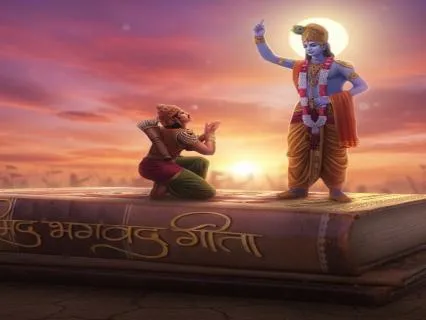
So today we are reading from the Bhagavad Gita.
This particular version is by Stephen Mitchell but it doesn't matter if you want to follow along or if you'd like to have a version of the Bhagavad Gita.
There are hundreds and hundreds of beautiful versions.
It doesn't really matter which version you have.
The Bhagavad Gita is a story of our inner journey.
It's a story of Arjuna standing in the center of a battlefield and in the battlefield are all the things that he struggles to let go of.
It's also the battle of good and evil and if you're new to this I highly recommend I have a playlist called Bhagavad Gita.
The very first lesson I go into great detail about the foundation of this great battle within the battlefield of the heart.
So the two main characters of our story are Arjuna our hero who is also you and me and then there's Krishna and Krishna is his charioteer but he is also God or the Lord or your highest self your highest wisdom within every one of us our own divinity.
And Arjuna has come to a place in the battle a place in life where he doesn't know how to go forward.
He doesn't want to fight.
The analogy is all about fighting and he doesn't want to battle because he sees so many loved ones on all sides of the battle he thinks what's the point?
And of course taken literally you know that's one discussion but when we understand this as part of our personal journey this is like stand those moments in life when you're standing there and everything you've ever learned from your family is on one side.
Everything you truly want to achieve in this life and experience is on the other.
On the side where you're everything you learn from family maybe it's old trainings from church maybe it's experiences you had that you believe that you know and we all do this.
We develop ideas about life that may not be true like for example I got married when I was 23 back in 1993.
I was married for 20 years and in those 20 years I could have written a book about what men were like and it would have been based on my husband.
We bought a dairy farm,
His family's dairy farm.
His family was around so there were also his brother and father and the men folk that worked on the farm you know.
Between them and my own father and maybe a boyfriend I had in university I had a pretty clear idea about what men were all about and I could have told you exactly how they don't show up for you and how they this and how if you don't do it nothing will ever get done and someone was disagreeing with what I was saying.
It was an amazing thing after I divorced and I started dating other men.
I started doing a lot of personal healing that I realized that everything I had developed about what I believed about men wasn't true.
That was true for the men I had met.
It was also true for the woman I was who interacted with those men.
As I changed different men came into my life.
As different men came into my life I changed and today you know I've been divorced now for I don't know 10 years,
11 years and I have an absolutely different perspective.
What I believed then is maybe still true for a lot of people,
Not just men but a lot of people.
But my belief is bigger now and this is often what happens.
We end up in a dark night of the soul because for good reason we've developed beliefs about the world,
Beliefs about people,
Beliefs about ourselves.
Maybe we believe that we're not good enough for anything.
You know maybe we believe we're never going to actually achieve what we want to achieve because teachers told us that or comparison to siblings or other people in school or our parents or whoever.
But it isn't true.
Maybe we believe that we have to achieve great things.
Maybe you were an A student in school and your parents expect you to save the world and all things must matter and so you reach a point in your life where you're so burnt out because you don't believe you're ever allowed to sit on the couch and close your eyes and relax and you have a dark night of the soul.
So that's where Arjuna is.
He's at a turning point in his life that he's just I don't know how to go forward from here and he turns to Krishna and he says please help me.
And so the rest of the Gita is basically Krishna undoing the training that he's had up until this point and replacing it with a new way of looking at the world.
You know for me you know lots of you guys have heard this but when I was 21 I was sick.
I had breast lumps.
My mom had just died of breast cancer.
I had little kids.
I was extremely burnt out.
It was probably my key dark night of the soul.
I mean we have lots of them in our lives.
And a man appeared in my life who became my first spiritual teacher.
He wasn't you know if you looked at him you'd certainly not think he was a spiritual teacher but this man lived in the world differently.
He saw the world differently.
He saw me in a way that no other human had ever seen me.
I remember the first time he had done my energy grid which is something he taught me later and he looked right into my eyes and he said what are you doing?
You are so far off your path.
And I cried and cried but he saw me.
And it's very interesting to meet someone who doesn't seem to be living in the same 3D reality that you are and yet they've got a job and maybe they're married or maybe they have kids or their gym was as normal as you get.
I mean he had three children.
He had a farm.
He had a tree farm.
He also cropped organically which is how we met him.
He went hunting with his kids and played darts with the boys and yet he was this amazing teacher.
And so it's interesting to be able to open to a teacher like that which is where Arjuna is.
He's open.
He's ready for a new way to live in this body,
On this earth,
In this consciousness.
So today we're looking at chapter 2 verse 30 and starting in verse 11 Krishna began a journey of trying to unpack this fear of death because Arjuna was like well I'm afraid I don't want to kill anyone.
And none of this is all about it's okay to go kill people.
That's not the point.
But it is about understanding the nature of life and the nature of death.
And so for example I'm just going to give a little summary here.
So since verse 11 Krishna says wise men do not grieve for the dead or the living.
There was never a time when we didn't exist.
Just as we change our clothes our soul passes from body to body.
Physical sensations come and go.
But the presence within is imperishable and unchanging.
Our true self,
Capital T,
Capital S,
Cannot be pierced,
Burned,
Or affected by the elements.
But the soul within that is eternal is very hard to experience.
Some people experience it directly,
Some people talk about it,
But it's actually difficult to fully embrace.
So today's verse is the summary of all that.
And after this Krishna goes on to a different teaching.
So verse 30 says this self,
Capital S self,
This self who dwells in the body is inviolable forever.
Therefore you have no cause to grieve for any being,
Arjuna.
I'm going to read you a couple of other versions of that guy.
He who dwells in the body of everyone is eternal and invulnerable,
Oh Arjuna.
Therefore you should not grieve for any creature whatsoever.
And then,
Oh Arjuna,
The one who dwells in the bodies of all is eternally inviolable.
Grieve not,
Therefore,
For any created being.
What does it feel like inside when you imagine that you always have this infinite,
Invulnerable soul within?
Almost like there's two of you.
There is the personality,
The human that has all of the relationships and wonder and fear and plans and everything.
But there is also an infinite you in the same car.
What does that feel like to walk down the street knowing that it feels intangible at the moment?
It's not easy.
I want to know this self.
Like a wide,
Expansive experience.
It makes taking hard things a bit easier.
It feels sad that some of those souls have left us,
But happy we will unite again.
I want to believe in the infinite self,
But uncertain.
So the fact that it's hard is right.
It's correct.
But I feel free-ish.
The way I feel it,
And this is just the way I see it,
So to fully understand that how your soul interprets this is all that matters.
But whenever I think of living in duality,
You know,
Living the life of Katrina Boss in Godridge,
Ontario,
Canada,
Cat sitting for her daughter for this week,
Here with you guys on Insight Timer,
This is me in my three-dimensional physical being with all my personality and hopes and dreams and blocked ear from sickness.
You know,
It's just me.
My brain can understand all that.
My brain is part of that world.
It's designed to create a life in duality,
In maya.
So my brain can define all of that for you.
My brain can navigate all of that.
It can drive a car and it can go grocery shopping and it can read the Bhagavad Gita.
But when we talk about ourselves as infinite beings,
As divine beings,
As immortal,
Invulnerable beings,
That's not here in duality.
Duality is designed in a birth,
Change,
Death,
Rebirth cycle.
It's designed for that.
But inside that cycle or permeating that cycle is this infinite playing field that we are.
We are also this infinite playing field,
This infinite essence.
But it's not in duality.
Like if for us to access that infinite space,
We can't do it through our brain.
We can't do it through touch,
Smell,
Hearing,
You know,
We can't do it through anything like that.
So this is why it feels a little hard to grasp.
And yet,
We've learned to feel it.
We've all had moments where we touched it.
Moments where the hair stood up on your back for some reason.
There might be a song that you love to listen to,
That for some reason,
We might say that it transports us out of this world,
Out of our thoughts.
You might love lying in the grass.
You know,
For me,
It's cold here in Canada,
And spring is toying with us,
Like it was snowing yesterday again.
So every so often,
A few days ago,
It was warm.
The sun was shining.
We still had coats on,
But the sun was shining.
And we were walking along,
And all of a sudden,
The heat of the sun got into my back from the coat.
And it was like my whole being just stood still,
Like I left time and space as I felt this heat permeate my body.
You could be sitting in meditation,
And you close your eyes,
And you feel different.
There's an opening.
You know,
It's that Leonard Cohen saying,
You know,
That it's in the cracks that the light gets in.
And we've all had those little moments.
They might be big moments.
They might be small moments.
But we all can experience them.
But what we begin with is even allowing it to exist in our mind.
That's the first step.
That,
In a way,
That's helpful in the world.
Like for me to just say,
Go out and have a transcendental experience with nature,
And then you'll be better.
Like,
In the land of things that we cannot plan or force,
Experiences of oneness is definitely one of the big ones.
But what we can do is begin with a philosophy.
We can begin with the idea that,
Okay,
Then what if I am both?
What if I am this human who feels and does all the things as we should,
But I also am this infinite being?
What if it's true?
Whether I feel it or not,
Whether I have an intimate experience with it or not,
It doesn't matter.
You know,
We've believed a lot of things in our lives without having necessarily concrete proof of it.
So how does this help?
Well,
Let's say you're having a difficult time with someone.
If we are completely,
If we only believe that we are this body,
This personality,
This being,
I might tell you,
Here's what happened to me.
Here's what they did to me.
See what they did to me?
See what happened?
And again,
I'm not saying that we shouldn't heal trauma and all that.
Obviously,
We should.
What if it's the 50th time we're talking about it?
And the reality is,
We're stuck.
We're stuck in a thought.
We're stuck in a thought that someone else did this to me,
Which gives them,
Alive or dead,
Present or not present,
All the power looping by the ego exactly.
It gives them all the power and we can do nothing except replay this memory.
So now all of a sudden,
Let's imagine that you just say,
Hold on a minute.
I am a divine being having this physical experience in this moment.
So really what happened is this experience happened within this being's time here.
It's almost like suddenly you get to watch it and see the players.
But then you start to realize that,
Wait a minute,
There are more players.
There's a lot of people in this game.
It's not just me and it's not just them.
There's many,
Many things happening.
And I believe that this ability has a lot to do with what they call the fifth dimension.
We talk a lot about that,
Depending on the circles you run in,
That the world is moving from 3D to 5D and all that kind of thing.
I am a mathematician at heart and originally,
Professionally.
And so I think of things mathematically.
And so if you imagine what a dimension is in mathematics,
It's like you have a line and then two lines intersect.
And that makes like a,
They call it a plane,
Like a two-dimensional plane,
Like a sheet of paper.
And then if you intersect that plane with another sheet of paper,
Now you have three dimensions.
You have a box.
And now let's imagine we take that box and that box is you and I.
That's us in three dimensions,
Length,
Width,
And height.
You can measure us,
You can weigh us,
You can measure our height.
That's the third dimension.
And now let's imagine that we pop out of that and now observe the third dimension.
Well,
I don't know what dimension we're in at this point,
Whether we're in the fourth or the fifth.
I don't know.
I mean,
It's all a mystery,
I think,
As it unfolds.
But at this point,
We are now popping up a dimension and observing ourselves.
This is what the gurus are asking us to do.
They're asking us to say,
Yes,
Live your life.
That's what you're here for.
That's why you incarnated.
But also cultivate the ability to back up and observe the third dimension that you are living in,
To observe yourself,
To observe the other person,
To observe the everybody around you.
How different is that?
So for me,
For example,
My most recent drama is that I'm babysitting my daughter's cats.
And one of her cats is very food-oriented and very cuddle-oriented.
And last night,
He would not take food or be cuddled.
And this really bothers me.
As it should,
Because I'm concerned about her cat and I'm caring for her cat.
I care.
I'm not going to be all like,
Ah,
This is an immortal being.
I'm completely detached from its journey through life.
Like,
I'm not going to do that.
Because obviously,
I care about these cats and I care about my daughter.
But I found myself starting to lose sleep last night about it.
I started to watch my mind start to go,
Well,
What if I wake up in the morning and she's still,
And what if she's passed?
What if,
What if,
What if,
What if,
What if?
And I started doing all this stuff.
And I had to actually stop myself and do that dimensional shift and just pull out and watch myself and say,
Hey,
Why are you spinning?
And I don't know why I was spinning.
I was too tired to really analyze it.
But today,
I may be afraid of something happening and it becoming really expensive for my daughter to fix it.
She's 28.
Vet bills are expensive.
Maybe I don't want my daughter to be hurt because her cat passes away or something.
Maybe I don't want to disappoint my daughter.
What if I would feel eternally responsible for this?
These are all natural things.
But at some point,
I had to pull out of the emotions,
Of the looping,
Of all of it,
And say,
You have to sleep now.
Nothing can be done.
We'll look at it in the morning.
There's a magic there.
There's a magic in being able to back up and observe.
Another really helpful lesson or a teaching from this is about emotions.
The emotions are real,
And they're valid,
And they're important.
But they are not the end point.
They are not the ultimate.
They are not our absolute experience of anything.
And if they become that,
We need to look at it.
So what does that mean?
It means that let's say someone dies or something happens and I feel grief,
Or something happens and I feel angry,
Or I feel sad.
The best thing we can do is feel those emotions for all they're worth.
That's what they're there for.
They're there to be felt.
And we feel them,
And we feel them,
And we cry,
And we rage,
And we journal,
And we eat chocolate,
And we talk to our friends,
And we go for car rides,
And we do whatever it does we need to let it go.
And then it will pass.
Those emotions will pass.
We will not grieve forever.
We will not stay angry forever.
We should not be sad forever.
And I say should,
Which I know is a dangerous word,
But if we have fully felt whatever the feeling is,
It should pass.
And if a year later we are still feeling it,
And depending on the grief,
It's different because we often have to live through a whole year of birthdays,
And celebrations,
And holidays.
But if time goes on and we are still feeling it,
Like imagine something like anger.
Imagine something happened when you were a child,
And you're very angry at a sibling or a parent.
If we are still angry about it 40 years later,
To know that this isn't anger,
This is a mental program that you are replaying.
It's not like,
Well I'm going to be mad at him for the rest of my life.
I'm going to grieve them for the rest of my life.
I'm going to be sad about this for the rest of my life.
This is not living.
This is not moving on.
This is not,
You're not even alive.
You're like,
And this is the brain choosing to create a story that will keep you looping forever.
And those loops will keep bringing up this emotion,
And that emotion will go into your body,
And it will create illness,
And anxiety,
And depression,
And all kinds of things.
So it's very interesting when we really deeply understand again that we are these physical beings,
But we are also eternal beings.
And if you imagine,
Like let's say you find yourself in one of those loops,
Which we all do.
This is not just for the few.
Then we close our eyes,
And we just ask,
Why am I looping in this?
What's going on?
And it gives us a wonderful perspective,
That zooming out,
Yeah,
To zoom out and kind of go,
Why am I replaying this tape?
Why do I want to be mad at this person 40 years later?
Why do I not want to keep living?
Why do I not want to evolve?
Why do I not want,
Why?
And this is really important to healing.
But you need something to pop you out of that 3D,
Almost unobserved state.
And so then part of our journey is actually cultivating a relationship with this infinite self,
Our true self.
And how do we do it?
Well the funny thing is in yoga,
If you're into yoga,
Which I'm sure lots of people here are,
Patanjali sutras are all about this.
And they talk about the yamas and the niyamas,
Which we're not going to get into.
But the first thing they say is,
The first step is,
Or the third step is asana,
Seat.
So you sit,
You sit wherever you are right now.
You can do this right now.
So let's do this.
Let's just go through the last six of the steps,
The limbs.
So wherever you are right now,
Lying down,
Sitting,
Standing,
Really feel yourself on the earth.
Surrender to the seat you're on,
Surrender to the bed you're lying on,
The couch.
If you're driving,
You're not allowed to do this exercise.
So just fully let yourself surrender into your posture right now.
And the next step is to breathe pranayama.
Breathe deeply,
Expanding the belly as you inhale,
Contracting as you exhale.
Close your eyes.
Allow yourself to look within,
But at least close your eyes to all the visual stimulation.
Allow yourself to be comfortable so you're not feeling your body.
Allow the sounds around you to just fall into the background,
Except my voice.
This is pratyahara,
Withdrawing of the senses,
Because the senses are what the physical body responds to,
But not the eternal one.
Roll your eyes up to your third eye,
Or gaze into your heart center.
Find a single point to focus on.
Continue to breathe.
Continue to relax.
Find a single point inside of you to focus on.
That was dharana.
And then allow yourself to just be absorbed into that feeling.
Release yourself into the point that you're focusing on.
Allow your breath to be easy.
Allow your being to be relaxed.
This is dhyana.
And then gently release it all,
Keeping your eyes closed,
And feel this eternal self beyond the senses,
Beyond time and space.
This aspect of you will always be the same.
It was the same when you were six years old.
It will be the same when you are 96.
Everything else changes,
But not this part of you.
And you can slowly return to the physical body as you'd like.
But it's really helpful to return to this state as often as you'd like,
Once a day,
Twice a day.
Maybe you feel it going for a walk in the sunshine.
Maybe you feel it sitting in meditation or doing yoga.
Maybe you feel it swimming or running,
Sitting by a big body of water.
Maybe you feel it just by pouring a cup of coffee,
Sitting in your favorite chair,
Lighting a candle,
And just closing your eyes and smiling.
But this is the true spiritual practice.
That's what a spiritual practice is,
To deeply connect with this part of you.
And then what happens is,
It starts to feel natural,
Even though you can't explain it.
And it's very,
Very,
Very important to not try to explain it,
Because it's impossible.
And so anything we say won't be true.
We will have oversimplified it,
And therefore made it incorrect.
And this is why a spiritual practice is always experiential.
Because that's the only way we can touch it.
We can only touch it with the feeling.
And as we keep cultivating that feeling,
It shows up in difficult times.
It's like it's a little bit more woven into your 3D self.
And all of a sudden,
Something's going amok,
And that little divine thread inside just sort of allows you to take a breath.
And allows you to remember.
And even though you can't explain it,
We remember that there's more.
Which is really beautiful,
Because what it does is it allows us to experience life even deeper.
It isn't that at that moment we become aloof to the situation.
If we're having an argument with someone we love,
We suddenly see the other person again.
And we say,
I really love you.
I really want to resolve this.
Can we back up a little?
Or maybe you're going through a difficult time.
Maybe you're having illness,
Or financial struggles,
Or relationship struggles,
Or who knows what.
The more we practice,
The more woven in this is to our consciousness.
And then it just becomes a little bit easier to say,
Well,
I guess things are changing.
And something new is coming into my life.
Hmm.
All right.
Because one of the beautiful things about this particular teaching—and I know some people have joined in a bit later—this is the final teaching of this.
All of those things out there are transient.
We must focus within.
And I'll actually reread Stephen Mitchell's version from 11 to 30.
But over and over and again,
He says,
So therefore do not grieve.
So therefore do not grieve.
And what's interesting is he's talking about grieving others.
But really,
We're talking about ourselves.
We're talking about redefining our soul.
But he's using other people so that we can look at them.
Because if we deeply understand that we are eternal beings,
Then naturally,
We understand that,
Oh,
And that person is an eternal being.
And this cat is an eternal being.
But we really do have to believe it about ourselves first.
All right.
So I'm just going to reread it from 11 to 30.
And just to know that whenever they say the self,
It's capitalized.
And also to know that sometimes it sounds like Krishna's being really hard on Arjuna.
But you know how sometimes teachers are like that?
That sometimes we need to be shocked a little because we're sort of lost in something?
Although you mean well,
Arjuna,
Your sorrow is sheer delusion.
Wise men do not grieve for the living.
Never was there a time when I did not exist,
Or you,
Or these kings,
Nor will there come a time when we cease to be.
Just as in this body,
The self passes through childhood,
Youth,
And old age.
So after death,
It passes to another body.
Physical sensations,
Cold and heat,
Pleasure and pain are transient.
They come and go.
So bear them patiently,
Arjuna.
Only the man who is unmoved by any sensations,
The wise man indifferent to pleasure,
To pain,
Is fit for becoming deathless.
Non-being can never be.
Being can never not be.
Both of these statements are obvious to those who have seen the truth.
The presence that pervades the universe is imperishable,
Unchanging,
Beyond both is and is not.
How could it ever vanish?
These bodies come to an end,
But that vast embodied self is ageless,
Fathomless,
Eternal.
Therefore,
You must fight,
Arjuna.
If you think that this self can kill or think that it can be killed,
You do not well understand reality's subtle ways.
It never was born.
Coming to be,
It will never not be.
Birthless,
Primordial,
It does not die when the body dies.
Knowing that it is eternal,
Unborn,
Beyond destruction,
How could you ever kill?
And whom could you kill,
Arjuna?
Just as you throw out used clothes and put on other clothes,
New ones,
The self discards its used bodies and puts on others that are new.
The sharpest sword will not pierce it.
The hottest flame will not singe it.
Water will not make it moist.
Wind will not cause it to wither.
It cannot be pierced or singed,
Moistened or withered.
It is vast,
Perfect,
And all-pervading,
Calm,
Immovable,
Timeless.
It is called the inconceivable,
The unmanifest,
The unchanging.
If you understand it in this way,
You have no reason for your sorrow.
Even if you think that the self is perpetually born and perpetually dies,
Even then,
Arjuna,
You have no reason for your sorrow.
Death is certain for the born,
For the dead,
Rebirth is uncertain.
Since both cannot be avoided,
You have no reason for your sorrow.
Before birth,
Beings are unmanifest.
Between birth and death,
Manifest.
At death,
Unmanifest again.
What cause for grief in all this?
Some perceive it directly in all its awesomeness.
Others speak of it with wonder.
Others hear of it and never know it.
This self who dwells in the body is inviolable forever.
Therefore,
You have no cause to grieve for any being,
Arjuna.
I'd love to know where that brings you.
Into my heart,
Deep acceptance.
Strangely grateful for this lifetime.
A sense of calm and peace,
Sincerity,
Stirred emotions,
Wonder.
Today is bringing up my long-held shame and fear.
Awareness is the first step,
Right?
Totally.
Relief.
Gratitude for this incarnation.
He's talking about those hundred cousins,
So many aspects of the self.
Totally.
To just be grateful for that.
Mind and heart are in different places.
Grief is complex.
The war of family cultural beliefs versus these teachings.
Exactly.
A better understanding of my past difficulties and joys and why I'm still struggling.
Thank you guys so much.
This has been wonderful.
Have a wonderful week.
We'll see you guys later.