I see what's going on.
Okay.
All right.
Hi,
Everybody.
It's Judy,
And this is Wake Up Call 546.
We are on Chapter 14 of the Dhammapada,
Which is called,
This chapter is called the Buddha or the Awakened One.
So the last few chapters seem to be about what direction we should point,
What happens when we do and when we don't.
And who can do that.
And then I really love chapter 14 because,
At least to my reading,
It's offering some hows.
Like,
How do we do this?
I was talking with a friend just this week and they were saying that mindfulness is difficult because no matter what books they read,
Even when they include suggested practices,
The how is so elusive,
Coming away with a sense of mindfulness,
But not how to develop a more settled body or a non-reactive nervous system or less reactive or more focused mind,
Or how do you develop loving kindness and compassion?
Or cultivate a mind that defaults to joy for the success of others,
Right?
And so this chapter first names that the one who has learned how is awake,
Unshakable.
So the Thomas Byram and Ram Dass translation says that such a person's eye is open,
Their foot is free,
The world cannot reclaim them or lead them astray,
Nor can the poisoned net of desire hold them.
They are awake and find joy in the stillness of meditation and in the sweetness of surrender.
So my reading this implies the how meditation and surrender or letting go simple but not easy because well,
I don't know about you,
But I know what happens when I sit down.
A lot comes up.
The mind isn't necessarily still.
The body and the nervous system aren't necessarily deactivated.
Something in the larger world or in My individual world arises or some memory arises or the mind begins to plan or fantasize.
So sitting down doesn't necessarily feel joyful or still and surrender may not be possible or it may not feel particularly sweet.
Shreema in her interpretation of this chapter explains why we don't necessarily sit down with our unsettled mind.
We know that when we sit down,
It's unsettled,
But why then do we not sit down?
And maybe the answer is obvious,
But she says,
Often there is a kind of emptiness in the course of life,
An unoccupied moment,
A few minutes,
Sometimes more.
And what do you do?
Immediately you try to distract yourself and you invent some foolishness or other to pass your time.
And this is a common fact.
All humans,
From the youngest to the oldest,
Spend most of their time trying not to be bored.
Right so we sit down and this is this is happening and we're we just don't you know it's hard to look but she says this chapter of the dhammapada is saying when you have a little time whether it is one hour or a few minutes tell yourself at last i have some time to concentrate to collect myself to relive the purpose of my life if you took care to do this each time you are not harassed by outer circumstances And her proposition is that there are plenty of moments when we're not harassed.
And of course she was living in a different time,
But still.
Maybe if we were paying attention,
We would see that there are also plenty of moments.
You would find out that you were advancing very quickly on the path.
So for Shreema finding joy in the stillness of meditation and in the sweetness of surrender is also for her it's the how.
And then Bhairava and Ramdas offer a parallel how kind of emphasizing that Chapter 14 points at the classical teachings of mindfulness.
So it points at the Four Noble Truths.
It points at the Eightfold Path.
They say,
The teaching is simple.
And I always love that when I hear a teacher say that.
The teaching is simple.
Do what is right.
Be pure.
At the end of the way is freedom.
Till then,
Patience.
Offend in neither word nor deed.
Eat with moderation.
Live in your heart.
Seek the highest consciousness.
Master yourself according to the law of mindfulness.
This is the simplest teaching.
The part that jumps out for me about in this part of the how,
Which is a little bit tracking the eightfold path,
Right?
And this is what Gil Fronsdale emphasizes in his translation,
Is the part about patience,
That one word,
And Gil calls it patient endurance.
And he actually translates,
Patient endurance is the supreme austerity.
So for me right now,
And I'm qualifying that because at a different time,
I'm sure I'd be learning something completely different from this chapter.
But for right now you know patient endurance feels like the heart of the chapter patient endurance in relation to meditation and surrender and patient endurance in doing our best to do what's right and pure.
And to me,
This is a special kind of patience,
Right?
It's not a patience that's waiting,
But underneath really wanting things to speed up or for someone to hurry or to do better or change.
And it's not patience,
But we're really waiting for our minds and hearts to be farther down the path than we are,
Right?
So it's not that kind of patience that has grasping sitting underneath it,
Lurking underneath it.
Patient endurance,
What it feels like for me is about staying in the present moment.
So staying with the busy mind,
Staying with the restless body,
The tight heart.
The activated nervous system.
And reminding ourselves that even though our aspiration might be the stillness of meditation and the sweetness of surrender,
Right now it's like this.
So staying with that right now,
Maybe we don't feel well,
Or someone we love isn't well.
Or staying with that right now we have way too much on our plates.
Or staying with how it feels when the weather is too hot,
Or too rainy,
Or too flooding.
Look what's happening in Nepal,
Or too windy,
Or just frankly too scary.
Or staying with how it feels to be living in this political moment.
Or how it feels to be activated,
Or how it feels right now when the world is on fire.
And also.
This moment is like this,
Right now it feels like this,
How it feels when I can help and how it feels when I can't,
Right?
When I can influence things for the better,
When you can influence things for the better,
And when you know there's nothing you can do.
So that's what it feels to me like this chapter is pointing to when it lifts up the quality of patient endurance.
And the only way.
That I know how to get to a point where I remember to practice patient endurance in the middle of the day when things fall apart.
Meaning the only way I remember to say to myself right now it's like this is to practice that on my cushion.
Day after day after day.
And I wish I could.
Tell you I could,
But I can't seem to find a shortcut.
I haven't found a book or a podcast.
Or even a teacher.
That can do more than point me in the right direction.
Which is amazing and I'm so grateful,
But.
If what I want is for patient endurance to show up.
For me in my life,
And that is what I want,
And I really feel like that's what this chapter is inviting us to want,
Then I have to practice every day as much and as often as I can.
Because that way I'm imprinting patient endurance on this mind-body-heart,
And then it shows up.
So the last bit of Shreema's interpretation of Chapter 14 or her advice we could say is,
When you have nothing to do,
You become restless,
You run about,
You meet friends,
You take a walk,
To speak of only the best things you might do.
Instead of that,
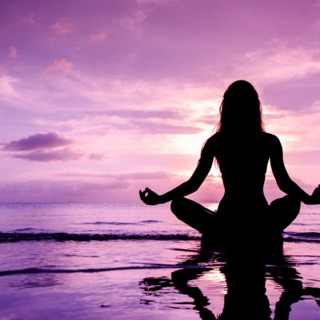
Sit down quietly before the sky,
Before the sea,
Or under trees,
Whatever is possible,
And try to realize one of these things,
To understand why you live,
To learn how you must live,
Or to ponder over what you want to do and what should be done.
Okay,
So let's sit.
Finding your posture for this sit for this time.
And settling in.
Inviting the body to settle.
Inviting the mind to settle.
Finding the breath.
And beginning to follow each breath from breath to breath.
The beginning of the in-breath.
Till the end of the out breath.
And just beginning to notice if there's stillness.
There's stillness right now.
Sitting in stillness is like this.
If there's not stillness.
Right now,
It's like this.
The invitation to surrender to however things are in each moment.
Invitation to bring patience.
To your experience,
Whatever it is,
Whether it's still,
Whether it's restless.
Whether letting go is sweet or not even available.
Being patient with how things are in each moment.
Right now it's like this.
Thank you so much,
Everyone,
For being here and for your practice.
Beautiful to see you.