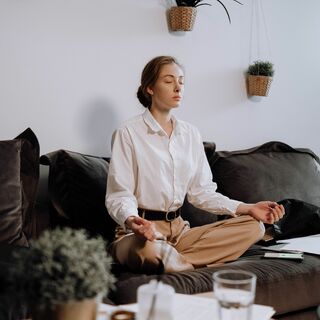
Most people don't practice meditation to be good meditators.
We practice meditation to bring the benefits of the meditation off the mat and into our daily lives.
So in this talk I'm going to briefly mention some of the ways that we can use meditation to best benefit ourselves in our day-to-day lives,
In our day-to-day existences and start to find and apply the stuff that we're learning on the mats to real everyday situations to best benefit ourselves and those around us.
The first thing I want to consider is relationships.
In particular relationships with people that you're forced to interact with that might cause you a little bit of anger.
This could be a boss or subordinate or potentially a family member or a stranger that's cut you off or is rude to you.
It's really wise to lash out in the moment and to be overcome with anger or any other emotion.
The long-term consequences of doing so can be catastrophic.
Rather it would be better to have control over our emotions to be able to best proceed with calm mindful control.
But how do we do this?
One of the ways that we can learn to use our mindfulness in daily life is to start paying mindful attention to emotions as they come.
Think back to a time when you were angry.
What did it feel like?
What were the mental and physical sensations involved?
Did it bring up other associated moods or emotions or feelings?
What does anger as a sense feel like?
What's its shape?
What's its color?
What's its shape?
What's its color?
What we're doing here is developing a profile of anger.
Sort of a way to identify it and label it.
Now this might seem obvious.
It's like well,
Of course,
I know what anger is.
But you might know what anger is in its extreme.
But do you know what it feels like when it's creeping up?
Can you grab it before it becomes extreme and overwhelming?
Because if you can,
That's your opportunity to jump in and take action to make better choices.
So we can apply the same concept to any emotion.
Jealousy,
Anger,
Shame,
Whatever it is.
Sort of work out a profile of what that emotion feels like.
And then over time as we feel these emotions in the real world,
We can really start to hone our sense of what anger or whatever emotion it is feels like.
And then eventually we'll spontaneously recognize the fact that oh,
I'm starting to feel a bit angry here.
I'm starting to feel a bit jealous or anxious or whatever it is.
And we'll be able to take a mindful break,
A pause.
We'll be able to act with a little bit of clarity and calm.
It's almost like you're over here and your anger is over there.
And there's a little bit of space,
A little bit of a breath in which you can choose to take action.
And the more you meditate,
The quicker you'll notice those upcoming emotions and the more space you will have when you do.
And from that space you can then make better choices.
The same approach can be applied to dealing with cravings and addiction.
It's beyond the scope of this talk,
But the negative feelings that come with a craving are due to a neurotransmitter imbalance.
Something going on inside your brain where the brain is now not communicating to itself correctly.
The neurotransmitters or the receptors are either working too much,
Not enough,
Or there's not enough present.
And what that does is it causes you to want the substance.
To want to eat the sugar or have the smoke or do whatever it is to be able to correct that imbalance.
So you feel the craving and you go straight to it and then you feel better.
The problem is this is a self-fulfilling cycle that just perpetuates and increases the addictive behaviors.
Both from the physiological as we just described,
But also a psychological.
I feel stressed so I use.
But what mindfulness does is that it allows us to see and write out and look at what the feelings of cravings actually feels like.
Is there a physical sensation to it?
Is there associated moods and feelings and emotions and thoughts?
What does the craving actually feel like as it's happening?
Once again,
This process enables us to get a little bit of space and just to observe what's happening.
And from that space,
We may be able to ride the craving out because the cravings will come in waves.
They'll start off small,
Then they'll peak,
And then they'll fall.
And if we can observe that rise and fall,
We will learn that we don't have to be subject to the whims of the craving.
We learned that it might feel bad now,
But it will get better.
And in addition,
We'll be able to listen to the little voice that's saying,
Hey,
Remember the last time you did this?
How bad you felt?
The shame,
The physical guilt,
The hangover,
The whatever it is.
Remember that?
That's what's going to happen again.
So by practicing mindfulness meditation,
We can both address negative emotions as they come,
And we can address feelings of addiction and craving as they come.
This isn't a cure-all,
But it's the best way that we can internally address negative emotional states in our everyday life,
And actually take the benefits of our meditation practice off the mat and into the real world,
Where it really does matter.
So I encourage you to try this the next time you notice a negative emotion or a craving.
Just look at it.
Take a moment to observe what is happening.
How does it actually feel?
What are the associated emotions and thoughts and moods and all of that that comes along with it?
What does it feel like?
How extreme does it feel?
Is there any space beside those feelings in your mind?
If we can label it,
If we can look at it for what it truly is,
As it is,
We can look at it for what it truly is,
As it is.
We can look at it for what it truly is,
As it is.
We may be able to better address it,
Rather than becoming slaves to our emotions and addictions.
Good luck.