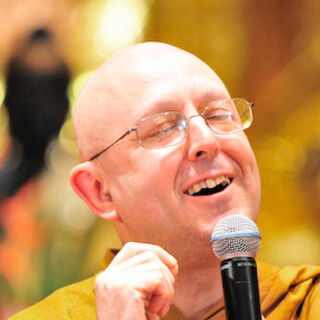
There he goes,
Welcome to the ongoing meditation class.
And this is what happens in meditation,
You don't do anything,
Things come to you.
So this is just,
If you want to be cool and get rid of your thirst,
Just do nothing,
Just sit there and all these amazing things happen when you don't want anything.
This is an old simile from meditation.
And that is of the lake,
Imagine a lake up in the mountains and when that lake up in the mountains has got waves on the surface,
You can't have a good reflection of the moon and the stars above.
But when that lake is perfectly still,
Then the reflection comes by itself,
You can perfectly see the reflection of all the heavens above only when there are no waves on the surface of the lake.
And I think you can all understand that that lake refers to your mind.
And if the mind has got lots of waves on the surface,
In other words,
It has many thoughts,
Especially of the past and the future,
You just can't see things as they truly are.
Your awareness,
Your mindfulness is very,
Very weak.
But if you can somehow find a way of stopping those waves on the surface,
Try and find a way so that the surface of your mind becomes calm and smooth,
Then not only do you enjoy the bliss of stillness,
But you also find that you can see things,
You get wiser and wiser.
So usually our job in meditation is learning how to be still.
It's such a hard thing to be still.
And a lot of times people try to be still,
They put forth effort and try and be still.
And they find that they just keep thinking and wandering because that again is not the way to find stillness.
There's a simile from my teacher,
Hajan Chah over in Thailand years ago.
He's actually very still now,
Because he's dead.
And even when he was alive he was very still.
And he would often pick up his hand and go waving it.
And he didn't want you to go away.
When he was waving his hand like this,
He was saying,
This is like a leaf on the tree,
It only moves because of the wind,
And if the wind would stop,
The leaf would move less and less and less until the leaf on the tree would be perfectly still.
Because that is the nature of a leaf on a tree to be still.
It only moves because something is blowing it.
And the simile is with the human mind,
Its nature is to be still.
What is the wind which blows the mind and makes it keep on moving,
Thinking,
Wandering and stops it being still?
And that is the wind of wanting.
Wanting something.
Every time you want something,
You move your mind and the mind has more thoughts,
More agitation and moves further away from stillness.
So a job in meditation is learning how to stop wanting things,
Learning how to be at peace,
Content,
At ease.
And if you are still,
You don't want anything,
Then it may be counterintuitive,
But it works.
You don't want anything,
Everything just comes to you,
Just like the drink of water.
Mmm,
That's so cool.
And that's the simile of meditation.
You just sit here and do nothing and not wanting things and all this stillness,
All this peace,
All this happiness,
They just come to you.
You want it and it runs away.
You are still and it arrives.
So the job of meditation is really learning how just to be content,
Not to want anything,
Just to stay here.
And I know that I've given this little exercise before,
But meditation is always repeating these little exercises until you get them down pat and then you can do it any time you want.
That was the exercise which I usually teach every month or two months of remembering the most peaceful moment you've ever had in your life.
This is a useful experience because,
A useful method,
Because if you can just,
When you start your meditation,
Closing your eyes and remembering the time in your life you were so content,
So peaceful,
So happy,
The happiest moment you can remember so far.
And you'll always notice that the reason it was happy was there was a great sense of contentment.
There was no other place in the world you wanted to be rather than there.
There was nothing missing,
Nothing you wanted to get,
That you could not improve that moment.
That's called like contentment.
And we've had times like that in our life and meditation recreates those moments,
Those moments of utter contentment where you're just sitting with your eyes closed not wanting to be anywhere else in the whole world,
Not missing anything,
Not wanting anybody,
Not being able to improve the moment at all,
Totally content.
Now the main ingredient of those experiences is the fact that you don't want anything.
That's why you have this beautiful experience and feeling of just contentment,
Being at home,
Just being here.
When you have those experiences of the past,
In this little meditation exercise,
At the beginning of the meditation you just close your eyes and you recollect those experiences,
Or one in particular.
And to recollect it you have to persist by remembering as many details as possible of that event,
The time,
The place,
The scenery around,
Whether it was winter or summer or morning or afternoon or night time,
Who was around,
What did you feel like,
What were you wearing.
When you recall as many details as you can,
Then it fills in the picture and it reinforces the memory of that experience.
It reinforces the feeling of contentment,
Even though you're only remembering it,
Still the feeling which you had so many years ago remains to a certain extent.
And at the end of the imaginary,
Not the imaginary,
But the memory of the most calm and peaceful time you've had so far in your life,
At the end of that,
Then you just start the meditation as normal,
As usual,
And you find that you will retain a great degree of the contentment.
It's as if the mind knows this is contentment,
This is what I can be doing in meditation.
Just learning how to be still by not wanting anything,
Just being so content to be here,
In this hall,
In this body with my eyes closed,
Not wanting anything in the world,
Nothing missing,
Nothing to do,
No place to go,
Just like you had before.
And those memories of the most happy moment of your life so far,
For one which was so content,
It just instructs you about what the goal of meditation is and how it is achieved.
And by keeping that goal in mind and knowing the path to that goal of letting go of wanting,
The leaf which is your mind will move less and less.
Your mind will become more like the still forest pool with less and less waves on the surface,
Until soon it can be perfectly calm,
Like the still forest lake,
Perfectly reflecting everything around,
Wisdom,
Peace and the happiness of just being free of all those problems.
So that's a little instruction to start off the meditation.
So now we can actually start.
Just the announcement that this is the ongoing class,
So anyone who's come for the introduction to meditation class,
The introduction class is being held in the room to my right,
This is the ongoing class.
So we are going to be meditating for about 45 minutes,
So it's a long period for those of you who haven't meditated before.
So we're going to start now,
If you just want to stretch your legs a little bit before we start,
Just to make sure you're nice and comfortable and then when you're ready we can start with the meditation today.
So just coming in for the meditation class.
So you're closing your eyes,
And bringing your awareness into the body,
And bringing kindness together with the mindfulness.
What I said last night is kindfulness,
The combination of mindfulness and kindness,
Kindfulness to your body.
What that means is you can experience any sensations in your body,
Especially any aches or pains,
And don't just sit there,
Do something about it,
Adjust your legs,
Move your bottom,
Scratch the itch,
Blow the nose,
Whatever is necessary to make your body more comfortable.
And don't let the body go too early,
Keep on being aware of your body and learning how to bring it to a deeper state of ease or relaxation.
Sometimes we may think we've arranged our body well,
But after a few minutes we found there was a part of our body,
Maybe in a foot which is trapped under the leg if you're sitting cross-legged,
Which causes a pain later on,
Because we weren't aware enough and careful enough at the beginning.
So really double check your body.
One of the methods is asking yourself what is the most prominent feeling in your body,
The feeling in your body which stands above all others.
Now that's usually a disturbance,
An ache or a pain.
So see if you can do something with that,
Moving,
Scratching,
Loosening,
Clothing,
Until the most prominent feeling in your body settles down and comes to a deeper sense of ease.
And then try the next most prominent feeling,
Being aware of all these sensations in your body which often we neglect because we're so busy,
And being kind to them.
And if there's any ache or pain inside of you,
Pain in the chest or in the guts or whatever,
Focus on it,
Be aware of that special feeling inside your body and give it this beautiful compassion as if you were stroking it softly.
Imagine it expanding,
Loosening,
Softening.
Your mindfulness gives you feedback.
You will notice the feeling of pain or ache inside your body gets less,
It relaxes.
You are learning through kindfulness how to relax the inner parts of your body.
Not only does this prepare your body for meditation,
It also prepares your mind by developing the two important qualities necessary for deep meditation.
The awareness and the kindness is what relaxes the body,
What stops the leaf from shaking and brings the lake to a state of calm,
Mindfulness and kindness.
So once your body has been settled down,
Before you let it go,
Just linger on the feeling of delight of having a relaxed body.
There's a special feeling of pleasure when we relax.
I'd like you to know that pleasure.
It will help later on in the meditation process.
The special delight of having a body which is relaxed.
And when the body is as relaxed as you can make it,
And you're delighted in that pleasure of a body of freedom,
Then let the body go and focus on your mental world to learn how to relax that.
As I mentioned at the beginning,
You may try the exercise of now recalling the most peaceful moment of your life so far.
A time maybe when you were very young,
In mountains or by the sea.
Or wherever it was,
A time you can remember feeling so peaceful,
So safe,
So happy.
Then fill in the details.
When was that?
Was it in the winter time or the summer or the spring or the autumn?
What time of day was it?
Morning,
Lunch,
Afternoon,
Evening,
And night time?
What were you wearing?
Who were you with?
Fill in the scenery.
Was it water or hills or mountains or seeing the vastness of the sky?
Where were you?
What was it like?
What was the surroundings?
You notice as you fill in the details,
You are sustaining the memory long enough for that feeling of peace and contentment to establish itself in this present moment.
You get an echo of that calmness.
How long were you there when you experienced that beautiful,
Peaceful,
Content state many years ago?
What was it like just to be and not want anything?
Just to be so happy where you were with what you had,
Not wanting anything in the world,
Not wanting any other people just being happy with what you had.
What did that feel like?
Just arousing a memory of the goal of meditation and also seeing the path of contentment,
Letting go of all wanting,
Of just being.
And now you can let go of that memory.
And in this moment,
In this hall in Nollamara,
Australia,
You still have a residue of that feeling of contentment.
In this moment,
Be content.
The more happiness you have,
I'm not talking about exciting happiness,
The same delight in relaxation,
That appreciation of the freedom just to be without having to go anywhere.
Appreciate that happiness of just being here right now.
And all the past and future won't be able to come in.
If you are happy in this moment,
If you don't want anything more in this moment because you have enough,
Then all these thoughts and problems have no way to come in.
You are free.
It's called opening the door of your heart to this moment,
To right now.
Be mindful and kind to the present moment.
And now you can open the door of your heart to this moment.
And all the past and future won't be able to come in.
You are free.
You are free.
You are free.
You are free.
It's like time is now.
It's like.
.
.
Energy.
.
.
Squatz.
.
.
.
.
.
.
.
.
.
.
.
.
.
.
.
Just be kind and aware in this moment.
If you drifted after the past or the future,
Bring yourself back gently.
Stay in this moment where life is happening.
If you are concerned about the future,
Always remember now,
This moment is where your future is made.
If you care for this moment called the present,
Then you are going to have a peaceful,
Happy,
Healthy future.
Look at where your future is being made,
Right now.
Make peace with this moment.
Be kind,
Be gentle with every moment.
.
.
.
.
.
.
.
.
.
.
.
.
.
.
.
.
.
.
.
.
.
If the mind wanders,
You can focus in on something like your breathing.
Remember to keep this beautiful sense of peace and contentment.
Just being with the breath,
Just contentedly watching a breath go in,
A breath go out.
In the same way you'd sit on the beach on a calm day,
Just watching the waves come up to the beach and then fall away again.
Just like the air coming into your body and ebbing away again.
.
.
.
.
.
.
.
.
.
.
.
.
.
.
.
.
.
.
.
.
.
.
.
.
.
.
.
.
.
.
.
.
.
.
.
.
.
.
.
.
.
It's getting close to the end of the meditation now.
How do you feel?
What's it like inside?
How peaceful are you compared to when you started?
How content?
This is where we learn the result of meditation and what leads us here,
The path of peace and what peace is like as an experience.
.
I will now ring the gong three times to end the meditation.
As usual,
Open the eyes at the end of the third ringing of the gong.
.
Oh,
You have some questions in the box?
Amazing.
Okay,
If we now and again,
If anyone has questions to ask,
We do have a box.
The box is there with paper and pens.
All it needs is your question because it is true that sometimes people don't like asking questions in public.
They always think their question is stupid.
The only stupid people are those who don't ask the questions.
Those who do ask the questions are always the very intelligent kind ones.
So we have the box here so you can write anonymous questions.
You talked about guilt last night.
How can one stop feeling guilt?
There's just an example about using kindfulness to stop feeling guilty.
Every one of us has done something in their life they feel terrible about.
Maybe years ago I told a story when I was a student,
Really poor because my father had died and was trying to get through Cambridge,
Would never take any money from my mother because she was poor and just struggling to survive.
So I had jobs during the holidays and one of the jobs I got as a student was the worst job in the world,
A door-to-door salesman selling children's encyclopedias.
And the worst thing was,
Was I sold one.
And I felt so guilty as a result because you go into these houses,
Knock on the door,
And there's very strong psychology.
The first question you ask is,
Are you interested in children's education?
Of course everybody would say that.
And then a series of questions would make the parents feel just one step higher than child offenders and paedophiles because if they did not buy this book they were destroying their children's chance for happiness and success in life.
It was such an important book.
And sometimes,
You know,
I'm a good speaker even then so I could convince these people.
And I convinced this lovely young couple,
They just had a kid and they were so excited about bringing up their child and I got them to buy this stupid encyclopedia for children.
And the following night I just didn't sleep well at all,
I felt so guilty.
You know,
These poor parents struggling to survive,
They'd given up so much money for a hopeless book and I felt so guilty I just resigned the next day,
I couldn't do it anymore.
I didn't believe in what I was selling and I felt so guilty for it.
And for years and years I carried that guilt around until I one day I just said,
Oh come on,
You're just a student,
Just let it go.
But I did tell people about that story of one of the things I was not very proud of.
And then just after I gave a talk,
I remember this girl came up to me and said,
Just life is very strange,
There's so many coincidences which are really weird.
She said,
I lived in England,
She said,
Before my family migrated to Australia.
And I remember,
Just I was a very small kid and this long haired student came to my parents' store and they sold me this encyclopedia.
And I loved that book,
That was the best book I ever had,
I took it with me everywhere.
I just enjoyed that book so much.
And it's such a weird,
What I thought was a hopeless book.
Well,
I don't know if it was the same person,
But just the way this world works,
I think there's a really good chance that was that girl,
The way that karma works around,
We meet again many,
Many times.
So that just totally overcame my guilt.
I thought I'd done something terrible,
But in the end it turned out to be quite wonderful.
It just taught me just how when we judge ourselves,
We judge ourselves so unfairly.
And we never give ourselves the benefit of the doubt,
Which is one of the big problems with guilt.
So when you meditate with kindfulness,
Give yourself the benefit of the doubt,
Whatever you did in that life,
Maybe it was for the best after all,
Who knows how things turned out.
So we don't blame anybody and we don't blame ourselves.
What I was talking about last night,
We forgive others very easily.
Well,
It's hard sometimes what people have done to you,
But with a bit of encouragement you can forgive someone else for what they did.
You must have been drunk or mad or crazy at the time,
They're going through some terrible stuff,
Which is why they did that to you.
But the hardest is to forgive yourself.
So when you hang around this joint long enough,
You'll find we don't do blame,
We don't do guilt.
That's one of the reasons why I said last night for those who weren't here,
I just returned from teaching in Hong Kong and every place I go,
I like to learn a new word and a new language,
It's actually the same word but in different languages.
And the word which I always keep on repeating is very good and very good and very good.
So I know very good in so many languages.
You know,
It is Kubalo in Bangladeshi,
It is Dimaak in Thai,
It is Bagusakali in Indonesian and in Cantonese it is my favourite,
It is Ho Ho Ho.
That's true.
In Hong Kong,
If someone says Ho Ho Ho,
It means very very good.
So it's not like whatever you've done in your life,
You know whatever bad thing,
Look at it and say Ho Ho Ho,
Very good and don't blame each other.
And that is why,
As I said last night,
The joke last night was Santa Claus,
He wasn't from the North Pole,
He was from Hong Kong,
Which is why he keeps on going,
Ho Ho Ho,
He's just saying in Chinese,
Very good,
Very good,
Very good.
So what a lovely word,
Ho Ho Ho,
Being very good in Cantonese.
So it's the same,
Whatever you have done in your life,
Whatever's happened to you,
Ho Ho Ho,
Very good.
It's all grist for the meal,
It's all,
Not grist,
That grist for the meal is the old saying,
My saying you all know is,
Dog shit for the mango tree.
We had some mangoes this morning,
They were very delicious and I'm sure they had some dog shit on them to fertilise it,
Which is why they tasted so nice.
You put dog shit on your mango tree,
One year later,
Two years later,
Your mangoes will be really sweet and juicy.
It's true,
Isn't it?
But what you should always remember is where that juicy mango came from.
What you're really eating,
Which is dog shit,
Transformed into juicy mangoes.
So anything which happened in your life,
The bad things you've done,
The bad things you've done,
It's just more dog shit for the mango tree.
So it's wonderful,
You don't have to scrape it off,
Take it home,
Put it under your mango tree and you get sweeter mangoes.
So where's the guilt?
It's not blame or anger,
It's great,
Thank you for giving me more dog shit to work on,
More fertiliser for my mango tree.
So whatever,
Any time they cheat you,
They rob you,
They abuse you,
They sort of tell a terrible thing or whatever you've done.
What do you say to all that bad stuff in your past?
Ho ho ho,
Very good,
More dog shit for my mango tree,
Yes.
A totally different attitude which is why it's called kindfulness.
So whatever happens to you in your meditation,
You feel tired.
It's a hot day today for goodness sake.
So if you're tired during meditation,
What do you do?
Don't feel guilty,
Oh I'm sleepy,
I shouldn't feel sleepy,
I'm a monk,
I should be fairly up straight.
No,
Use kindfulness,
It's more dog shit for your wisdom and compassion,
Thank you so much.
Cos with kindfulness,
When you're kind to the moment,
You accept it,
You'll find you become peaceful.
It's no longer a problem anymore.
If you're angry at it,
Get out of here,
You don't belong,
I don't want you.
Guilt,
I don't want you,
Anger,
I don't want you,
Sleepiness,
I don't want you,
Restlessness.
That's not kindfulness,
That's getting angry,
Rejecting.
So whatever happens to you in your meditation,
Whatever you're feeling,
Restless,
Tired,
The mind all over the place,
What should you do to say to your mind,
Ho ho ho,
Very good mind,
You're sleepy,
Very good,
I'm tired,
Very good,
I'm thinking all sorts of things,
Very good.
You try that and you find your mind gets peaceful because you don't want anything,
You're happy just with all the terrible things you've done,
You're happy,
We all do wrong things.
That's the other thing with guilt I said last night,
The simile of the two forests,
One person walked into a forest and all the trees were in lines and rows with all the branches in place and every leaf just right and that is called plantation.
No one likes to go into plantations owned by the government but they went into another forest which was old growth natural forest with the trees leaning all over the place,
All the branches crooked,
Half the limbs fallen off,
Leaves all over the place,
A right mess,
That is beautiful.
So the trees with the crooked,
The crooked trees,
They are the beautiful ones,
They're the ones we like to hang out with,
So each one of you is like a crooked tree.
You're all damaged goods,
Every person in this room is damaged goods,
Including me and the monk sitting next to me.
We've all had our difficulties and problems in life,
We've all been damaged and that's what makes us beautiful like the trees and the crooked forest and you wouldn't like to live anywhere else.
Would you like to go for a walk in a plantation?
Would you like to have a picnic with trees all perfectly straight?
It's not natural,
It's not beautiful anymore.
So all the crookedness of your past,
All the stuff you've done wrong and the things which have done wrong to you,
They make you damaged goods just like every tree in an old growth forest.
You are beautiful.
So that is a simile of turning guilt into delicious mango,
Turning crooked trees into the most beautiful forest.
And understanding we're all damaged.
So if you're trying to find a partner in life,
All you young people,
Say no,
He's damaged goods or she's damaged goods or I'm damaged goods,
Who would want me?
Wonderful,
We're all damaged goods,
Welcome to humanity.
It's just some people are more damaged than others,
That's all.
Some trees are more beautiful because they've got more juice in their life.
So anyway,
That's with guilt.
So nothing to feel guilty about.
Be proud of all the bad things you've done.
Can you do that?
Say thank you for all those people who've done you wrong.
You learned so much from them,
Thank you so much.
All those girlfriends who dumped me,
Oh thank you so much for dumping me.
If it wasn't for you dumping me,
I might be married to you for now.
Because the monk sitting next to me said he met one of his ex-girlfriends this morning.
So I hope you thanked her for not sort of continuing on with the relationship.
Anyway,
Okay,
Any other questions to get more serious?
Sometimes we don't do serious in this place,
Do we?
Meditation is quite serious.
Okay,
Very good.
It's hot so if you have a question,
Come up and ask it afterwards.
Now we can finish off and we can pay respects to Buddha Dhammasanga.