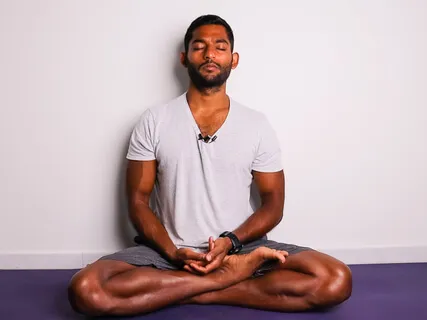
Namaste and a very warm welcome to all of you in this daily morning live meditation session with me,
Dhyansa.
In these sessions,
We are right now meditating upon Yoga Sutras of Patanjali.
What is Yoga?
Yoga is the union,
Union of the two.
What are these two?
Consciousness and Prana,
The energy.
Yoga is the union of these two and in fact life is the union of these two.
Life is yoga of consciousness and prana.
These two you can call them forces,
You can call them energies,
You can call them entities.
Something these two are there very distinct in our cosmos.
These do not belong to the body,
They do not belong to the physical,
They do not belong to the mental.
These two have their distinct existence in cosmos,
The consciousness and the energy which we call as prana.
And life as we know it is the yoga,
Is the union of these two.
As long as they are together,
There is life as we know it.
If you take one of them apart,
Life does not exist anymore.
If there is no consciousness,
If there is just prana,
Then life is almost just like a sleeping person all throughout his life.
That there is breath,
There is prana,
The heart is beating but the consciousness is not there.
So it is as good as being dead all throughout the life.
And if the consciousness is there and if the prana is not there,
Then also there is no life.
Without the prana,
The body cannot exist.
Without the prana,
The mind cannot exist.
And one remains only as consciousness but the form,
The manifestation is not there.
So for the form,
The manifestation to happen,
These two have to come together.
Consciousness and prana.
These two have to come together and have to be in the right dance,
In the right combination to move together through life,
To give you the experience that you want through your body,
Through your mind.
So yoga is that practice,
Is that path where you learn to be with both the consciousness and prana.
You understand both of them,
You learn the mechanisms of how they work,
You learn how they work together.
And in this learning,
In this inner development where your perception,
Where your sensitivity,
Where your intelligence,
It grows to that you can understand these two,
You can realize these two.
Then you also know how to put them together.
You can then work with them,
Not just as they are given to you,
But you can take them further in your life as you would like them.
Consciousness is of a certain higher order than prana.
If you were to see that these two entities,
These two energies,
These are on a different order,
They are not the same,
One is higher than the other.
Although both are essentials,
But consciousness is a much more finer energy,
Is a much more finer concept,
Is a much more finer entity and prana is more closer to the body,
More closer to the mind,
More closer to the physical.
So you can understand and grasp the prana more easily.
You can access the energy of prana,
This vital energy,
This vital life force more easily.
Once you learn,
Once you validate in your own experience what is prana,
Are you able to regulate prana,
Then you move higher,
Then you move towards consciousness.
Other than that,
Consciousness remains only as a concept.
Consciousness only remains as something that is there other than the body,
The mind,
All our energies,
Whatever is left in us we call as consciousness.
But to reach to consciousness,
To reach to the understanding of consciousness,
The experience of consciousness,
This pure consciousness,
This energy which penetrates all of us,
Which is making us aware,
Is what one can reach once one understands prana,
How to regulate prana and from there on,
So from the physical to the mental to the prana and then moving on towards consciousness.
This is also the developmental path,
The path to become more and more sensitive,
Become more and more aware.
The access to prana is through the breath and as we go higher and higher,
The access to consciousness is through pure only awareness.
So the access to prana is through the breath and imagine what control we are having,
What access to control we are having when we say that prana is accessible via breath.
It is almost like that you are right now put in an autonomous vehicle.
If you see the developments of technology,
They are going in the opposite direction.
Meaning right now when you are driving the car,
You are in control of the car,
You know when to turn,
When not to turn,
When you want to accelerate,
When you want to decelerate,
When you have to stop,
When you should stop and so on.
But once you are put into an autonomous vehicle,
After few months of being there,
After few months or few years of being in an autonomous vehicle,
You would forget how to stop the vehicle,
How to accelerate the vehicle,
It will do everything on its own.
It has its own place that autonomous aspect of running those things which are redundant in life,
Which have no value in life,
To put them,
To make them autonomous is fine.
But breath is so valuable,
It is the doorway to access to life energies,
To prana,
To how your body is,
Your physiology,
How your mind is,
Your mental plane,
Your emotional states are all controlled by prana,
Are all controlled by breath,
The pattern of your breath.
So it is a very powerful gateway,
It is a very powerful access which must not be ignored,
Which must not be just left autonomous.
The breath that we take right now is all autonomous and whatever experience we go through life,
It changes by itself,
It has certain default patterns,
Certain default gears that it shifts and thereby creating the experience or in the experience a response to whatever is happening around the world.
So if you learn how to regulate your breath,
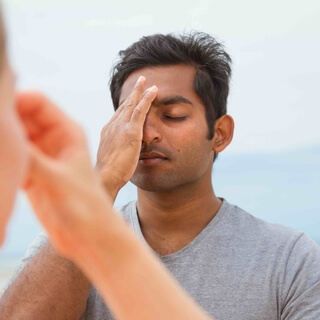
If you learn pranayama,
Then you get that first degree of control back on your breath.
And that doesn't mean that you start suppressing the breath,
You start holding on to the breath,
That means that you train the awareness to see how the breath is behaving and then modify it slightly,
Modify,
Give it those slight modifications which allow you to have regulation over your emotional states,
Have regulation over your mental states,
Have regulation over your physiology.
Let us see what Patanjali has to say in this regard for pranayama.
He says in his sutras,
Bahaya abhyantra stambha vritti desha kala samkhyabi paridrishta dirga sukshma.
The modification of life breath are either external,
Internal or stationary.
They are to be regulated by space,
Time,
Number and are either long or short.
So here in this one sutra he is talking about these basic modifications where he is saying that the modifications of life breath are either external,
Internal or stationary.
Let us understand what he means by that.
There are three components to our breath,
The inhalation,
The exhalation and the retention,
The pause in between.
The whole control,
The whole regulation mechanism is based on different permutations and combinations of these three,
The inhalation,
The exhalation and the retention.
The inhalation is what how fast you would inhale and in relation to that the exhalation how slowly or how fast you will exhale.
So inhalation and exhalation they are in always in combination they are related,
But the retention is that variable which you can modify,
Which you can change and that retention changes the entire experience where you retain the breath.
If you are retaining the breath after you have exhaled,
After the exhalation you know there is a natural pause before the inhalation.
If you start modifying that pause that is known as this external modification where the breath is out,
Where the prana is outside,
The prana is in the external,
Inside there is no new prana.
So there is a negative space inside,
Negative not in the sense of bad negative,
It just means the prana has left the body.
It is somewhat of a state which is like death.
When there is no prana,
When you have exhaled and when you retain the breath at that point,
In that state is one type of modification that happens in your body,
In your mind and gives you control over your body,
Your mind and what you can do with that in very simplistic terms is through of all the negative energy,
All the restlessness,
All what you have been carrying on,
The suppressions,
The subconscious impressions that are all bothering you for all this time,
You can throw them away once you learn to retain the breath after the exhalation.
So you throw them away with the exhalation and you retain.
In that retainment,
In that pause that you take,
Then your internal system reorganizes.
It has the chance to reorganize before another prana comes in.
Then the second retention that you can practice is the retention which is internal,
Meaning once the prana has entered in you,
Once the prana has entered in you after inhalation,
There is a point,
There is a pause and if you modify that pause by elongating that pause or practicing a certain set of that pause,
Then that modification according to Patanjali is internal pranayama,
So that internal modification of pranayama where the prana is inside of you.
When you are inhaling,
You inhale fresh energies,
You inhale all the positivity,
You inhale the vital energy in and to assimilate that in the system to let that really reorganize your energies within the system,
That internal retention is also needed.
So both have their place,
The internal retention and the external retention,
The pause after the exhalation,
The pause after inhalation.
And these are the basic fundamental constructs of pranayama and as I said by having different permutations and combinations,
By changing the pace of the breath,
By changing the retention,
How long you are retaining and which are you retaining after the exhalation,
Are you retaining before the inhalation or both,
It gives you so many different possibilities and you only have to try it out to see the impact of that on your physiology,
On your psychology,
On your emotional states and start regulating them.
Before we practice,
Just one more aspect to that what Patanjali says,
He is saying they are to be regulated by space,
Time,
Number and are either long or short.
So the space is where you are,
It's not just the internal space but where you are also matters which permutation and combination you choose and how you respond.
Time it also matters when you are practicing this pranayama,
Are you practicing it in the morning or in the afternoon or in the evening.
Why?
Because the time if you see our 24 hours are not the same.
We are living in these 8 different 3 hour phases,
If you observe yourself from 6 o'clock in the morning to 9 o'clock,
From 9 to 12,
12 to 3,
3 to 6 and so on,
You will see that your emotional states are completely different,
Your mental states are completely different.
So you have to calibrate your pranayama according to space,
Time,
The number,
So how many breaths that you want to regulate in this pranayama and either they are long or short.
So the duration or the elongation of these breaths that you regulate in pranayama.
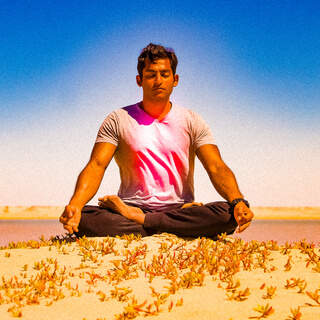
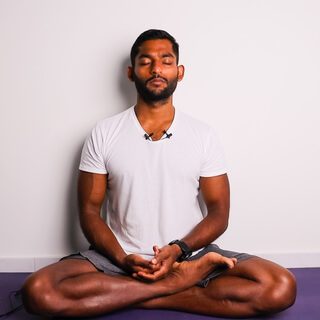
Let us practice the simple versions of that by first of all closing our eyes,
Taking a posture that is easy,
That is not too tensed,
Not too loose,
Giving you stability,
Balance,
Your spine erect and allowing your breath to first of all flow naturally.
For the next few minutes,
You will inhale with a count of 4 and exhale with a count of 8.
Later we may introduce retention,
But first inhalation with 4 counts and exhalation with 8 counts.
You may mentally count as you breathe in 1,
2,
3,
4 and as you exhale count until 8.
Once again inhale 1,
2,
3,
4 and so on.
Find your flow along these counts of 4 and 8 for inhalation and exhalation.
At no point stressing yourself or contracting yourself,
Allow this rhythm of 4 and 8.
Flow easily,
Effortlessly in your breath.
4 counts inhalation.
8 counts exhalation.
A few more breaths with 4 counts inhalation and 8 counts exhalation.
With inhalation,
Breathe in the new.
The positive,
The fresh,
The prana.
And with exhalation,
Let all the negativity out.
All the darkness out of your body,
Of your mind.
Now leave the effort allowing your breath to naturally find its own pace,
Whatever that may be,
Allowing it to relax,
Becoming gentle,
Natural,
And easy.
For the next step,
Focus on the retention.
After the exhalation,
There is a pause.
Try to elongate that pause for 3 to 4 counts before you inhale back in,
Leaving rest of the breath cycle natural at its own pace and only focusing on holding the pause after exhalation for 3 to 4 seconds.
Notice the stillness that arises in your mind,
In your body,
In your energies.
Let go of the breath and stay in the stillness,
In the silence as long as you like.
No more effort.
No more modification of the breath.
From here on,
Let's relax.
Now,
You may maintain this meditative silence,
Keeping your eyes closed,
Going deeper within,
Or very gently and slowly,
You may open your eyes with me,
Maintaining this stillness,
This freshness in your energies and take them into your daily life.
Please pass on this message of yoga,
Meditation,
Pranayama to your family and friends.
Thank you very much.
Namaste.