Namaste and a very warm welcome to all of you in this daily live meditation session with me,
Dhyan Se.
We are going through Yoga Sutras of Patanjali and at a point we are where we can join this stream of yoga,
This flow of Yoga Sutras in a very practical lifestyle way which we can bring into our daily life.
We are starting to move into the Ashtanga Yoga,
The eight limbs of yoga.
Before we go through the Sutras and sit in meditation,
I would like to point out that if you are a yoga teacher,
If you have been practicing Hatha Yoga and teaching Hatha Yoga and you want to move beyond the postures,
This is the point to join.
If you are somebody who is completely new to yoga,
This is also the right point to join this stream of yoga.
If you are somebody who has experience of yoga,
Who still wants to revive this energy,
This sacred knowledge back into the lifestyle,
This is the point of transformation.
And if you're somebody who simply just wants to benefit out of this knowledge and transform your life,
Come out of the sufferings,
Whatever you're going through,
Whatever you have been struggling with for a long time and want to put an end or move towards something that you want to achieve,
This is the point to bring yoga in life.
Yoga takes you from the minus hundred to the zero,
Meaning it takes you if you are in somewhere low in life,
It picks you up from wherever you are.
It does not matter if you are having physical issues in life or psychological issues in life or spiritual things in life.
It picks you up from wherever you are,
From the minus hundred to the zero.
And it is such a potent science that it can take you from the zero to the hundred to the highest peak.
So the whole journey can be covered in these eight limbs of yoga,
Provided you go through them sincerely,
Provided you imbibe them in your life and bring this structure of eight limbs of yoga,
Which is a complete structure,
Which is a complete framework.
It does not leave any aspect of your life untouched,
Unnoticed,
Unmoved by yoga.
What are these eight limbs?
Let us hear what Patanjali has to say.
Patanjali says,
Yama niyama pranayama pratyahara dharana dhyana samadheo astavangi The eight limbs of yoga are yama,
The abstinence,
The regulation.
Let us go through them one by one.
There will be sutras where Patanjali will describe each of these eight limbs in much more detail.
But in this sutra,
He summarizes these eight limbs and for us to have an overview of what these eight limbs are,
What all dimensions we will be covering in this lifestyle change that we will bring along with yoga starting today.
The first is yama.
Yama is self restraining.
See it like this,
That your life has an energy flow.
You are flowing with life.
There is constantly an energy flow and this flow of energy is not always all the energies flowing in the right direction.
There are energy wastages.
There are energy leakages that are happening.
The energy is getting caught up in the wrong behaviors,
In the wrong patterns,
In the wrong pockets.
What to do with them?
There is no other science.
Even when psychology wants to deal with this,
There is only management of the situation.
There is not cure of the situation and yoga is the cure.
It takes all these different eight different dimensions holistically together so that they help each other.
The psychology helps the body,
The body helps the mind,
The mind helps the heart,
The heart helps the spirit and so on.
It creates a holistic situation for you to actually cure and move towards transformation.
And the first limb of yoga is this yama,
Which is more related to how you are with others or in the outside world,
How your energies are flowing in the outside world.
So yama is a process where you take vows to stop certain behaviors,
To stop certain patterns from happening,
Because if the energy would keep on collecting in the wrong channels,
In the wrong pockets,
You will never be able to gather them and put them in the right direction.
So you have to first of all stop the leakages.
You have to stop the waste of this energy,
Which is creating all the misery.
That would be step number two.
Number one.
Then he says Niyama,
Step number two,
Which is to have rules.
Niyama is rules.
Yoga,
You have to see is a discipline and in that discipline,
There are rules.
You may not rely on all the rules that are presented here by Patanjali.
You may see that according to your lifestyle,
According to your time and place where you are,
You choose what rules apply to your lifestyle and you follow them.
Asana,
Asana is the meditative postures.
So all the postures that you see in Hatha Yoga,
These are all the postures to train meditativeness in specific body postures.
So here the third dimension,
Which Patanjali brings in,
In the Ashtanga Yoga is of asana.
You have to practice postures as well.
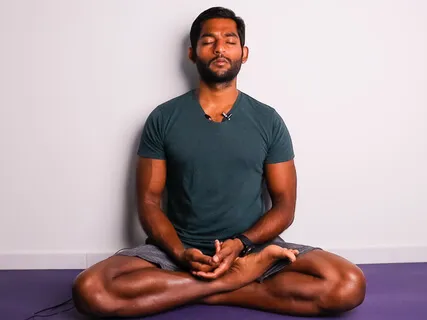
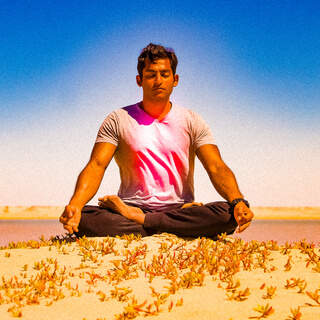
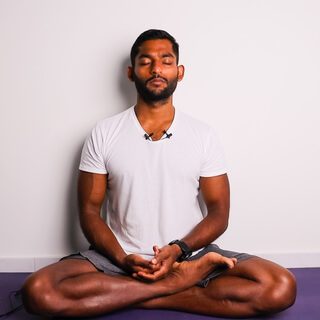
If you see even just the posture of sitting cross legged,
Sitting with your spine erect,
Even this much,
Even this much,
If you master,
If you practice,
There is a lot to achieve with that.
Even when you learn to keep your body still,
Half of the battle is already won because your mind automatically follows everything in you.
All your energies automatically follow if you learn to keep your body still.
So postures come into play over there without you having to always just meditate over the couch or lying down.
You learn how to meditate in postures and the simplest posture is sitting with legs crossed and with your spine erect.
You don't have to make a full lotus.
You don't have to make a half lotus,
But try to sit so that your spine is erect and your body is not constantly fighting with you,
Moving in here and there and creating pain.
So this asana becomes important to learn to put yourself in a meditative posture so that you can leave the body behind.
You can leave the body at rest and move your awareness where you want it to move.
Pratyahara,
Withdrawal of senses,
Inward flow of senses.
Pratyahara is another dimension where you learn to go beyond the five senses.
What we have these five senses and the mind,
This is what creates the entire experience that we are living in.
In order to come to truth,
In order to move beyond perception,
You have to learn how to withdraw your energies from different senses,
From all these different directions,
From the mind and from all the five senses and then put them together so that you have that energy to move again in the direction where you would like it to move.
So you see that the entire science is about how you are gathering,
You are mastering energy and learning how to direct this way you want this to be directed.
It starts with first of all,
Stopping the leakages,
Setting rules so that your lifestyle helps you to live that powerful energy state.
Then you have asanas to practice so that you can also allow your body to not come in the way.
And then you have pratyahara where you withdraw yourself from all the senses.
And then once you have the awareness,
Once you have the energy collected in you,
Then what to do is there's one more step in between,
Which is pranayama.
Pranayama is when you control the energies through the breath.
This is a dimension which has been explored deeply in over the years and there have been several breathing practices developed to control these energies and the flow of these energies through the breath.
We will also go in depth into pranayama as we go to these sutras individually in each of the sessions.
So these five are to learn to bring the energies from all different directions,
Bring them to one point.
Then to do what is dharana,
Concentration.
Then you take this energy,
This awareness and learn to direct this at an object that is dharana where there is an uninterrupted flow,
Concentration on a particular object,
Focusing on any object.
It can be the object outside any object outside a tree,
A mountain,
Sky,
Anything,
Or it could be an object inside your own breath,
Your any aspect of your mind,
Of your body.
The idea is to learn to focus and concentrate the energies at one point.
So first of all,
To gather the energies and then to be able to direct these energies uninterrupted towards an object that is dharana.
Once you have learned to do that comes the next step,
Which is dhyana.
In dhyana you lose the object,
You let go of the object because the purpose of directing the energy towards the object is fulfilled.
What is the purpose is to know the object.
The knowledge happens when your awareness is concentrated at the object.
That's the only way to know any object that you want to know any subject,
Any aspect that you want to know.
You have to bring your awareness and allow it to concentrate your energies to concentrate on that.
That's how knowledge happens.
So once the purpose of dharana is over,
Then you take the object away and there is only the subject and the flow of energy remains that is dhyana.
And the last,
Which is samadhi.
This is a state when even the subject,
It also disappears,
Melts into the pure awareness.
And then there is this only pure awareness,
Pure consciousness where there is no object,
There is no subject,
There is only experience,
There is only pure consciousness.
That is the state of samadhi,
Which is the last step in these eight limbs of yoga.
Here Patanjali also says that this also has to be achieved for the entire transformation.
So we will go through these eight limbs one by one in detail over the next sessions.
For now,
Let us move into silence.
Let us take this point in our life,
In our journey through yoga as the point of change,
As the point of transformation and begin this point of transformation by chanting om,
Which allows all the energies in us,
In our body,
In our mind,
In our mind.
In our heart to rise up and to reorganize,
To move towards the positive directions in life.
Please close your eyes.
Make sure that your body is comfortable.
With your spine erect.
You're breathing in and out naturally.
And with every breath,
Your body,
Your mind is settled more and more in this moment.
We will chant om with silent pauses in between.
Let go of yourself in the sound,
In the vibrations of om,
Allowing your energies to reorganize,
To unleash,
To come out of all the negativity and move towards positivity in life.
Inhale.
Om.
In the silence,
Let the awareness arise in silence,
Becoming more and more.
Another deep breath in.
Om.
Feel the sensations.
Feel the vibrations in your body.
Om.
Om.
Allowing your mind to calm down.
And the vibrations of om fill your body,
Mind,
And your entire inner space.
Om.
Om.
Letting go of all the past.
Remaining in the present.
Open for the future.
Whatever that may bring.
Om.
Leaving no corner in you where the vibrations don't reach.
Allowing everything in you to vibrate,
To reverberate,
To be touched by the sound of om.
Om.
Om.
Notice the silence,
The stillness that comes along with the vibrations of om.
Om.
Move into the stillness,
Into the silence.
Allowing your energies to reorganize.
In your body,
In your mind,
In your heart,
In your spirit,
Into all dimensions of your existence.
Om.
Om.
Remaining in this silence,
In this awareness.
No effort.
No effort.
No doing.
Staying in what is.
Om.
If you wish to continue in this meditative state,
Keep your eyes closed.
Move deeper within as long as you like.
Or very gently and slowly,
You may open your eyes with me.
Taking this point in life as the point of transformation along this journey of yoga.
I will see you tomorrow at 7am Central European Time.
Namaste.