Good morning,
Everyone,
And welcome to members of the extended UVA community from all over the world.
Before we begin our exercise,
A small simple object like a pebble,
Coin,
Eraser,
Even like a little corner of paper or a blank post it will do.
My name is Dan Hirschberg.
I am presently an associate professor of religious studies at the University of Mary Washington.
I'm also the founding director of the Contemplative Studies Program.
And this year I'm a visiting scholar at CSC,
Working on meditation apps in particular.
One of my core interests are contemplative interventions for the adverse effects of technology usage.
Unless we live a more monastic,
Less constantly connected life,
We all inhabit a hyper distracting environment of digital alerts,
Notifications,
And repetitive demands that undermine the depth and richness of uninterrupted concentration.
This is the exact target of today's contemplative exercise,
A traditional Tibetan technique for flexing the faculty of our attention.
So if you've been able to locate a small object,
Again,
It doesn't have to be anything special,
Even better if it's not.
I'm just going to use an eraser.
And you can place this a little bit out in front,
Easily within your range of view.
And this will serve as the anchor of our attentional focus.
So now we can begin our brief training session here.
And what I'll ask you to do is please close your eyes at first and take a few deep breaths.
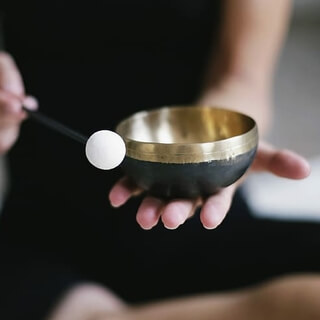
And as we listen to the bell ring out.
That's clear.
Relax fully with the breath.
Understanding how good it feels to simply breathe right now in this moment.
Now please open your eyes and direct them to rest on the object.
There's no need to stare intensely.
Simply rest your eyes upon it,
Breathing naturally and relaxed.
As you do,
Try to stay fully present with your visual field focused on the object.
Watch as attention naturally fluctuates.
What do you notice?
If you notice attention to the visual field soften or waver,
Or when you return from being dissolved in thought,
Simply retrain your attention on the visual field as it perceives the object.
Continuing in this way,
The actual target of our concentration here is not so much the object itself,
But our actual attentional process in real time.
We are completing cognitive reps,
Deliberately focusing our attention again and again,
Striving gently.
To extend the length of time,
We can remain focused while gaining insight into our attentional process.
How long can we remain stable and with clarity,
Acutely focused on the present?
How long can we remain stable and with clarity,
Acutely focused on the present?
In the Buddhist contemplative tradition,
Exercises for focusing attention and relaxation are often the same.
We now strive to find a balance between tightening tight,
Holding attention to the object,
And simultaneously loosening loose,
Relaxing deeply so that attention rests naturally.
Now,
Please close your eyes again.
Release the exercise.
Can take a few deep breaths.
Again,
Enjoying breath simply for the sake of breathing.
Okay.
Thank you for your participation.
It's recommended to perform this exercise in short sessions of around five minutes.
This is considered ideal,
And you are welcome to apply it whenever convenient as a mode of training attention and also employing it as an instrument that clarifies the nature of both attention and distraction.
May it serve you all well.
Have a good week.
Toughest of New Zealand and