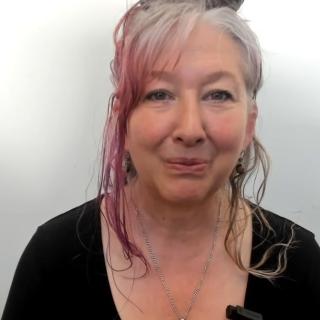
Hello.
Welcome back.
I am Colleen Fletcher.
And today with this beginning meditation series,
We are going to tackle the number one thing that I hear all the time,
Everywhere.
My clients say it all the time.
It is pervasive.
Would you really?
It doesn't need to be,
I understand it,
But we're talking about that monkey mind or brain chatter.
That constant thing of I can't turn my brain off to meditate.
I know you can.
Yours might be different than someone else's and how that comes into play,
But you can.
I.
.
.
It is.
I think the biggest thing that keeps people from meditation.
Now,
Most people also think you have to have this perfectly empty brain with no thoughts ever roaming through it.
And that's just not.
.
.
Kind of how it goes.
It really just isn't.
Um.
.
.
And it's certainly not about stopping those thoughts at all,
Because they're going to come up.
It's about working with that and how.
We bring our breath,
Our anchor,
How we move with our geometry,
With our posture of coming right back.
So if there's a thought that comes in.
Know that you're not wrong.
To having that thought come in and that you haven't failed.
You have not failed at all with this.
Right?
Your brain is meant.
To have these thoughts come in,
It's like your eyes are meant to see or your ears are to hear.
That's what it is.
So we're really going to be changing our relationships.
With.
Monkey mind,
Brain shatter.
And that's what we're doing today.
Now if you want to imagine your mind is like this vast blue sky.
Your thoughts,
The to-do lists,
The memories,
The worries,
The plane going overhead.
They're just clouds passing through.
That's what they are.
They just kind of come.
And they go.
And some clouds are white and fluffy,
And some are dark and stormy.
But no matter how big the cloud is.
It cannot hurt that sky.
It can't.
The sky simply provides the space for the clouds to exist.
And we are not,
In this practice here,
We are not trying to push the clouds away.
We're simply sitting back and watching them drift by.
Knowing that we're the sky.
Not the weather.
Now another way to look at this is you are traveling along,
Driving along,
Or walking,
However,
And you're on a freeway and you're just going.
You're in your groove.
And then a thought comes in.
That is like you're getting off on an off ramp.
And about here,
When you're on that,
You realize,
Oh!
I've kind of wandered.
Take that breath,
Take that anchor.
Bring it back.
And on your exhale,
You get right back on that freeway or road or wherever you are.
So those are two different ways of looking at this that can really,
Really make a big difference.
Of a big difference in helping get you back into your internal space.
Now when that brain chatter starts,
Or that monkey mind,
It can get loud.
We're going to use a technique called labeling first.
And when you've noticed that you're drifting and some thought comes in,
Something.
Sometimes it can also be like your body's uncomfortable or you get an itch or something like that.
Any of those things.
Anything that kind of.
.
.
Distracts you from where you are.
A noise,
Anything like that.
That's where we're going to want to.
Yes,
Come back with the breath,
But we're going to also help our brain a little bit more.
With labeling it.
So.
.
.
Different labels for it.
Oh,
That's the sound.
Oh,
That's a to-do list.
It's a thought.
I've had another thought.
Right?
Anything like that?
And label it.
Just gently label it.
And it's not that it goes away.
It has to go away.
It's that you've acknowledged it.
I've also found it can be very,
Very beneficial to say.
Not right now.
Let's say a thought comes in.
You gently,
Calmly,
Nicely say to yourself,
Not right now.
I will come back to you.
At times,
I recommend people keep a little pen and paper so you can hand scratch little,
Oh,
Because I personally find it very frustrating when I remember one thing I need from the store and then I don't write it down right then and then I've forgotten.
I don't like that so for me it is easier and with many clients to just have a little pen and paper quickly Go ahead and scratch it out,
Write it down.
Very,
Very,
Very quickly.
As part of that noticing something and labeling what it is.
Just so that your brain can calm down even more.
So you have to find whatever balance there is for you.
Gonna give you some time now.
Compound all of these layers and layers of wonderful things that you're doing through meditation where you're sitting indoors,
Outdoors,
Chair,
Cushion.
Ah.
Body,
Your sits bones,
Right?
Your posture.
Your breath all the way down into your low back and belly.
Now we're working with that brain chatter.
If something comes in,
Give it a gentle label.
Find connection with yourself.
How many times did you catch yourself?
Catch yourself with a thought and how many times did you label it?
Look at how well you did.
Labeling it.
Noticing it.
So well done.
Now remember.
A good meditation isn't one where you had no thoughts.
And you've done this,
You've noticed those thoughts.
And you returned using your breath.
To your body,
To you,
To your being,
To this experience.
Very precise moment.
You're doing the work.
You're doing amazingly well.
These are things that even after all the years I've been doing this,
That I come back to this.
I ensure that my posture is stable.
Is upright.
I'm using my breath to work with it.
I use that noticing.
That labeling of,
Oh,
Just a thought.
Take care of things that way.
These are the very,
Very,
Very basics and you are doing an amazing job.
And in our final session of this series,
We're going to piece everything together,
The space,
The body,
The breath,
The mindset,
Into one complete practice.
Thank you for being with me and I'll see you then.