The silent scrolls of Khafre's shadow Tonight,
Let us journey far across the sands of time and distance to the ancient land of Egypt.
Picture those silver streaks of moonlight stretching into pathways across a vast desert,
Leading you to the edge of a place where the stars seem closer and the echoes of history clearer.
We find ourselves in the shadow of the Great Pyramid of Giza,
The magnificent tomb of Khufu,
Also known as Cheops,
The second pharaoh of the fourth dynasty.
But our path leads us to its quieter,
Yet still monumental neighbour,
The Pyramid of Khafre,
Khufu's son and successor.
A colossal structure that stood as a central focus of his reign during what historians consider the Old Kingdom,
A golden age of prosperity,
Organisation and artistic achievement.
As you approach,
The air fills with the dry,
Dusty scent of the desert sand,
Mingling with the faintest hint of something ancient and resinous,
Perhaps the remains of oils used in rituals long forgotten,
Or the lingering scent of acacia wood,
Once used in abundance for funerary barges.
The stones of Khufu's pyramid are massive,
Each block a testament to a skill and labour so immense that its true origins are lost to the deepest strata of time.
They simply were,
Standing as an eternal mystery,
Claimed by the passing millennia.
The surface of the pyramid is rough,
Weathered by millennia of sun and sandstorms,
And as you run your hand over them,
You can feel the grains of sand clinging to your skin.
Archaeological evidence suggests that these stones were originally cased in polished white limestone,
Giving the pyramid a gleaming,
Almost otherworldly appearance in the bright Egyptian sun.
The plateau on which Khafre's pyramid stands is higher than Khufu's,
Making it appear taller,
A clever architectural reality that enhances the presence of the structure.
Whether forged by his people or simply utilised and dedicated by the pharaoh,
Its perfect alignment with the cardinal points suggests a knowledge of geometry and astronomy that speaks to a profound,
Perhaps long-forgotten,
Understanding of the cosmos.
The moon casts sharp shadows,
Making the pyramid appear almost jacked against the night sky.
There is a profound silence,
Broken only by the soft whisper of the desert wind and the occasional distal bark of a jackal.
The stars above seem impossibly bright,
Like diamonds scattered across a velvet cloth,
And you can almost feel the weight of history bearing down,
The presence of countless lives lived and lost along the banks of the Nile.
During Khafre's reign,
Egypt was a highly centralised state with a sophisticated bureaucracy.
The pharaoh was seen as a divine ruler,
A link between the gods and humanity,
Responsible for maintaining Ma'at,
The cosmic order and balance of the universe.
Our adventure tonight lies not within the dark,
Hidden chambers,
Which some people say predate the pharaohs themselves,
With their narrow passageways and the grand burial chamber,
Deep within the heart of the pyramid,
But along the outer walls,
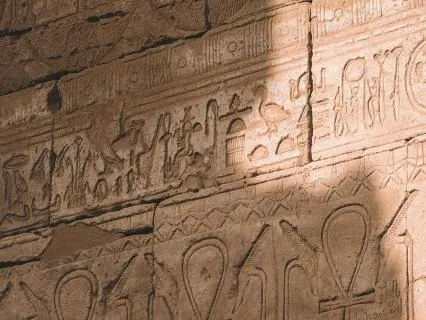
Where rows upon rows of hieroglyphs are carved into the stone.
These are not mere decorations,
But the very language of the gods,
Each symbol telling a story,
Each bird and eye and hand holding a piece of ancient wisdom.
Hieroglyphs,
Derived from the Greek word hieros,
Sacred,
And glypho,
Carvings,
Were used for religious and monumental inscriptions.
They were a complex system of writing that included logograms,
Symbols representing words or morphemes,
Phonograms,
Symbols representing sounds,
And determinatives,
Symbols that helped clarify the meaning of other symbols.
Many glyphs have faded over time,
Worn smooth by the relentless sand and wind.
Others are as sharp and clear as if carved yesterday,
Depicting scenes of pharaohs making offerings to deities like Ra,
The sun god,
And Anubis,
The god of embalming.
Gods in their divine forms enjoy a celebration of life and prosperity.
Ancient Egyptians' religion was polytheistic,
With a pantheon of gods,
Each responsible for different aspects of life and the natural world,
All working together to maintain balance and harmony.
Tonight,
We imagine a young scribe named An-Ku,
Who comes to the base of Khafre's pyramid under the light of the full moon.
An-Ku is dedicated to the study of the ancient texts.
He carries with him a small oil lamp,
Its flame flickering in the breeze,
And a set of brushes and papyrus scrolls.
Papyrus was a crucial material in ancient Egypt,
Made from the pith of the papyrus plant,
Which grew along the Nile.
It was used for everything from official documents to religious texts to personal letters.
An-Ku is here to decipher the hidden stories carved into the stone,
And to bring their silent words to life once more.
An-Ku approaches the stones with reverence,
Murmuring a small prayer to Thoth,
The god of writing and knowledge.
Thoth was often depicted with the head of an ibis and was considered the patron of scribes,
Scholars,
And magicians.
He was also associated with the moon,
With timekeeping,
And mathematics.
An-Ku sets to work,
His lamp casting dancing shadows across the glyphs.
With careful strokes,
He traces the outlines of each symbol on his papyrus,
Speaking their names aloud.
Ra,
The sun.
An-Ku,
The symbol of life.
Ma-At,
Truth and justice.
Ma-At was the fundamental concept in ancient Egyptian society,
Representing cosmic order,
Balance,
Truth,
And justice.
The pharaoh was responsible for upholding Ma-At.
He was also ensuring the stability and prosperity of Egypt.
As An-Ku works,
He begins to understand the messages.
The glyphs seem to come alive in the lamplight,
And An-Ku starts to piece together the stories.
He reads of life along the Nile,
Of bountiful harvests and life-giving floods,
Of victories and trade,
And friendly relations with neighboring lands,
Of hopes and joys for the present life.
The Nile River was the lifeblood of ancient Egypt,
Providing water for agriculture,
Transportation,
And trade.
Its annual inundation of flooding brought fertile silt to the land,
Allowing for bountiful harvests.
An-Ku deciphers the story of Khafre,
The pharaoh who presided over this pyramid,
Dedicating the massive structure to the gods,
Showcasing his wise leadership and his desire for the prosperity of his people.
We know from archaeological findings that Khafre's reign was a period of stability and prosperity.
He likely continued many of his father's policies,
Maintaining a strong,
Centralized government and overseeing the construction of numerous monuments.
But as An-Ku looks at the perfect triangular geometry,
He realizes the deeper wisdom inherent in the form.
The pyramid is a cosmic ramp,
Its shape echoing the Ben-Ben stone,
The primordial mound of earth that first rose from the waters of chaos,
Noon,
At the moment of creation.
It's a physical machine built to transform the pharaoh's soul,
Or Ba,
Upon death,
Allowing it to ascend its smooth faces and join the circumpolar stars,
The imperishables,
That never set,
Thereby guaranteeing his eternal life and the stability of Egypt.
The pharaoh,
In becoming a star,
Continued his sacred duty to maintain Ma'at,
The very order of the universe.
He learns of the rituals performed at the pyramid's base,
The processions and offerings,
The prayers and songs of gratitude.
These rituals were elaborate and involved priests,
Musicians,
Dancers,
And offerings of food,
Drink,
And precious objects.
The goal was to honor the gods and to celebrate the good fortune of the kingdom.
Stories of ordinary people,
The engineers who planned Khafre's complex around the existing monument,
And the laborers who maintained it,
Along with the farmers and the fishermen,
Whose lives were enriched by the stability of their pharaoh.
These people formed the backbone of Egyptian society,
Providing the labor,
Food,
And resources necessary for the maintenance of the kingdom.
The air grows heavier as Angkou immerses himself in the task of deciphering.
You can almost see the scenes depicted on the stone coming to life,
The barge of the sun god sailing across the sky,
The people celebrating with music and dance,
The farmers rejoicing at a rich harvest.
The images swirl in his mind,
A vibrant tapestry of ancient beliefs and joys.
The night deepens,
Angkou feels a sense of connection to these ancient people,
A bond that transcends time.
He is no longer just a scribe copying symbols,
But a bridge between two worlds,
The material and the celestial,
The transient and the eternal.
He understands that his act of preserving these stories,
The proof of a life lived under Maat,
Is itself a vital piece of the cosmic order.
The true wisdom he realizes that every humble life lived justly,
Every successful harvest,
And every prayer of gratitude adds weight to the great balance of the universe.
The pyramids may reach for the eternal stars,
But the stability of the kingdom rests on the daily actions recorded on these very walls.
Finally,
As the first hint of dawn touches the horizon,
Painting the sky with streaks of pink and gold,
The glyphs on the stone become still once more,
Silent and enigmatic.
Angkou gathers his scrolls and his brushes,
His heart full of the stories he has deciphered.
He knows that he will return,
Again and again,
To study the silent scrolls of Khafre's shadow,
To uncover their hidden truth,
And to bring their ancient voices back to life,
Sharing their tales of joy,
Prosperity and gratitude.
As you drift off to sleep,
Imagine the quiet figure of Angkou,
Illuminated by the flickering lamp,
Surrounded by the vastness of the desert and the silent majesty of the pyramids.
Imagine him poring over the glyphs,
His mind working to unlock the secrets of the past,
And revealing stories of the hieroglyphs.
Sleep well.
Good night.