We're going to be doing a gentle kind of stress-relieving flow today.
And when we feel a little under pressure and a little stressed in life,
When things are getting on top of us,
We tend to have this posture that rounds through the upper back,
Rounds through the shoulders.
We close off the chest,
The heart,
The lung space area,
Which makes it harder for us to draw energy in,
Which then helps us to shift gear from that state of fight or flight mode.
And it kind of prevents us from moving into the place where we want to get to,
Which is the rest and digest part the nervous system.
So what we want to do is find a little bit of space and open up through the chest.
We want to invite today some mobility through the thoracic spine to that lesser mobile part of our upper back.
I'm going to work a little bit with tension release around the neck and some shoulder mobility.
Because once the body gets used to sitting in this curly kind of opening,
Rounding upper body position,
The brain and nervous system believe that that's our default position.
It believes that that's how we want to be.
So it stops trying to open up this area.
And then we put pressure on all the nerves that are trying to send signals between the brain and the hands and the legs.
So everything about today's class is just kind of getting into those areas where we tend to have trouble spots of tension that linger over time and just releasing all of that.
Okay,
So we're going to be going nice and slowly,
Nothing too speedy today.
Let's get started then.
So I'm going to put my bolster and this is a bolster if you have one.
I'm going to use that behind my back here and I'm going to lie down onto it.
Now if you don't have bolsters you can set your blocks up so that you've got one block for your head and one block just sitting underneath the shoulder blade area okay the base of the shoulder blade so either of those options is going to work for you and if you're using your bolster Let's grab a block and put them either side of the knees.
If you're using the blocks to lie on you'll ignore this part.
Have a couple of inches between the lower back and the cushion.
And then just lower yourself down and you want the base of the bolster to kind of be sitting just beneath the center of the ribs,
The lower part there.
Knees are going to be bent,
Soles of the feet touching,
Knees dropping out to the side and then you're resting your blocks underneath the hips or underneath the knees.
First second height will be fine.
And then lie yourself down and allow your arms to come out a little bit wider than they would normally.
Away from the body.
And then go ahead and just close your eyes there.
Make any little adjustments that you feel like you need to,
To make that more comfortable.
We want this to be a really relaxed place.
In which you were starting.
And those of you who don't have the blocks available for under your legs,
Just let the legs be as if you were in Shavasana here instead.
And once you've made all of those tiny little adjustments that your personal body needs,
Just go ahead and close your eyes.
And as you close your eyes,
Just take a moment to soften in between the eyebrows.
The center of the forehead area,
An area that we tend to and consciously clench or kind of tighten when we're under a little pressure.
And take your attention around to the outside edges of the eyes.
Notice how they can have that same invitation to soften and slow down there as well.
And then guide your attention down to the corners of the mouth and just invite a little smile onto your lips so there's this feeling of relaxing.
That instantly comes with a smile on the face.
Hard to feel stressed or worried when there's this energy of smiling.
And then notice where the tongue is.
If the tongue's resting in the roof of the mouth,
Can you just gently relax it away?
Notice how that gives you a feeling of ease around the neck and the throat area.
And let the shoulders melt down effortlessly either side of your cushion.
You might take the fingers a little wider away from centre as you start to feel the fascia around the front of the chest and the shoulders start to unravel and unwind.
And just notice how it feels to take a breath in either through the nose or the mouth and nose if you're able to.
And guide that breath down through the throat,
Down into the centre of the lungs.
So there's that awareness of the gentle rising of the area just where that cushional block is sitting.
And the ribs lift upward,
But they also lift out to the left and right side of the body.
So just becoming aware of space arriving into our upper body.
And then notice on the exhale all of those areas that expanded just slowly starting to work their way back towards centre.
And none of this really requires any effort on your part.
It's just noticing what's naturally happening in the body.
And then each inhale that arrives,
Just become aware of whether that breath reaches down a little bit further.
So is the belly area soft and relaxed as well?
This is another area that we tend to clench and hold on to.
Causes all sorts of trouble.
The core stabilizing muscles,
Our digestive system.
Invites us back into that state of fight or flight.
So notice if that area softens and relaxes and then again with each exhale just letting everything work its way out of the body that we no longer need.
Everything comes back to centre that we need to hold on to.
And now let's just take three rounds of breath together.
So as you inhale,
Let's see if we can let the inhale last for four counts,
Your own count of four.
Guiding the energy down deep inside of you,
That awareness of expansion and space arriving into the lungs.
Reversing the effect of.
.
.
How we've spent the week sitting.
And when the count is finished,
We're going to let the exhale begin.
And the exhale is going to be counting to six or eight,
If you can get to eight.
So the exhale is longer than the inhale.
And let's take three rounds like this from this point.
Three inhales,
Three exhales.
With this extended exhale.
When the third round is finished,
Just coming back to the natural breath.
And as you do,
Just notice how things have naturally slowed down a little from when we first began the practice together today.
Know that you can use these tools at any time that you need them during the day.
And let's just slowly,
Slowly start to walk the arms in a little closer to the body and we'll take our hands underneath our thighs,
Guiding the legs together.
Feet come down to the mat here and we're going to take the block if you're using one on the left side of your body and just move it out of the way so that you can gently roll yourself onto the left side of your body and just pause on the left side for a moment.
And just again,
Notice how you're feeling.
No hurry about the practice.
At all and then reach around with one of your hands and just gently invite the the bolster to kind of be pushed away so off the mat.
Then go ahead and grab one of your blocks and we're going to place it where the head would be on the second height.
Okay.
And then once the block is on the mat,
I want you to just roll yourself slowly back on so the back of your body is on the mat and you're going to rest the base of your skull.
Just on the corner of your block.
Okay,
So the base of the skull,
The top of the neck on the corner of your mat here.
And readjust that until you feel like that's a comfortable position.
And you want all four corners of the block flat to the ground,
So there's no nasty surprises for the neck here.
And you're just going to slowly massage the neck here by rolling or turning the head gently from side to side.
And again,
This is an area where we store a lot of our physical tension,
Our mental tension as well.
An area that gets really congested from how we sometimes have that tendency to sit with a little slouchy.
Upper back and neck and the neck takes the load of carrying the weight of our head.
So whenever you find a part of the neck that feels tender,
I want you to just pause there for a moment,
Either in stillness and just let the weight of gravity draw down into the block,
Or you'll just slowly move in tiny movements from side to side over that knotted area until it starts to feel like it releases.
And I practice this myself on those more busy days or when I've been sitting down at the desk editing things a lot.
And it just invites me to remember to let tension go.
Physical and mental.
So let's just spend another five breaths here and I'll do the counting.
You just do the awareness of how your body's feeling today.
Two more breaths here.
When that second breath is complete for you,
Just slowly come back to centre,
Lifting the head just enough to release the block with the hands.
Block goes to the side and just let the head come back down to the ground for a moment and just pause.
Pause with your eyes closed and just notice how that feels.
And again,
We're in no hurry in this practice today.
This is just building awareness of the benefit of slowing down.
The benefit of not being in a hurry.
And this idea of not always racing from one project to the next,
Which is,
I know,
Something I'm often guilty of myself.
And reminding ourselves to pause in between all of the doing.
Finding a better balance.
Now go ahead and just slowly reach the arms all the way up overhead and then point the toes away from the fingers.
So you're coming into this nice long full body stretch and then once you're in it,
Spread the fingers and the toes as wide as you can.
So you're really getting into the tight fascia spots in between the fingers,
In between the toes,
Just reminding the muscles that one of their jobs there is to find space as well.
And once you've got as long as you think you can,
And you've enjoyed that delicious stretch through the front of the body,
Hug the knees in towards your chest,
Get as small as you can,
Opposite motion,
And just wrap the arms around the shin,
So the head is probably gonna lift up from the mat.
Shoulders,
Neck a little bit as well.
Can you keep that connection in the belly and just take the hands now to the back of the thighs and let's rock and roll along the length of the spine here.
Little massage along the lower back and middle back and upper back.
And just notice how that feels,
Anything that feels really,
Really good,
Anything that feels a little out of place,
And then eventually rock and roll yourself up to a comfortable seat.
So the furthest point we've been from the ground so far.
Okay,
So you're sitting nice and tall now,
Taking a cross leg or sitting on your shins,
Whatever it is that works for your body today.
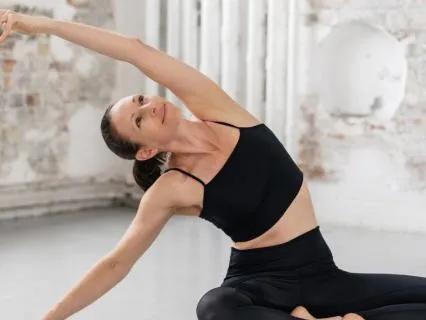
And then take your left hand down to the side of the mat.
Big inhale,
Sweep the right hand up to the sky.
And as you exhale,
Just slowly,
Slowly working your way into a side bend.
And I want you to just see if you can,
Rather than focus on how deep you can go into it,
Notice the sensation of release and notice how that feels through the lower back,
Through the side waist and the space in between the ribs here as well.
Can you draw the shoulder back a little further?
Maybe the arm is straight or like mine is with a little bend here or you can take your hand to the back of their head with a bend in the elbow.
And just notice what feels best for you.
Finding a little release.
There's a little bend in left elbow as well.
Take another big breath in.
And then let's slowly come back up through center and we'll go to the second side.
So we're taking right hand down,
Left arm up and over.
And again,
That shoulder's just drawing back.
The fingers are reaching.
Maybe you've got the bend in the elbow,
Hand on the head.
Maybe the hand is reaching.
Towards the side of the room but the heart is kind of lifted,
Shoulder jaws back and notice how it feels in this direction.
And another benefit of going a little bit more slowly is we get to tune in,
We get to notice what's happening from side to side,
From front to back.
How is my body doing today?
Where is the symmetry?
Where do I need to find a bit more balance?
Nice.
And then let's just slowly guide ourselves back up to center.
And now we're going to roll ourselves over into a simple tabletop position.
So shoulders above the wrist,
Hips above the knees here.
Okay.
And on the inhale,
Let's just soften the belly.
Let the pelvic bowl tilt a little forward.
So the chest starts to come forward naturally,
Tailbone lifts up.
So the front body is awakening and opening.
As we exhale,
We're going to push the ground away and we're going to curl through the spine,
Chin draws towards the chest.
So there's this feeling of separation in between the shoulder blades and muscles that draw the shoulder blades together,
Getting a nice big stretch.
And then come back through center on the inhale.
Chest comes forward.
There might be a little clicking and popping as things start to wake up.
Let that be okay,
As long as there's no pain.
And then the exhale is that rounding through the spine,
Really drawing the belly to the spine,
Spine to the sky,
And just notice how that feels.
Let's do that two more times and you can go at the rhythm that suits you best and working with your breath.
And just trying to maintain that awareness of the breath is one of the easiest ways for us to stay present.
When we stay present,
We're much less likely to worry about things that have already happened or worry about things in the future.
Last one.
Nice,
And then just slowly coming back to center.
Let's walk the fingers just a little further forward,
Tuck the toes under,
Lift the knees,
And we're coming into our first downward facing dog.
So again,
The highest point of the class so far is this.
Hips are lifting high,
Hands are pushing the ground away,
Thighs are reaching back,
And let's just start to walk the dog.
So we're lifting one heel,
Bending the same knee,
Getting some movement through the back of the legs now.
Notice how it feels around the back of the ankle.
How it feels around the calf,
How it feels around the hamstrings,
Those bigger juicy muscles at the top of the leg.
Head is heavy,
Neck is relaxed.
Slow,
Calm breath.
And just take another movement with the legs,
One on each side.
And then you'll slowly pause in center.
And when you do,
Let's lift the right leg up.
Three-legged downward dog.
And then bend the knee,
Heel towards the bottom,
Knee towards the sky.
And let's just draw a couple of circles here.
Let's say three circles.
And let's go in a clockwise direction on this side.
So just a little awakening around the hip socket there.
And when you finish the third circle,
You'll square the hips back to face the ground and the foot will return to the floor.
And then let's do the same thing on the left side.
So left leg lifts,
Inhale.
Exhale,
Bend the knee,
Heel to bottom,
Knee to sky.
And let's go anti-clockwise with our circles here.
And just notice how that feels for you.
Taking another circle.
Bagel smoke.
Nice,
And then squaring the hips,
Foot returns to the ground.
Looking forward,
Stepping right foot between the hands,
Lowering left knee down,
Coming onto the top of the foot,
Guiding those fingers up to the sky.
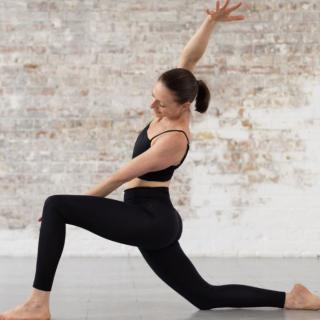
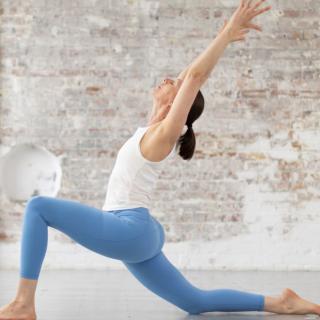
So low crescent.
And I want you to sink into the hips,
But rather than kind of going into that kind of floppy thing,
I want you to draw the belly in and up,
Which kind of draws you a bit further away from the ground than you might normally practice.
And I want you to grip the earth with the feet.
And as you do that,
You're gonna almost be drawing left hip forward,
Right hip back a little.
And can you imagine that the inner thighs are squeezing something in between them?
Even though it's literally impossible.
And then also can you imagine something in between the hands?
So you're nice and strong in the upper back here as well.
And you're feeling it potentially through the front of that left hip.
And this is an area that can get a little congested when we sit down here as well.
And this muscle attaches into our lower back,
So when this muscle is tight,
It's pulling or tugging on the lumbar part of our spine,
The lower back in particular.
Which can restrict so much of our movement all the way through the body.
Not just in that area.
So when you hold the belly in lightly,
But still sink downwards.
And then visualize everything from the belly button up lifting.
Now let's turn the palms to face forward,
Bend the elbows so that they come to be parallel to the ground,
And then lift the chest.
And now you're squeezing the shoulder blades towards each other.
And just notice how that feels in the upper back.
There's this feeling of awakening again through the front of the chest,
Which is where we were working with that bolster or blocks in the beginning.
Take another big breath.
And then simply taking left hand down to the earth next to the right foot,
Twisting body to the right side of the room,
Right hand reaching up to the sky.
Okay,
So left hand pushes the earth away,
Which helps you to draw ribs more around to the side of the room.
Some of us are gonna pick up left foot,
Reaching the heel to the bottom,
And maybe we'll catch the foot.
Maybe we'll be working hand and foot towards each other by energetically squeezing here.
And some of us are going to stay where we started.
Just focusing on the twist itself,
So options there to play with.
Now if you do reach the foot and hand together,
Push the foot into the hand so that it helps you to lean back more into the twist,
Which is my main focus.
Keep the smile in place,
Just relaxing through the jaw,
The neck.
One more breath here.
And then releasing the foot,
Hand comes to the top of the mat,
Hug the toes,
Lift the knee,
Stepping back to downward facing dog.
So back to where we started,
That familiar place.
To return to.
And just notice how it feels to lift the hips high to the sky again.
All of that space that we've created through the spine here.
And then looking forward,
Softening the knees,
Left foot between the hands,
Right knee comes down now,
Coming onto the top of the foot.
Gripping the earth with the feet,
Which prevents us from kind of going down.
It takes us up a bit higher.
Fingers up to the sky.
Palms are reaching towards each other as if there's a block that we're holding.
And just noticing as you draw yourself a little further away from the ground,
That feeling through the front of the right hip here.
Awareness of this action of squeezing inner thighs towards each other,
Even though we know they can't touch.
Nice and relaxed around the jaw,
The neck.
Consciously aware of all of these little habits that slip into the practice.
Knowing that probably they slip into our day-to-day life and routine as well.
So notice what areas where tension creeps in and see if you can swap it for that feeling of ease.
Let's turn the palms to face forward,
Cactus the arms again,
So bend those elbows,
Lift with the heart,
And just squeeze shoulder blades towards each other.
Tongue is relaxed,
Little smile in place.
Tuning in,
Noticing how you feel.
Take another big breath,
Just here.
And then take the gaze down,
Right hand down to the mat.
Simple twist the left side of the room.
So right,
Left hand up to the sky,
Right hand is pushing the ground away,
Which helps us to actively draw ribs on the left side back.
Lift the fingertips higher.
Let the right hip sink down towards the earth more.
And then make the choice,
Picking up right foot or not,
Maybe reaching around with left hand towards the foot.
If you can reach the foot,
Great.
Pushing the foot into the hand so you can lean back into that thoracic twist a bit more.
And if you can't reach the foot,
You're reaching hand and foot towards each other.
And if none of that makes sense today,
Just keeping it really simple.
Listening to the body,
That's the purpose of the practice.
Tuning in,
What do I need today?
Rather than how should it look,
What do I need to push myself to do?
How do I feel?
What do I need?
Take another big breath in.
And then lower left hand down to the ground,
Release the foot if you had it in the hand.
Tug the toes under of the right leg,
Lift the knee,
Step it back to downward facing dog.
Take a big breath here,
So the hips are lifting high,
Hands are pushing the earth away,
Thighs are reaching back.
Notice how that feels,
A little opportunity to invert.
And then lower the knees to the ground,
Tabletop position.
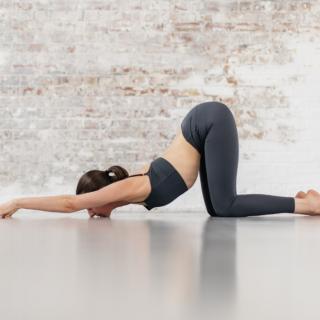
Walk the fingers forwards,
Melting heart.
So chest reaching down to the earth.
Just notice how that feels.
You're either on the chin or the forehead,
Most likely forehead.
If there's a gap between forehead and the ground,
Grab a block.
Place it underneath,
A cushion will work as well.
And as you're here,
Just try to soften and relax around the chest,
Around the shoulders,
Around the armpits.
Breathe into any areas that feel a little tense.
And let your mind know that it's safe to be here.
And often we think that stretching is the answer to finding space in the body,
But really it's letting our brain,
Our nervous system know that we're in this safe place.
And once they receive this information that we're in a safe place,
The muscles relax,
Tension works its way out of the body.
One more breath in.
One more breath in.
And then just slowly start to lift your chest.
Walk the fingers back to where you were and just slowly come to the outside of your hip,
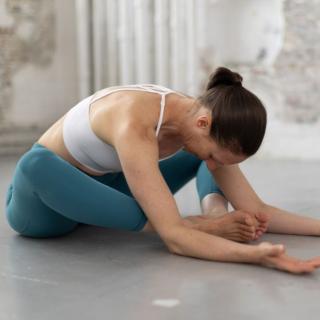
Bottom to the earth and let's guide the feet to come together in front of us.
So we've got the soles of the feet together here.
Knees are drawing out to the side,
However you need to get there is fine.
Interlace the fingers around the toes.
Sitting up nice and tall,
So keep that collarbone broad.
You've done the work to open that area up now.
Keep the spine long,
And as you exhale,
Just begin to forward fold.
Doesn't matter how deep you get.
And just notice how it feels through the groin.
Notice how it feels through the lower back.
A nice light grip of the feet.
So we sometimes have this tension that lingers around the fingers.
We make a fist with the hand when we're under pressure here as well.
Notice when that happens,
The white knuckle effect I call it.
So when the white knuckles are there,
What can you do to soften and relax that?
Collarbone broad.
As you breathe a little more deeply and calmly,
Notice the space that arrives into the physical tissues.
Notice how the mind is doing.
Slow down the breath.
Two more rounds of breath here.
Whamma!
And then gently releasing the fingers from the toes,
Rolling yourself up vertebrae by vertebrae.
Guide the legs together with the help of your hands here.
And let's slowly start to walk ourselves forward.
So bottom is in the middle of the mat,
Legs are extended out ahead of us.
And we're gonna lie ourselves down slowly,
Slowly onto the back.
And let's draw the right knee in towards our chest.
Keeping it nice and simple with our choice of twist today.
Right hand out to the right side of the room.
Knee draws across the body towards the left here.
And just notice how that feels.
So we want to try to maintain the upper back connection to the ground so that we really focus on the twisting and thoracic spine.
So if the knee doesn't touch the ground,
But the shoulders do,
That's my preferred place for you to be.
Notice how it feels.
Some of you might prefer to bend both knees together,
Some of you might keep it simple like this.
Some of you might feel it through the outside line of the right side of the body,
Maybe even outer hip.
Notice how when you breathe in you're inviting this state of calmness and as you breathe out there's the option to let that knee take a little bit more space reaching over to the side of the room.
One more breath in.
And then guide that knee slowly,
Slowly back to center,
Giving it a little hug.
And then releasing the right leg down to the earth.
Left knee comes into center here.
Left arm to the left side of the room.
Knee draws across the body.
Shoulders stay connected to the ground.
So we're only going so far that upper back stays connected to the earth.
And just notice how that feels.
Notice how it feels through the ribs,
The center of the chest,
The space that we invite into the lungs.
Notice how it feels through the left side body.
Upper body and lower body.
Perhaps one side of the body allows a little bit more rotation or twist than the other.
And perhaps they feel pretty balanced.
Take another breath here.
And then guide the leg back through to where we started.
Giving it a little hug if that feels good.
And then this is where you might want to grab your bolster.
For the end of the practice.
We're gonna rest it potentially behind the knees,
If that feels like a nice idea for your body today.
And then just lying yourself down into Shavasana.
I like to scoop the buttocks under,
Create a little bit more space in the lower back.
Feet are just naturally falling in whichever direction they go.
Taking the arms out to a position that feels good for the upper back.
Closing our eyes,
Softening the space in between the eyebrows.
Relaxing around the corners of the eyes,
The corners of the mouth.
Tongue away from the roof of the mouth,
Just taking a moment to pause as you settle into stillness here.
Our final resting pose.
For those of you who have time to spend a little longer in Shavasana,
Please feel free to do so.
Those of you who are joining me for the end of the practice,
Just slowly starting to bring a little awareness and movement back into the fingers and the toes.
Gently reaching the arms all the way up overhead,
Inviting that full body stretch.
Drawing the knees in towards the chest,
Giving them a hug as we roll a little from side to side.
Back and forth.
Eventually coming to roll over and rest for a moment on the side of our body,
Whichever side makes sense for you today.
From here,
Using your hands to push the ground away as you gently lift yourself up to a comfortable seat.
Taking a moment and notice how you feel.
Briefly aware of how you're doing compared to when we started in terms of space,
In terms of mindset.
Rhythm of breathing.
Let's see if we can carry some of this awareness of movement,
This awareness of space,
This awareness of posture.
And this feeling of calmness,
Finding calmness whenever we need it into the rest of our day,
The rest of this brand new week ahead of us.
Coming back to it at any time that we need to.
To bring the hands together at heart center.
Bowing the head to the hands in gratitude for our practice,
Gratitude for our health.
Namaste.