Hi,
I'm Andrea.
I'm a registered music therapist and a Thought Field therapy practitioner.
Today I will be going through the sequence of collarbone breathing.
This is a technique that we use in Thought Field Therapy for a variety of reasons.
And collarbone breathing is still tapping because we're going to be focusing on tapping on the gamut spot throughout this practice.
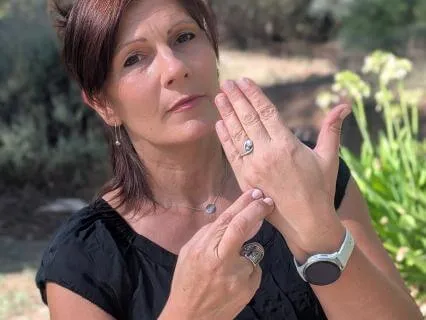
Let me just describe the gamut spot to you before I talk about sort of the areas that we'll focus on.
So the gamut spot is in between the little bones of the little finger and the ring finger.
So we have sort of a crease in there and you can feel it.
And we'll tap this spot with our other hand with two fingers.
We'll be tapping on one side and we'll be also tapping on the other side.
So you want to sort of get a feeling for that tapping point.
You can practice right now if you'd like to.
And you're going to say,
How in the world is this collarbone breathing?
We'll get to that.
So that's the gamut spot,
The tapping point we'll be using for this process today.
The sequence is a little bit tricky,
Really need to focus.
So I'll talk through some reasons of why we might use collarbone breathing and then we'll go through the practice together.
And it's great that you can have this guidance because it's sometimes hard to remember all the parts when you're doing it yourself.
You can get a little bit lost in the process.
So collarbone breathing has so many uses.
One great way to use it is simply by waking up every day and using this technique.
It's really good to just bring energy into the lungs because it's also a breathing exercise.
So it will.
Help set you up and give you fresh energy for the day.
Another way to use it is if.
.
.
Perhaps during the day you work with different people,
Or you might be a therapist or a practitioner yourself,
And you maybe pick up energy from other people really easily.
This is a great way to set yourself up in between your clients,
Or at certain points of the day you might want to stop and do it,
Or at the start and end of your day you can use it.
Just to,
Again,
Bring in fresh energy to yourself.
Other ways we can use it,
We can use it for.
.
.
Sort of perturbations that have to do with ADHD,
So having trouble focusing.
We can use it for learning disabilities.
So if you have a slight learning disability and,
Again,
Needing to focus and sort of clear the mind,
This is a focusing exercise.
So it really does help.
Corral the brain in.
It can be used to address dyslexia,
Stuttering,
And even Tourette's syndrome,
And sometimes it's helpful for people who have some mental health disorders like schizophrenia as well.
So the application is quite wide.
You can use it for so many things.
It's really useful.
It's also a good adjunct technique to have.
In addition to your tapping.
Sequences for other perturbations.
So it's a great addition to those.
In saying that,
If you're having,
Let's say you're tapping for pain and your rating is not coming down,
It's really stubborn,
Like your pain is five out of five,
You've tapped through at least five or six sequences and it's just not budging,
You can stop tapping through that pain sequence and just do a round of collarbone breathing and often then,
Going back to the pain sequence,
You'll see a difference in the decreasing of that perturbation.
So.
Again,
Collarbone breathing has many uses.
I'm going to go through the whole process.
Today with you so you can always come back to this video and use it,
Or you might want to memorize the process after a certain point and use it on your own.
And just get good at doing it all the time.
So we'll go into it now.
So collarbone breathing,
What we're going to be doing is using a breathing sequence,
And I'll talk through that first so we're not doing too many things at once.
The breathing sequence will be taking in a full breath.
So it means if you can do a belly breath,
That's great.
Just taking in a full breath,
Feeling like you're 100% full.
And then we'll be breathing,
Letting out half of that breath.
Letting out all of the breath.
Taking in half.
And then breathing normally.
So I'll say that again,
For each part of the sequence,
We'll be taking in a full deep breath.
Letting out half.
Letting out all.
Breathing in half.
And then breathing normally.
You can breathe through your nose is most helpful and out through your nose is helpful.
There's no really prescribed way of breathing for this exercise.
You can use whatever you feel is most comfortable.
So that's what we'll be doing with the breath.
Exercise a little bit of a sort of a mind-bending challenge is that we're going to be using different hand positions on the collarbone.
Aha!
Here's where the collarbone comes in.
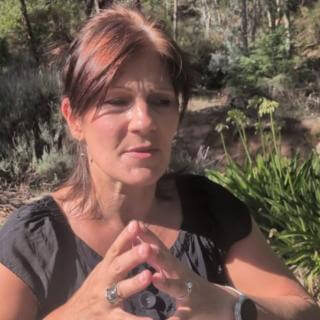
So the first hand position that we're going to be using is actually taking our knuckles and putting them on our collarbone and tapping the gamut spot as we do that.
So we're going to be doing that.
I'm starting on one side.
I'm moving to the other side with that same sequence.
And then here's where it gets tricky.
Watch very carefully.
We're going to do that with the other hand.
We're going to start there.
And finish.
Where we started.
Okay and after we do that what we'll be doing at that point is closing the hand And this is going to allow us to achieve negative polarity.
And we're going to tap.
We're going to keep the thumb sticking out.
We're going to go to the other side and tap.
And then what we're going to do is switch hands.
And tap.
And all of this is right under the collarbone.
In the collarbone area.
So I'll talk you through it.
So with each of those hand positions,
We'll be doing one of those breathing,
Whole breathing sequences,
One of those whole breathing sequences.
And back again and through the whole process.
Hang on tight.
Pay attention and we'll get through this and hopefully you'll feel like a new person afterwards,
Okay?
So getting in a comfortable spot,
Sitting up straight if you can,
And having the feet flat on the floor and not crossing the legs.
So this is really important because we want to make sure the energy is flowing through the system really easily.
So what we're going to do is start with our first position,
And you can take one of your hands.
It doesn't matter which one goes first,
But we do want to make sure.
Whoops,
We have two fingers.
That spot.
So we're going to start tapping and we're going to keep the tapping going throughout this whole practice.
With me.
Breathing all in.
Half out.
All out.
Half in.
And breathe normally.
Go to the other side.
Take the same hand to the other side.
Continue tapping.
Breathe all in.
Half out.
All out.
Half in.
And breathe normally.
Change hands.
Tapping.
Breathe all in.
Half out.
All out.
Half in.
And breathe normally.
Move the hand to the other side.
Breathe all in.
Half out.
All out.
Half in.
And breathe normally.
We're going to change polarity,
So I can change hands here.
I'm going to have my thumb sticking out like I'm kind of doing a hitchhiker.
Tap again in the gamut spot.
Breathing.
All in.
All out or half out.
All out.
Half in.
Breathe normally.
Other side.
Breathe all in.
Half out.
All out.
Half in.
Breathe normally.
Change hands.
Tapping the gamut spot.
Breathe all in.
Half out.
All out.
Half in.
And breathe normally.
Bring that hand to the other side.
Breathe all in.
Half out.
All out.
Half in.
And breathe normally.
And then stop.
So that's the whole sequence one time through.
That's one round of that whole sequence.
So,
To sum it up again,
We're using that same breathing sequence of breathing all in,
Half out,
All out,
Half in,
Breathing normally,
In each position.
We're starting with the positive polarity with two fingers.
And two fingers touching the collarbone.
Switching to the other side,
Changing hand.
Switching side,
And then we're moving to negative polarity.
Bringing all the fingers in,
Allowing the thumb to stick out,
Other side,
And switching hands,
And other side.
The whole time those hands are in positions,
We're tapping on the gamut spot.
So perhaps right now you can notice just that.
By having that focus and by taking those breaths in and out,
You might already feel like you're in a whole different space.
You might have noticed that I stumbled a couple of times.
I really had to make sure I was paying attention to the process as we were going.
So I hope this.
Colorbone breathing sequence helps you in whatever way you find most helpful.
Some of the examples I gave are perhaps you have other things that you might want to use it for.
You can use it alongside,
Like I said,
Your panic and anxiety sequence.
We also have used it with people who have addictions to sort of Replace the addiction with this practice.
And.
.
.
People with obsessive compulsive or OCD.
Can make use of this as well.
So it's just taking the brain and allowing it to focus on the breath.
And on the tapping pattern rather than the perturbation that's around you.
It's a really great tool to have up your sleeve.
I hope that you find it helpful.
Voila!
Have fun with that,
And then let me know how you go,
And share it with your friends if you can.
Test your ability to share it after you've done it a few times,
Of course,
And practiced it,
And you might get a few laughs as you're going through as well,
And just enjoy it and have fun with it.