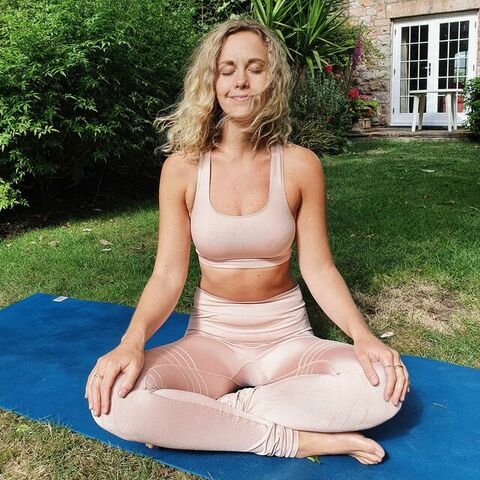
This exercise is known as cognitive diffusion,
Which is the willingness to let go of the attachment and over-identification with thoughts that tend to cause us suffering.
When fusion to thoughts become problematic,
Those thoughts tend to feel and become true or real in a ways that prevent us from engaging with our lives according to chosen values.
It doesn't have to be this way.
Cognitive diffusion is a tool that when mindfully and diligently practiced,
Serves to disentangle you from thoughts that cause you to suffer.
The first step is to recognise that you are the observer of your thoughts,
Not the thoughts themselves.
Your thoughts do not define you.
You are the eternal and mindful presence that is capable of noticing your thoughts enter into your conscious awareness,
Sit in the forefront of your awareness and then leave awareness.
The way to begin to free yourself from unnecessary emotional suffering begins with your willingness to look at your thoughts in a new way.
If your patterns of thinking or negative self-talk tends to cause you significant emotional distress,
Begin to ask yourself how willing you are to try to consider these thoughts differently.
Rather than choose to become caught up in negative thinking to the point where you lose perspective,
Begin to let go of your attachment to that negative thinking.
Mindfulness skills help us to focus our attention,
Especially when we are overwhelmed with strong emotions.
This skill can lead us to stay calm and rational,
Allowing us to choose how we want to respond rather than automatically and impulsively reacting to situations.
We want any thoughts such as I blame myself,
Feelings I feel angry,
Urges I want to hurt myself and physical sensations such as I feel sick that come up in this activity to float away using your mind.
Make your thoughts to be like leaves on a stream.
Follow the instructions of this short activity.
If you haven't done a practice like this before,
You may find it challenging to begin with,
But just stay with the sound of my voice,
Watching and noticing.
And with practice,
As with anything,
This will naturally become normal to you.
This way of thinking will become more and more commonplace in your daily life.
So start by closing your eyes and making yourself comfortable.
Sit upright in your chair,
Putting your hands comfortably on your lap.
Or perhaps you may wish to lie down with your arms by your side and legs uncrossed.
Take a few deep breaths to ground you in this moment and in this practice.
Remember that your task is to simply observe any thoughts,
Feelings,
Sensations or urges that you may experience in your body.
If you have trouble with visualising or seeing an image clearly,
Just know that by really imagining that you can see,
Feel or believe what I'm saying,
This will be okay.
Some people find it helps to just repeat the words that I say.
And with practice,
You will naturally get better and better.
I want you to imagine that you are standing in a woodland beside a stream.
This may be a stream that you've actually been to before,
One that's near your house perhaps,
Or one that you are just imagining in this moment.
Floating on this stream are leaves from the surrounding trees.
Take a few moments to observe what is going on around you and what is happening within you.
Take note of the trees,
The weather,
Nature,
Sounds,
Anything that will really help you to imagine and believe that you are standing by the stream right now.
Remember observing is simply looking around,
Noticing your surroundings.
It is not attempting to label,
Describe or feel the need to respond in any way.
For the next few moments,
Take each thought that enters your mind,
Distance yourself from it and place it on a leaf on the stream and let it float by.
Do this with each thought,
Pleasurable,
Painful or neutral.
Even if you have joyous or enthusiastic thoughts,
Just become aware of them,
Step back from them,
Place them on a leaf and let them float by.
And when another thought arises,
Without judging it,
Just place it on a leaf and watch it float by.
If perhaps your thoughts momentarily cease,
Then continue to watch the stream.
Sooner or later thoughts will tend to start up again.
Allow the stream to flow at its own pace.
Don't try to speed it up or rush the thoughts along.
You are not trying to rush the leaves or get rid of the thoughts or have an empty mind and perfect concentration.
You are allowing thoughts to come and go at their own pace,
Giving them no particular attention.
If you notice that your mind has been distracted and you've lost the river,
Just come back to your woodland,
To the river,
To watching your thoughts and watching them float on a leaf down the stream.
If your mind says,
I can't do this,
I'm bored,
I'm not doing this right,
Simply step back from those thoughts,
Detach from them and place those thoughts on leaves too and let them pass.
If a leaf gets stuck,
Allow it to hang around until it's ready to float by.
If the thought comes up again,
Watch it float by another time.
If a difficult or painful feeling or thought arises,
Simply acknowledge it.
Say to yourself,
I'm aware of having a feeling or thought of boredom,
Impatience,
Frustration,
Sadness,
Fear,
Anger,
Grief,
Loneliness.
Allow them and place those thoughts on leaves and let them float along down the stream,
Recognising that you are just an observer of your thoughts,
Recognising that your thoughts don't define you,
Recognising how many types of thoughts we have each moment.
From time to time,
Thoughts may hook you and distract you from being fully present in this exercise.
This is entirely normal.
Just as soon as you realise that you've wandered into your thoughts,
Gently bring your attention back to the woodland,
Back to the flowing stream,
Back to the leaves.
Generally,
This loss of self-awareness as we become hooked by thoughts becomes less and we become more and more quickly aware of what we are thinking.
If a leaf gets stuck or won't go away,
Let it hang around and then let it float on down by the stream with each thought that comes into your mind just detaching from it,
Placing that thought on a leaf and letting that thought float on down the stream.
Practice this meditation often.
Allowing your distracting thoughts,
Feelings,
Urges and physical sensations to float away helps you calm the mind.
Our mind can be so full of past regrets and future worries that we can never enjoy the present moment.
Allow those worries and regrets to float away on a leaf on the stream.
A calm mind allows you to focus on what is important for you right now,
Today.
Gradually begin to dissolve that image of the woodland and the stream from your mind.
Bring your awareness back to the room,
Back to your body as you notice yourself sitting on your chair or lying down.
The feeling of contact against the floor or the surface beneath you.
Perhaps becoming aware of any sounds in the room and mindfully beginning to wriggle some fingers and toes,
Bringing movement and life back to the body.
Take a stretch if that feels right to you and very slowly in your own time begin to blink open to your eyes coming back to the room.