Hello!
Are you ready to breathe and meditate?
Then this video is for you.
I'll be sharing two different pranayama practices or yogic breathing practices.
And then we'll hang out and just sit and meditate for about 10 minutes.
I'll see you in the video.
If you're not familiar with seated meditation,
There's lots of ways to sit.
Of course,
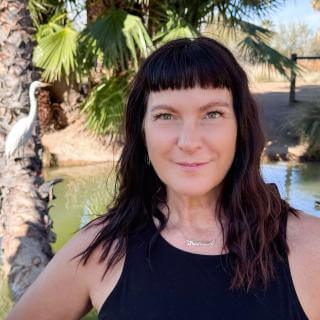
My legs aren't showing,
But I'm sitting up on some cushions.
With my legs crossed.
That would be a more traditional seated meditation.
Position.
But not everyone is gonna be able to be relaxed and comfortable in that way.
So you can feel free to sit in a chair,
Like one of your kitchen chairs or something,
Or even on your couch,
But sit kind of off the edge so your feet can be flat on the floor and your spine is long.
You can also sit up on like a meditation cushion.
I have this thing here.
I'm actually,
It makes me too high up,
So I just put it behind my back.
So again,
Finding your comfortable seat.
Where your spine can belong.
And you have plenty of room to breathe.
So nothing impeding,
Especially the backside of your body,
The backside of your rib cage,
The backside of your lower back.
We want that freedom.
And feel free to ask me any questions.
And please know that it's totally fine to change positions.
During your practice.
This general practice is going to take about 15 minutes.
We're going to do a couple minutes of each of the pranayamas and then we're going to just sit for 10 minutes.
And I will just not leave you there in total silence.
I will come back and bring you back to your breath.
And then that's when we're also going to hear these sounds and they're just such a nice touch point to come back.
To you yourself.
A daily meditation practice is so nourishing.
And if you've been practicing daily meditation in this way,
You'll know what I mean.
But if you're new,
That's great.
Welcome to the practice.
I think for me.
.
.
Just personally.
I feel like when I breathe and meditate in the morning,
I'm entering my day in a more centered and connected way.
I feel like I have more clarity and I feel like I remember.
The things I want to remember as far as moving through life.
As a spiritual person.
So what I mean by that is,
I find maybe I'm a little less reactive,
I'm a little less judgmental,
I'm a little more leaning towards peace.
If that makes sense.
So that's that's why I meditate and I've always I've been into this stuff since I was 21 years old so a really long time since I'm 56 now and I've gone through ebbs and flows of daily practice and I think the key thing to remember is that this is a practice.
Okay,
So.
Little enough background.
Our first practice is called Kapalabhati.
And this is sometimes referred to as the skull shining breath.
And if you're not familiar with it,
It's a quick snapping in and out.
Of the abdomen on the exhale.
So put your hands,
Ah,
I don't know.
I'm gonna try to like get it down here to show you.
So you're gonna put your hands right here on your belly.
See how my hand.
.
.
They expand with each inhale.
And now,
Of course,
Remember I'm super practiced at this,
So mine might be moving a little bit more than yours.
Just taking a moment to feel there.
Okay,
So now the breath,
I'm just going to show you.
I'm inhaling.
You can hear me,
I'm exhaling through my nostrils.
Okay,
So it's kind of like a little pumping,
But it's on the exhale and it's effortless.
So you're just breathing in naturally.
Now you can choose to keep your hands on your body or you can set them however you want them to be.
And we're going to practice this for two and a half minutes in rounds of 10.
I'm not going to be counting out loud,
But we'll start together.
I'll count in my mind.
You'll count in your mind.
I'm gonna put my hands back on.
Let's begin.
Inhaling.
Snap it in.
Breathe naturally.
Okay,
Let's do another round of 10.
So just counting in your mind,
Breathe in.
Relax.
We're going to go a little faster now.
I?
We're going to do 2 more rounds of 10.
Together,
Breathe in.
Breathe naturally.
Our last round of 10.
Big breath in.
You can relax your.
Hands if you've had them on your abdomen.
Just notice how you're feeling.
This particular pranayama is just a really great way to clear the mind,
Clear your energy,
To kind of wake every thing up your energy up your body up.
Hello if you've just joined.
We're about to learn our Second pranayama practice.
And this is called alternate nostril breathing or Nadi Shodhana.
There's a couple different ways that this can be practiced.
I'm going to show you the way that my tradition follows.
You're gonna hold your right hand up,
Pull down your index finger and your middle finger,
So these fingers are up,
And then bring that towards your face and cover your right nostril.
Breathe in through your left nostril.
Cover,
Exhale through your right.
Inhale through your right.
Cover.
Exhale through your left.
So that's one round.
Some people talk about how their hand can get a little crampy or if you have arthritis or something,
You can totally just use your thumb and your.
.
.
What happens if your nose is plugged?
Do you have a tissue?
Nearby,
Maybe try to get everything out.
Usually that breath beforehand can bring up some mucus if you have any.
So if one of your nostrils is completely blocked,
Just use your mouth and go along with it.
Let's practice a couple more times.
Inhale through the left.
Cover,
Exhale through the right.
Inhale,
Right.
Cover,
Exhale left.
And how left.
Cover,
Exhale,
Right.
And now write.
Cover,
Exhale,
Left.
So that's Naadi Shodhana.
So those are the two.
Pranayama practices we're going to do,
In case you're not familiar with the term pranayama,
That just means yogic breathing practice.
It's different than what's known as breath work.
I mean,
Technically you could call it broth work,
But I try to keep them separated because really,
In my mind,
It's two different things we're trying to do here.
So Nadi Shodhana is a beautiful way to calm the mind.
It's balancing the right and left hemispheres of the brain and your main energy channels.
So these breathing practices are the perfect thing to do before you sit for a meditation.
So we'll have two and a half minutes of Kapalabhati.
My recommendation is that you do rounds of 10 like we practice.
The quick snapping in and out of the breath.
Do rounds of 10 and then take a few breaths to relax and then you're going to hear the ping of the timer and then we'll move on to Nadi Chodronoff for two minutes.
Then we're going to move into 10 minutes of seated meditation.
And that's where you're going to hear some sounds coming out of these little speakers.
And also my voice will be a touch point for you in the guidance.
Again,
Make sure your position is comfortable.
And that you can always know that you can adjust and change if like your legs falling asleep and you want to stick it out that's Totally fine.
Okay.
So go ahead and close down your eyes.
Let's take a deep breath in together.
Marekau.
Starting in with your Kapalabhati.
As you practice,
We're going to keep the jaw relaxed.
If you want to stay with my pace,
That's fine.
10 counts for each round again.
So there's our time with Kapalabhati.
Now moving into Nadi Shodhana.
Bringing your arm and hand into position.
Again,
Covering the right nostril,
I'll guide you through the first few.
Inhaling left Cover.
Exhale,
Right.
Inhale,
Right.
Cover,
Exhale left.
Keep that pattern going.
If you feel any strain or lightheadedness,
Please just pause.
Maybe open your eyes.
And then come back when you're ready.
Doing your best to keep your breath smooth,
Even,
And continuous.
Now the next time you exhale out the left nostril,
Let that be the last one.
Just pausing here.
Healing me afar.
Of the pranayama.
Readjusting the length in your spine.
Sitting up with as little tension as possible.
Allowing your hands and arms to be at ease.
Return to the cadence of your breath.
Allow your focus.
To simply be the inhale.
And the exhale for now.
Thank you.
You can trust that you're doing this correctly.
Or simply breathing.
Feeling and listening.
When the mind wanders.
Simply return to the breath.
The body or the sound.
Simply breathe in.
The breath is your anchor.
You Breathing.
Listening.
Thank you.
Guiding yourself back to the breath if your mind wanders.
You.
You Come back if you've drifted away.
You Start to deepen your breath now.
Ever so gently start to move the fingers.
Wiggle around the toes a little bit.
Might like to start to move your head and neck.
Choose the position of your leg.
Before we open the eyes,
Let's Bring the palms together if you're wearing glasses,
Take those off if you haven't already.
Rubbing your hands and then cupping your eyes.
Opening your eyes into the darkness of the palms.
Starting to separate the fingers.
And then opening your eyes to the light.
Hmm.
Yeah.
How are you feeling after this meditation?
Hmm.
Let me know how that was for you.
If you have any questions.
That is.
.
.
My standard daily meditation practice.
I definitely can vary it.
Sometimes I do a little chanting.
Sometimes I sit a little longer.
But that really makes for a nice.
Well-rounded morning practice for anyone that's interested in cultivating that for themselves.
Kiss.
You are wanting to get into.
More of a unguided home practice.
This is a great way to start.
Namaste