Hi,
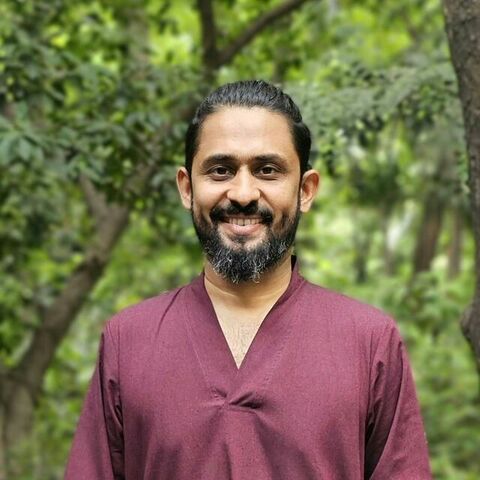
I'm Jerry,
A meditation and mindfulness teacher and the founder of Nishrayasa Holistic Wellness Studio based in Fort Kochi,
India.
Through my work at Nishrayasa,
I explore meditation,
Mindfulness and sound healing as ways of cultivating greater awareness and inner balance.
Thank you for joining me.
What brings someone to meditation?
For some people,
It's stress.
For others,
It's anxiety,
Better sleep,
Better focus.
Maybe they want to feel less reactive or more emotionally balanced.
Sometimes,
People begin meditating after a difficult period in their lives.
When everything feels uncertain,
They are looking for something that can help them feel a little more grounded.
And then there are people who don't really know why they are drawn to meditation at all.
They simply feel that they need to slow down,
To become a little quieter,
To listen.
And when you look at all these different reasons people come to meditation,
It's natural to wonder,
How can one practice serve so many different purposes?
Can the same meditation that helps someone sleep better also help another person understand themselves more deeply?
Can a practice that improves our attention also lead us towards greater compassion or even a deeper sense of purpose?
For a long time,
I thought these were different destinations.
Today,
I see them more as different stages of the same journey.
And for me,
That journey begins with something very simple.
Attention.
We often think of meditation as something mysterious or profound.
But at its heart,
Meditation is really about learning to pay attention.
Of course,
We already pay attention every day.
We pay attention to our work,
Our phones,
Our conversations,
Our responsibilities,
Problems,
Plans for tomorrow,
Memories of yesterday.
But meditation asks us to notice something slightly different.
It asks us to notice where our attention goes when we aren't consciously directing it.
So we sit down,
We bring our attention to the breath.
And within a few seconds,
The mind wanders.
Maybe we are thinking about something that happened yesterday,
Or planning what we are going to do later,
Or we are replaying a conversation.
Or we are worrying about something that hasn't even happened yet.
And then at some point we notice I am thinking.
And we gently come back to the breath.
And then it happens again,
And again,
And again.
The same act of noticing and returning.
Is the heart of meditation.
It can feel almost too ordinary to be important.
We are learning that we can notice where the mind has gone and choose to come back.
And over time,
I think this changes something quite fundamental because our experience of life is influenced not only by what happens to us,
But by where our attention habitually rests.
If our attention is constantly resting on worry,
Life can begin to feel uncertain.
If it is constantly returning to regret,
We can spend our lives reliving the past.
And if our attention is continually fragmented by notifications,
Distractions and thoughts,
We can move through an entire day without really experiencing much of it.
I am sure you have had these experiences.
You drive somewhere and suddenly you realize you barely remember the journey,
Or you eat a meal while thinking about something else.
Someone is speaking to you,
But part of your mind is already somewhere else.
The moment was there,
The meal was there,
The person was there,
The journey was there.
What was missing was our attention.
And meditation slowly strengthens our ability to return to the breath,
The body,
The conversation,
The moment we are actually living.
We start noticing our thoughts before they completely carry us away.
We notice emotions before they automatically become reactions.
There is sometimes a little more space between what happens and what we can do with what happens.
Stress still arises.
Difficult conversations still happen.
People still disappoint us.
Life still brings uncertainty.
Meditation doesn't remove any of that,
But perhaps we become a little less easily swept away by it.
We begin responding with greater awareness,
Instead of simply reacting from habit.
For many people,
This may already be enough.
They sleep better,
They feel calmer,
Feel less overwhelmed.
They become more present in their relationships.
They can deal with everyday life with a little more ease.
And honestly,
If meditation offered only this,
I would still consider it an extraordinary practice.
But along with this,
There is also something else that unfolds.
As the mind becomes a little less noisy,
Not silent,
But less demanding,
We begin to discover a little more space within ourselves.
And in that space,
Questions can begin to arise.
Why does this situation affect me so deeply?
Why do I keep repeating this pattern?
Why am I holding on?
What actually matters to me?
Am I living the life that I really want?
Meditation doesn't really give us answers to these questions.
In fact,
One of the things I value most about meditation is that it hasn't given me any answers.
It has helped me ask better questions.
And those questions have taken me into areas I might not otherwise have explored — philosophy,
Psychology,
Neuroscience,
And the contemplative traditions that have spent centuries trying to understand the human mind.
But meditation keeps bringing me back to something very simple.
Direct experience.
Because we can read thousands of books about awareness,
Listen to talks about compassion,
Learn theories about the mind.
But there is something different about sitting quietly and actually observing your own mind.
Watching a thought arise,
An emotion change,
Noticing an old pattern,
Seeing how quickly the mind moves towards judgement or fear or desire.
And slowly through observing ourselves we begin to know ourselves.
Not through an idea of who we are,
But through direct experience.
And this is where the journey becomes very personal.
Meditation doesn't take everyone to the same place.
For one person,
It may deepen their existing spiritual path.
For another,
It may lead to greater creativity.
For someone else,
It may simply help them become more patient with their children.
It may help someone listen more carefully to their partner.
It may help another person become kinder to themselves.
Someone might be meditating because they want to reduce stress and eventually they find themselves asking some of life's biggest questions.
Someone else might begin searching for spiritual insight and discover that their deepest transformation is simply becoming more present in ordinary life.
And I think that's beautiful because meditation doesn't decide where we should go.
It simply helps us see more clearly.
I have sometimes thought of meditation as opening doors.
The first door might lead to a calmer nervous system.
Another might lead to emotional resilience.
Another might open towards self-understanding.
Then perhaps compassion and creativity and purpose.
Or a deeper exploration of what it means to be alive.
But we don't have to force these doors open,
And we don't have to walk through all of them.
There is no particular destination that meditation demands from us.
The practice simply makes us more aware of what is here.
So when someone asks me now,
What is the purpose of meditation?
I don't immediately think about stress reduction or better focus or better sleep or even spiritual growth,
Although all these things can be meaningful.
I think about attention.
Because attention is where the journey begins.
When we learn to pay attention to our thoughts without becoming completely lost in them,
To our emotions without being completely controlled by them,
And to the present moment without constantly needing to escape from them,
Something fundamental begins to change.
We begin to see ourselves more clearly,
And from that clarity,
Something else becomes possible.
We can make wiser choices.
Have deeper relationships.
We can become more compassionate.
We can live with a little more intention.
Life may not become easier,
But perhaps we become more present for the life that is already here.
And perhaps that is the deeper purpose of meditation.
Not necessarily to make us calmer or happier and not necessarily to make us more spiritual.
Those things may come,
But underneath all of them is something much simpler.
Meditation helps us see,
To see our minds more clearly,
Our patterns more honestly,
To see our lives with a little more awareness,
And perhaps most importantly,
To see the present moment before it passes by us.
What we choose to do with that clarity,
That's where our own journey begins.
Thank you for listening.