My name is Larissa and we're going to practice together for about 15 minutes.
Just take a few moments here just to settle into your body.
If you've already chosen the posture that makes sense for you,
Just.
.
.
Perhaps taking a couple of deep breaths.
If you're still settling into your posture,
The simplest things,
Just a little wiggle to sink you deeper into your cushion so you have the right amount of support.
All of these things are helpful.
As we settle into a bit of slowness,
A bit of silence.
It's remembering that there is no perfect meditation.
We're not trying to be perfectly still or stop our thoughts.
We're just witnessing.
That witnessing,
It has a connotation of seeing something.
It's not just seeing,
It's feeling,
It's observing,
It's taking in the whole of your environment.
The whole of your being.
You're welcome,
Of course,
To close your eyes or just settling your gaze downward.
And we continue to witness even with closed eyes.
Part of our witnessing of ourselves is.
Perhaps setting an intention of being kind to yourself,
Whatever it is that arises.
And that kindness can come in many forms.
Comes in the form of just the fact that you showed up today to be still with yourself.
And the intention of being kind to yourself doesn't mean that it's always easy.
A part of the witnessing is also seeing at times,
Where we might be judging ourself or judging someone else as we sit.
And with a soft gaze,
Not intending to physically look at something,
But to feel into sensation,
To feel into our experience.
Part of this slowing down is getting to know yourself without the busyness of life.
Without the busyness of life calling your attention externally.
Starting to notice what is my experience internally.
What kinds of thoughts are coming and going?
And what do I feel in any given moment,
Rather than following the story of the mind?
We notice And we witness what our mind is doing rather than getting caught up in every thought.
Oh yeah,
There's thinking that's happening.
Here's breathing that's happening.
And what do I feel in my body?
Let's take a moment.
To notice.
The crown of your head.
And then your forehead and your eyes,
Is there any softening that can come there?
That soft skin around your eyelids,
Your cheeks.
The space between your upper lip and nose.
Can you be so aware of the sensory experience of your body?
You might even notice the air coming across your top upper lip as you breathe in and out.
What is your jaw?
Can you soften it to 2%?
Even curious where your tongue is in space.
A natural resting position.
As our tongue is toward the roof of our mouth,
Just noticing that position.
And soften your throat.
Your neck.
And noticing your shoulders.
In this next exhale,
Can you allow your shoulders to be just a touch heavier,
Softening.
From your shoulders.
Noticing your arms.
Often your palms,
Your hands might be resting in your lap in some way.
Is it possible to let your arms?
Hang a little heavier.
Let gravity hold them.
Your torso there's this natural rising and falling that occurs as you breathe.
Is it possible to let this next breath in be just a little bit deeper,
Ribs expanding?
And notice the softening that comes with the exhale.
This upper half of your body usually has a little more movement in meditation just because your breath is here.
Your heartbeat begins here.
Digestion,
Swallowing,
All of those things are happening here in this part of your body.
Notice your lower abdomen and your hips.
It's the steady foundation beneath you.
You might notice a sense of pressure rather than movement.
Is there any way that your hips or your lower abdomen could find just a little softening.
Just invite it in with this next exhale.
And your upper legs,
Your calves.
Noticing your feet.
And if these parts of your body are supported.
It's very often we don't notice them as much because they're not moving.
Our mind is oriented towards movement.
Noticing the steadiness beneath you.
Take a moment here just to wiggle your toes.
Notice with that wiggling it creates all kinds of sensation up your legs As you wiggle them,
Can you notice how your calves move a touch?
And as you settle back into stillness,
There's just a bit more awareness there.
That's very similar to our meditation.
Our mind moves throughout the day.
Sometimes we don't notice the movement because that's just what's always occurring.
So here that little body scan,
Not only checking in,
Is there any tensile points in my body that I can soften?
It also helps us feel into these experiences that we might miss because we're so used to them.
Just like wiggling your toes when they're still brings awareness to them.
Stilling your mind when it's usually in constant motion brings awareness to it.
I just look for that contrast.
Contrast of the inhale and the exhale.
Notice the steadiness of your lower half and the subtle movements of the breath in the center of you.
In this bit of stillness,
Can you even notice your heartbeat?
And it's okay if you can't quite feel your heartbeat.
Notice your breath moving.
What is the smallest amount of motion you can really sense into?
This bit of contrast,
The inhale and the exhale.
Effort and ease.
Action and rest.
Expansion and softness.
That little bit of contrast where we still our bodies so that we can notice the movement of our mind a bit more.
Just becoming aware of it.
Becoming so still.
You can notice your heartbeat in a new place in your body.
All of this is.
Helpful for concentration,
For focus.
It's also a reminder that everything is both-and,
Not either-or.
We need both the inhale and the exhale.
Both movement and stillness.
It's a helpful reminder.
That we experience both grief and joy in this human body,
In this human life.
And that neither one is good or bad.
Just like the inhale and the exhale.
Things to be experienced.
Grief,
Anger,
Pain in the body is just asking to be tended to.
Can we meet grief the same way that we meet joy?
The same way that we meet ears.
Even joy sometimes.
It's hard to receive.
The brain worrying.
What happens when we lose it?
That's why we invite our mind to rest at times.
Be grateful for the vigilance of your mind.
But also grateful for the wisdom of your heart that can receive everything in equal measure.
The non-judgment of the heart balancing out the judgment of the mind.
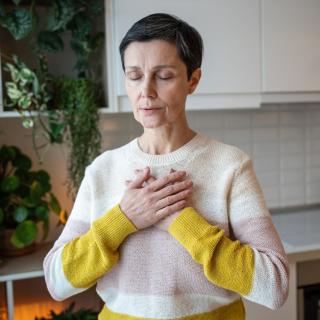
I invite you to place a hand or both over your heart,
Just feeling that area of your body.
Using your hands as a form of gratitude.
Your attention as a form of gratitude.
Let's take a moment to think.
Your lungs for knowing how to breathe.
Thank your heart for beating.
Thank your mind for keeping you safe.
Just one more piece of gratitude,
What can you call it?
Thank yourself for this morning.
What can you thank yourself for?
In this moment.
And we'll end with a few loving kindness praises.
It's repeating them back as they make sense for you.
Using the word we today.
Including yourself in these well wishes.
May we be healthy and supported.
May we seek and find contentment today.
May we collectively choose to move with ease and peace.
And may the merits of our practice ripple out.
To benefit all beings.
Whenever you feel complete,
Going slow if you can.
Find movement whenever you feel ready.
As always,
Thank you each for being here.
It's a reminder to thank yourself.