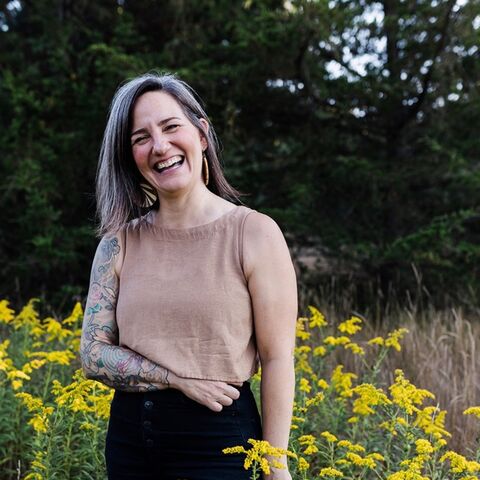
My name is Larissa.
We're going to practice together for about 15 minutes.
Spending a little bit of time with yourself,
Slowing down just a touch,
And also getting to practice together in community.
Just a reminder to check in with your body first and foremost.
Take a few moments to settle in.
Choosing a posture that feels supportive for you,
Maybe taking a couple of deep breaths.
Something as simple as just sighing out your breath.
Not only does it slow it down,
A slow exhale helps turn on our calming systems,
But it releases energy as well.
Whatever it is that you need here just to settle in for a little bit.
You're welcome to close your eyes or set your gaze downward.
Slowly starting to go a bit more internal.
Take a few moments here just grounding and stabilizing.
Notice what parts of your body are touching the floor.
And where touch is happening.
It goes both directions.
Everything is reciprocal.
It's like I am touching a chair,
But the chair is also touching me.
I am being held.
From your stable foundation,
You can start to notice the subtle movements that are always occurring.
Notice your breath coming in and out.
You might even be able to pause at the very bottom of your exhale and just notice a heartbeat.
Take a few moments here just to experience being in your body,
All of these different layers of sensation that are occurring simultaneously.
Notice again your breath.
And at the very bottom of your exhale,
Notice your breath.
Notice that tiny still spaciousness that occurs.
And as we look for these little subtleties in our breath,
We start to feel them.
We start to notice them.
And in the simplest way,
This starts to build our ability to feel anything.
Very often we miss little subtle feelings in our body.
Sometimes we consciously try to push a feeling away it's too difficult to feel,
Or feels frustrating to feel it in that moment.
Just this subtle act of consciously looking for sensation in your body is a part of our emotional intelligence.
Giving yourself permission to feel what you feel,
But also actively looking for what is it that I'm feeling.
And there's this concept in pretty much any wisdom tradition,
But in yoga and Buddhism,
That it's an allowance.
I'm allowing whatever it is.
Whatever it is that I'm feeling,
I'm allowing it to be here.
Sometimes that can get a little bit sticky because when we're feeling something difficult,
Allowance can turn into something else.
It's like I'm looking for it and we don't want to look for something that doesn't feel good.
And it isn't looking for something,
Trying to find the difficult and conjure it up and then dig into it.
It's just allowance.
I'm allowing myself to feel whatever it is that I feel.
There are many ways to consider that.
I heard a conversation recently between two humans.
One of them is Dan Harris.
He was a reporter and now he's very invested in meditation.
And his frame for that,
He used to say,
Welcome to the party.
And in the beginning,
When he first started his meditation practice,
It was almost a giving up.
All right,
Fine.
Welcome to the party.
This is softening though.
It's a softening.
For him,
It was a lot of anxiety that he felt.
And he had built his life around resisting that anxiety until he had a panic attack on the air.
Recognizing that resistance doesn't work.
Resistance is a tool and it can work for a time,
But it's a little bit like trying to press a fully inflated soccer ball under the water.
If you've ever done that,
You know that the soccer ball is going to come up a thousand times and it oftentimes pops up on the other side of the pool where you weren't even expecting it.
Our emotions are the exact same way.
When we try to stuff them down,
They're going to pop up some other place when we're at least expecting it.
And suddenly we have a blow up,
Like,
Oh my gosh,
Why did I respond that way?
Are we shut down when we wish we could engage?
So resistance,
It's a tool,
But instead of resisting,
Sometimes managing is helpful.
You know what,
I'm going to finish up this meeting before I check in with my emotions.
We need that.
We need the management to get through the day sometimes.
But then here we have time for allowance.
And not that we're trying to conjure up an emotion.
But it's important that we set aside time,
That we allow ourselves to feel all of the things that a human feels,
Which is everything,
Every emotion.
There is no good or bad emotion.
It's just a sensation.
It's just energy your body is asking for you to tend to.
So I'm just taking a moment here.
And just noticing what it is that you feel.
You might feel lots of neutrality in your meditation practice.
You might feel tiny moments of joy,
Tiny moments of frustration.
But being human means you have a constantly shifting and changing landscape of emotions.
Bringing the same curiosity you bring to your breath.
Notice the breath here.
Where do you feel it in your body?
Can you feel each rib move as your ribs expand to take in this breath?
Where do you notice softening is occurring as you exhale?
And from that tangible physicality,
Just bring curiosity.
What else do I feel?
Do any of my thoughts bring emotion with them?
Where do I feel it?
Do I feel that in my body?
Noticing again your breath.
And no matter what it is that you feel,
Your breath is something you can always contact.
Your breath can bring you steadiness again.
A sigh or a slow exhale helps you contact your systems.
No matter how much an emotion might be bringing you into a state of disarray.
And that state of disarray is usually the thing that makes us think somehow this emotion is wrong or bad.
There's nothing wrong with any single emotion.
It's simply asking to be felt.
And when we can give ourselves permission,
Here we've set aside time to be still.
There might not be a particularly strong emotion right now.
That's when we start to practice being gentle with ourselves.
Not waiting until we're in the middle of a difficult emotion or a difficult conversation or a difficult season in life.
The fact that you're here practicing means that you're already building your emotional intelligence,
Your emotional resilience,
Your own resourcing,
So that you can hold yourself,
So that you can allow.
It's Dan Harris's phrase,
Welcome to the party.
And Pete Holmes is a comedian,
Also has done his own study in Buddhism.
And his phrase is,
Yes,
Thank you.
It's just an appreciation when we feel something.
Yes,
Thank you.
Saying to any anxiety that lands upon you,
Any sadness that lands upon you,
Yes,
Thank you.
Thank you for sharing this information with me.
Not yes,
Thank you,
Please move in with me and stay forever and take over my life.
Just a simple yes,
Thank you.
I don't need to resist you.
I don't need to stuff you down like a soccer ball trying to hold it underneath the water.
I'm just welcoming this moment in time,
Just like I welcome my breath.
Yes,
Thank you.
Thank you oxygen molecules for entering my lungs.
Thank you lungs for knowing what to do with this oxygen.
And can we have that same welcoming quality,
That same gentleness,
Or any emotion that comes.
We're not trying to fix or change it.
We're just creating an environment that we can hold tenderly,
Anything that arises within us.
Sylvia Borstein,
Really wonderful meditation teacher.
She calls herself Sweetheart.
We have these little things,
Welcome to the party.
Yes,
Thank you.
And even just the tenderness when you feel particularly joyful or particularly filled with grief.
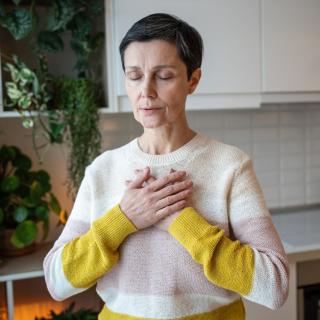
Just to place a hand on your heart,
You can try it right now.
And just say,
I see you,
Sweetheart.
And that might feel unfamiliar.
That's okay.
It's just a practice.
And with your hand on your heart,
Maybe you'd like to bring your palms together to any of your closing habits or practices.
Let's try on that last phrase one more time.
I see you.
Saying that to yourself.
I see you.
Maybe that little tenderness,
I see you,
Sweetheart.
I see you,
Little one.
I see you,
Human self.
And we'll end with a few loving kindness phrases.
Just repeating them back as they make sense for you.
May I be tender and kind to myself today.
May I be tender and kind with the humans I meet today.
May I be tender and kind with all creatures,
Including myself.
When action is needed,
May I choose to move with ease and peace.
And may the merits of our practice ripple out to benefit all beings.
Go slow if you can.
Find a little movement in your body.
Take a moment to thank yourself.
And no rush.
This is whenever you feel complete.
As always,
Thank you for being here.
Thank you for supporting each other in our sangha.