Stronger practices often lead to fatigue or irritation,
Not progress.
In this session we'll increase effort carefully while keeping the breath steady so the body learns to process work instead of reacting to it.
So when you feel ready,
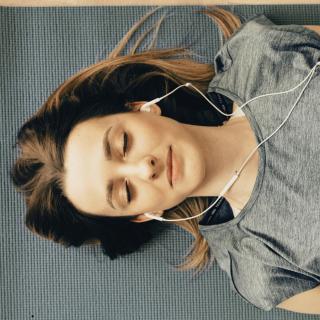
Lie on your back with your knees bent and your feet on the floor.
Arms may rest down by the sides wherever happens to be comfortable for you.
Take a moment here to notice the breath as it is now.
Without changing its size,
Notice whether the exhale finishes clearly or fades out early.
For the next few breaths,
See if you can encourage the exhale to complete fully before the next inhale begins.
We're not pushing or forcing in any way,
We're just encouraging the breath to complete fully.
We're now going to add a little movement to work alongside this full exhale.
So when you feel ready,
As you inhale,
Begin sliding one heel away from you along the floor.
When you're ready to exhale,
Slide it back to your start position.
Inhaling,
Pushing the other heel away.
Exhaling,
Returning when you're ready.
Keep working from side to side in time with your own breath.
Keep the movement as small as you need to so that the exhale remains steady.
If at any point the exhale starts to shorten or becomes rushed,
Reduce the size of the movement.
As you work,
Notice that maintaining a steady exhale requires focused attention.
Complete the movements after your next exhale and return to your start position when you're ready.
Both feet on the floor,
Allowing the breath to settle.
On your next inhale,
Just lifting one foot just a couple of centimetres off the floor.
Exhaling,
Lowering it slowly back to the floor.
Inhaling to lift the opposite foot when you're ready.
Exhaling to return it.
Keep the movement minimal.
Keep the breath smooth and even.
If the breath becomes uneven at any point,
Reduce the movement.
Continue to work from side to side.
As you work,
You might start to notice some warmth arising,
Just building gradually.
It's not a sharp heat.
It's just an increase in activity,
But throughout the breath remains smooth.
Completing after your exhale,
Returning both feet to the floor.
Taking a moment here to notice how you're feeling.
In classical yoga language,
Agni refers to the system's capacity to process effort.
It's not created by pushing harder.
It develops when effort can be completed without disturbance.
Maintaining a steady exhale helps regulate this process.
We're going to continue this work by using the posture bridge or two foot support.
So when you feel ready,
On an inhale,
Allow the pelvis to lift slightly.
As you exhale,
Lower slowly,
Allowing the exhale to last as the movement finishes.
Let the exhale determine the speed and keep repeating this movement.
Inhaling as the pelvis lifts just as much as is comfortable.
Exhaling as you return to your start position.
Keep working with this movement in time with your own breath.
If you find you're reaching the floor before the exhale finishes,
Try slowing the descent on the next repetition.
If the breathing starts to strain,
Reduce the size of the movement.
As you work,
Notice how the exhale organises the movement.
Effort becomes smoother,
Maybe a little less scattered.
Completing your movements after the next exhale,
Coming back to your start position.
Remaining here,
Noticing how the body feels.
Noticing what the breath is doing.
Noticing what the mind is doing.
When we work this way with the breath,
We often find there is more clarity without agitation.
The effort is being processed rather than accumulated.
Remain here for a few more breaths,
Allowing the breath to return to its natural rhythm.
When agony is supported in this way,
Practice builds capacity instead of depleting it.
When you feel ready,
Just rolling on to one side of the body and resting there.
And then taking your time to come up to a seated position slowly.
Take a few deeper breaths here.
And open the eyes,
Come back into the room whenever you feel ready.
Over the next few hours,
Notice whether effort feels easier to recover from.
When effort can be processed comfortably,
Practice begins to build capacity instead of fatigue.
Thank you for practicing with me today.