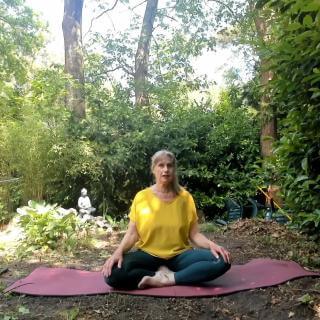
Hello and welcome.
I'm Mary,
I'm a yoga teacher and a theory provider,
Tension and trauma releasing exercises.
Now this video offers an explanation about alternate nostril weeding.
What it is,
What principles it holds,
How it can help to calm the nervous system,
And how to actually practice it.
In this session we will explore two ways of practicing alternate nostril breathing.
The Analoma Philoma,
Which is the simplest form of practicing alternate nostril breathing.
And the Nadi Shodhana,
Which is a more advanced practice.
The Yoga Sutras of Patanjali are foundational texts for Yoga Philosophy.
The opening sentence of the Yoga Sutra points to the fluctuations of the mind.
Which we all probably can relate to.
During our days and often also at night.
Our minds keep us busy.
Making up all kinds of stories about things that might have happened during the day.
Someone said something to us.
And we make our own story around it.
Which often might not reflect the real meaning,
The true meaning of what actually had been said to us.
We then get upset.
And a story.
Keeps on spinning in our head,
Which leads to exhaustion.
Our mind is not really trying to upset us.
It's actually trying to protect us.
Which comes from an old ancient survival mechanism.
Yoga with all its deepening practices.
Can help us to calm.
And to balance the fluctuations of our mind.
Balancing the mind.
Through asana practices.
And through panayama practices.
For a deeper emotional balance.
To which a piece of mine,
The Nadi Shorna,
Is very helpful.
For balancing our energy flow.
The body has over 72,
000 nadis.
Or energy channels.
Where the prana or life force flows through.
So now the children are we trying to clear the channels.
Or nadis.
To increase the free circulation of energy to our body.
Nadi means channel.
And Chorona means purification.
We have two main channels.
The Ida and the Pingala.
Now the Ida is associated with the right brain.
The left nostril,
And the left side of the body.
So inner awareness calming,
Cooling.
And relaxation.
It helps.
Too slow,
A level of stress.
And it helps you to come out of a fight flight mode.
Now the pingala is associated with the left brain.
The right nostril and the right side of the body.
It's associated with warming energy.
Alertness and focus.
Sun energy.
And it helps if we need an energy boost.
It's associated with warming energy.
Alertness,
And active awareness.
It increases focus,
Metabolism.
And energy.
And it's very helpful when we need a worst.
Now,
At any given moment,
One nadi can be more prominent.
Than the other.
And if you're active,
The pingela is more prominent.
And when we are more relaxing,
The Ida is more prominent.
And we can simply check which nadir is more prominent.
To do that we place our hand.
On our upper lip.
And just observe the flow of air.
Now if you feel The flow of air is coming more from your right nostril.
Then you know the pingela is more active.
And even turn it.
Floats more from your left nostril,
Then your Ida is more prominent.
The difference between the Anuloma viroma and the Nadi Chorona is that in the Nadi Shodhana we retain the breath or we hold the breath for Kumbhaka.
That makes the Nadi Shodhana a more advanced practice.
I will now show how to practice both alternate nostril greetings.
To show you what to expect.
In two other videos we will practice both alternate nostril breathings together.
Now we use the right hand thumb to close the right nostril.
And the right ring finger to close the left nostril.
And we use the right hand because it's traditionally associated with purity.
And as mentioned earlier,
The right nostril is associated with the pingala.
Or the Solar Channel.
Symbolically.
Connect it with worms.
Activity,
And dynamism.
We start our demonstration with aneloma filoma.
We bring our right hand up.
And we bring our hand in Vishnu Mudra,
So the The index finger and the middle finger are bent towards the hand palm.
We close the right nostril with the right thumb.
The left nostril with the right ring finger.
For this demonstration we use a 4 count inhalation and a 4 count exhalation.
To start,
At a slow pace.
We take a slow inhale through both nostrils.
And a long exhale out.
So both nostrils.
We close our right nostril gently,
And we breathe in through left for four,
Three,
Two,
One.
2 One.
Close the left nostril with your ring finger,
Open up the right nostril,
And breathe out for four,
Three,
Too.
One.
Breathe in through right,
Four.
So yay.
Too.
Go on close the right nostril.
And breathe out through left for 4,
3,
2,
1.
Breathe in through left,
4,
3,
2,
1.
Tool.
Or Close the left nostril with your ring finger,
Open up the right.
Breathe out for four.
Three,
Two,
One.
Breathe in through right,
Four,
Three,
To One,
Close the right nostril with your thumb,
Open up the left nostril,
And breathe out for 4,
3,
2,
1.
Breathe in through left,
4,
3,
2,
1.
3 too.
One.
Close the left nostril,
Open up the right.
And breathe out for 4,
3,
Two,
One,
Breathe in,
Through the right nostril,
Four,
3.
Tool.
One,
Close the right nostril,
Open up the left and breathe out for four,
Three,
Two and one.
Bring your right hand back.
On your lips.
And let your breath return to normal.
Although the fundamental structure of the Aniloma philoma is the same as the naughty short now.
In an Adhishorna we retain the breath or we hold the breath Kumbhaka.
In this demonstration,
We.
.
.
Use the 4 count inhalation and 4 count exhalation again.
And we hold the breath for a couple of seconds.
Two counts.
We bring our right hand up again.
We bend our index finger,
Our middle finger towards our hand palm.
We use the thumb to close the right nostril and the ring finger to close.
The left nostril.
Pinky finger is relaxed to the side.
And we take a 4 count.
In.
Four count out,
And two counts of holding the breath.
We take a slow inhale through both nostrils.
And a long exhale through both nostrils as well.
Then we close the right nostril.
We breathe in through left.
Four,
Three,
Too.
One,
Close the left,
Hold the breath.
For 2,
1,
Open up the right nostril and breathe out,
4,
3,
2 One.
Breathe in.
4,
3,
Tool.
One,
Close the right nostril,
Hold the breath,
Two,
One,
Open up the left nostril and breathe out.
Four,
Three,
Two,
One.
In through left four,
3 2 One.
Close the left nostril,
Hold the breath.
2 One.
Open up the right and breathe out four times.
Sweet.
Two,
One.
Breathe in.
Four,
Three,
2.
One,
Close to right,
Hold for 2.
1 Open the left without forking.
Four,
Sweet.
Tool.
1 and four,
Three,
Too.
What?
Close the left hold the breath,
Two,
One,
Open the right and out,
Two,
Four,
Three,
Two.
One.
The End?
4,
3,
2,
1 to hold.
Close the right,
Hold for two,
What?
Open the left nostril and breathe out for four three two and one and bring your Right hand back.
Onto your lap.
Let your breath return to normal.
And observe how you feel.
Now in the next two videos,
First video,
We will practice the Anuloma Philoma together.
And in the second video we will practice the Nari Shoruna together.
Now both alternate nostril breathings are very safe to practice.
But if you have a Block knows it's better to wait for a few days until.
.
.
Your muscles are open again.
If you have heart conditions,
High blood pressure or other health issues,
Please first take advice.
From your healthcare professional.
Thank you for joining me today and I'm looking forward to practice with you.
Both alternate nostril weavings in the next two videos.
Namaste.