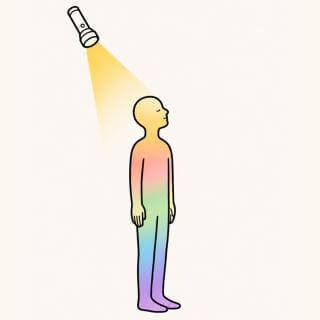
Inviting you now to re-familiarize yourself with some of the anchors that are available to you in the body.
So an anchor is something that keeps us safe.
Stops us from being pulled away in a storm.
One of the most common ones is the feet.
So as much as you're able to,
Just moving your attention to your feet.
Maybe noticing where they make contact with the floor.
We notice any clothing on the feet.
That's the texture of the surface on which they're resting noticing the toes the soul and the heel of the foot.
Complex bones and muscles of the ankle.
And the second really common anchor point is the seat.
Gently moving your attention now to the feeling of sitting.
Remember the feeling of the chair on the bottom.
Solidness of whatever support you need.
You might notice a different temperature at the seat than you did at the feet.
Letting go of the seat now and moving your attention to the hands.
So it might be the placement of the hands,
Maybe on your lap or on your chair.
Or if your hands are together it might be the feeling of the other hand noticing the warmth and the weight noticing the richness of sensation that can often be found in the fingers You might find pulsing and tingling here.
And the last,
Most frequently referenced ankle point is the breast.
The breath appears so many places,
Shows up in so many ways.
Everything from the movement of the tummy,
That's the rise and fall of the chest.
There at the nostrils or the throat.
And with the pause in between the in-breath and the out-breath was just a simple reminder of some of the most common anchors.
There's actually a.
.
.
Infinite variety.
Of anchor options in the body.
We're voting you,
Sir.
Move the focus of your attention to the forehead.
Forehead.
And the muscles around the eyes.
Noticing any tension here.
And knowing as ever if the mind wanders.
Just what lines do.
Chill out.
Mind's attempts to keep you safe.
Just smiling at the mind.
Acknowledging that you notice that it's wonderful.
And ever so gently bringing the focus back to the forehead.
And the muscles around the eyes.
Never really helpful anchor point can be.
The muscles that surround the belly.
It's homemade.
As much as you're able to,
Just setting in to the expansion and the movement.
Contraction of the lower part of the tummy as you breathe.
The Eternal War.
Just noticing where the mind is.
Maybe you're noticing thoughts about the past.
Any worries about the future.
As much as you're able to,
Just returning your focus the muscles of the abdominal wall.
As they expand and contract.
And if it's helpful for you.
Within three to use more than one anchor.
Maybe introducing the breath.
Feeling of the breath in the nostrils.
As you focus on the expansion and contraction.
And just knowing where else you need to be.
Nothing else you need to do.
No body needing to be.
Is resting here in this body in this moment,
In this breath.
Is coming home to the tangible reality of your experience.
Be exploring a more abstract anchor now.
Losing the focus of your attention.
The feeling of the tongue in the mouth.
And then noticing its weight,
Its position.
That's the sense of tea.
We don't tend to draw on any other anchors alongside the feeling's tongue.
And letting go of the tongue now and moving to the feeling of air on the forearms be really subtle.
Just feeling that feather-like touch of the air on the skin.
Noticing your breath in the background.
Nice of you tuning in too.
Rediscover this body.
Just becoming aware of any thoughts that are here.
Some idea,
Tone in your experience.
Maybe a familiar Don't worry.
That you've come to know.
Maybe a worry about something in the future.
Absolute regret about something in the past.
If it's there seeing if it's showing up anywhere in the body for you.
Perhaps the tightness of chest.
Hitting in the throat.
Noticing if this difficulty as a bodily signature of any time.
Just be an annoyance or a frustration.
That's a disappointment.
And if you find a pattern in the body.
.
.
Not worrying if you don't,
If you find one maybe just breathing into it or around it knowing that as much as you're able to it's okay to be with it.
It's okay to bring it to the front,
It doesn't have to be in the background.
Just breathing with it or around.
I'm inviting you now to select an anchor in the body that feels most steady and grounded for you.
Could be any of the ones that we've.
.
.
Introduced ourselves to or it could be a different one.
You might choose to use a combination of anchors.
Just noticing whatever shows up at your ankle points Resting your attention here.
And whenever the mind wanders.
Smiling at the mind.
And gently bringing your attention back.
Be helpful to just note what's coming up in your experience.
Perhaps giving it a label.
So perhaps boredom is here.
You worry his head.
Something that feels like anxiety.
Alongside this labeling,
Maybe just tuning in to see if there's a signature in the body that corresponds to that emotion.
Will float.
Of feeling.
As best as you're able to,
Breathing into it or around it.
Always knowing where your hard and soft edges are.
Knowing the tangible truth of your experience as you sense it through the body.
Its unwavering nowness.
Knowing that each breath is a chance to start again Each inbreath is a new beginning.
And each out breath.
It's a letting go,
A letting be.
Noticing where the mind is.
Minds wanders.
Again,
That was far from an anchor point.
Notice anything pleasant in your experience.
Knowing it's okay to savor it,
To enjoy it.
And if there's anything difficult or unpleasant in your experience.
Checking to see if there's a.
.
.
Corresponding pattern of sensation.
Breathe into it or around it.
That's noting where the mind is.
As we start to bring this practice to a close now just inviting you to take a couple of deep breaths.
Just noticing your posture and your facial expression inviting you to have a stretch.
In whatever way feels helpful for you.