Hey guys and welcome to this week's update.
I read something this week that stopped me in my tracks.
The biggest skill you can develop is the ability to reset fast.
Not resilience,
Not grit,
Not pushing through.
The reset.
Because here's the truth.
You can't control what happens to you,
But you absolutely can control how long you let it affect you.
Think about how most of us handle a bad moment.
A difficult conversation,
A mistake at work,
A poor decision.
A missed workout,
A missed target,
A missed opportunity.
We don't just experience it,
We carry it.
Into the next morning,
Into the car,
Into the kitchen,
At home,
Into bed at 2 a.
M.
One bad moment becomes a bad hour.
A bad hour becomes a bad day.
A bad day bleeds into a bad week.
Not because the event was that big,
But because we never reset.
The stimulus happened once,
We replayed it 50 times,
And every replay your nervous system responds as if it's happening again.
Same cortisol,
Same tension,
Same shallow breathing.
So how do you actually reset?
Because just move on is advice,
Not a myth.
Dr Richard Davidson,
A neuroscientist at the University of Winsconsin,
Has spent more than three decades studying this exact question.
And what his lab found changed how I think about resilience.
Resilience isn't about being tough.
It's measurable.
It's literally how fast your brain recovers after a setback.
In some people,
The amygdala,
The brain's alarm system,
Switches off quickly.
In others,
It stays lit for hours,
Replaying the moment on a loop.
Here's the part that matters.
Davidson found the recovery speed is trainable and one of the most direct ways to retrain it is the breath.
Slow nasal breathing with an extended exhale activates the vagus nerve.
Heart rate drops,
Cortisol drops,
The alarm switches off,
The loop breaks.
You're not pretending the bad thing didn't happen.
You're telling your body it's over.
We're done with it.
Next.
24 years as a paramedic,
12 on the helicopter.
I didn't have the luxury of carrying one job into the next.
Whatever happened at the last scene,
However hard it was,
The next patient needed me 100%.
The reset wasn't optional,
It was the job.
And what I know now is the tool I was reaching for instinctively,
Particularly later in my career when the jobs started to pile up,
Was learning to control my breath between the jobs.
Exactly what the science says works.
Bad conversations,
Reset.
Bad decision?
Learn.
Adjust.
Reset.
Bad day?
You don't need tomorrow.
You need 90 seconds and your breath.
Am I perfect at the reset?
Absolutely not.
But each day is a new day,
And with each good nasal breath,
I become better.
And this isn't just my experience.
In 2023,
Researchers at Stanford ran a controlled trial and found that just five minutes a day of slow breathing with extended exhales improved mood and calmed the nervous system more effectively than meditation.
So let's do it right now.
This is the reset I teach.
90 seconds,
Nasal breathing only.
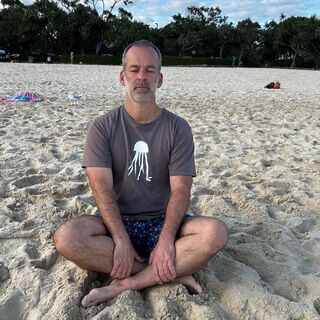
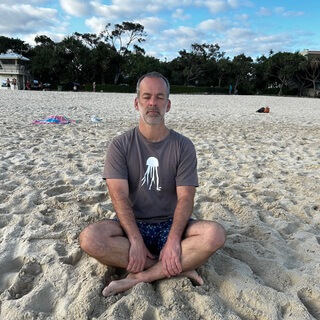
Sit tall.
Drop your shoulders.
First,
One full exhale through the nose.
Empty the lungs completely.
That's the letting go.
Now breathe in the nose for four seconds.
And then out for eight seconds.
Long slow quiet.
In for four.
Then out for 8.
With every exhale,
Let one thing go,
The conversation,
The mistake,
The what ifs.
Three more rounds.
In for four.
Out for eight.
Feel that?
That's your nervous system letting go of what your mind was holding onto.
Mental issues and dramas and stress and anxiety are not just in the brain,
They are physiological.
We can't control what happens to us.
But with our breath,
You control how long it stays.
Reset fast.
That's the skill.
See you next week.