Welcome to today's myofascial release session.
Where we'll be focusing on our feet today.
In my world,
The feet are extremely important for your overall posture and tension in your body.
If there's one region that I would recommend for you to do.
Work on on a regular basis,
Ideally even daily,
That would be the fit.
You can easily include that in your day-to-day practice if you so will.
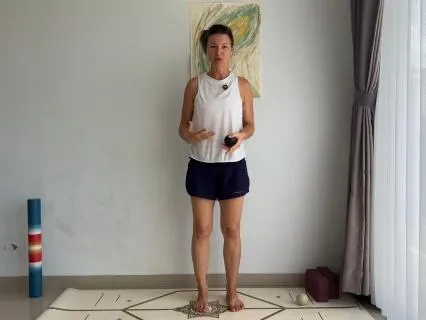
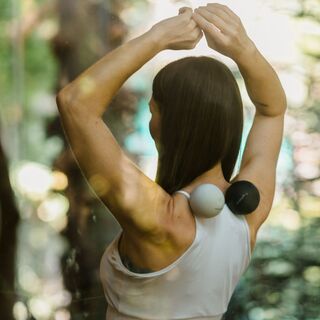
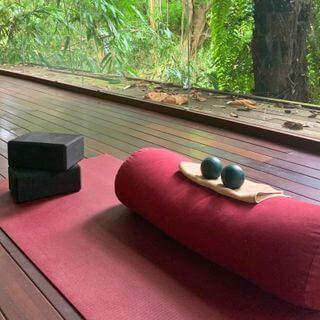
What you need to work on is one ball,
Any sort.
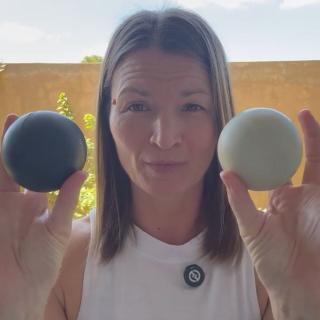
A cork ball would be really great to be more precise on the release work.
A tennis ball is good too.
If you want to level up,
You can use a golf ball.
But anything like this size is recommended.
A golf ball will be increasing the intensity of the class.
And all you then need to do is start with one foot first.
I always start with my right one.
If you're close by a wall,
It's very convenient to just lean onto or hold it for balance purposes.
And then you start the center of the first foot,
Like in the middle of the arch.
And then roll back to your heel.
And to the front.
To your toes.
Then you continue rolling.
As you do that.
But then add more and more body weight.
So the addition of the body weight really means.
.
.
You're adding.
More angles to find attention points in the body because that's what we are really here for.
With your body weight you intensify the pressure on the ball and with that you get a very quick feedback on where you have tension on your foot.
So we just want to find the first point.
That stands out to you.
And for some people,
Maybe less pressure is okay.
You're just leaning away from where the ball is.
But if you need more pressure,
You get the middle of your body over the ball as much as possible.
And once you found that first spot,
And why did you stay there?
Stay with that spot?
Find the right body weight so that you can stay with that spot for a little bit.
And then start working with your breath to support the release here,
Meaning in through the nose.
Out through the mouth.
Really make it audible,
Maybe a sigh,
Maybe a tone that wants to come up.
But you're Exhale through the mouth is a support in this practice.
To transfer the pressure that you feel in your foot.
To release that from your overall system.
You want to stay with that point.
For as long as it feels right for you.
And for some that can mean shifting.
And have a minute,
Maybe for you that means two minutes on the same spot.
There is no.
.
.
Specific timing that I need you to stay with that,
Really listen to your body.
And what feels right for it today for that specific point.
Will be different next time.
But once you feel it shifted,
The intensity has changed,
It has reduced.
It's softened.
Then you continue your journey,
You're exploring the rest of the food.
Moving very slowly.
Cross your soul.
If you're not finding anything,
You add more body weight.
Or you change to a ball that is harder.
So these are your two elements that you can play with that will define how much.
Trigger points you're able to find and work through.
So if your ball is too soft and it just totally gives,
You can put your weight on and you just don't feel anything,
Then you're not doing it wrong.
You just have the wrong ball.
So find something that is reasonably Um Not too soft,
But also not too hard,
So that reasonably in between.
Or if it's a very hard ball,
Then just be careful with how much body weight you are adding to that.
You can also,
If you like,
Work on the inside corner of your foot.
So on the side between your heel and the base of your thumb.
That can be very interesting as well.
While we've worked on the soul but its inner part.
Can also hold some tension.
The easiest way to do that is to bend your arm.
Standing knee and then move the other leg outwards so you can place the inside corner of your foot.
On top of the ball.
And then you just move your leg from slowly behind.
Slowly forward so the ball moves.
Between the inside corner and the heel.
And the inside corner.
Of the base of your head.
Big toe.
And if there's anything juicy here,
You say again.
Give it some breaths,
Give it some time.
The magic really happens with the combination of the time that you stay.
The weight that you allow to put on.
The breath that you are holding.
And the space you are holding your body with.
So don't push yourself through a tension point.
Rather create the environment where your body feels supported.
And it can open up the tension by itself.
Fear about a war like me?
Sometimes it's comfortable to just.
.
.
Lean against the wall while you're standing there or use your arms accordingly.
To support your overall body.
Just have a few more breaths here on the first leg.
By the way,
You can also do that sitting,
When you're on the chair or by your couch.
You can also press that.
Or you can also do that from the floor.
I showed it on the second foot.
How they can look like.
I used to do that.
I was working on the recovery of my injury and my TMJ.
I used to work on my feet every single morning when I was brushing my teeth.
And that helped a lot to undo the compensation patterns that my body had developed.
Over the years.
So it's very,
Very effective.
Place to work on to support your overall body.
And last inhale to lift off your foot.
Coming to a brief rebound.
And rebound means,
Take the foot,
Give it some about a minute.
Feel into.
What has shifted?
What points have you worked on?
How do they feel now without the pressure?
And Does your sole or your ankle do the need?
Any movement,
Any shaking,
Or do they just want to be still?
Sometimes also tapping or pressing feels nice to just support the integration of the shifts.
Of what has happened.
Set the moment without the.
Pressure of the ball.
Your fascia is now reorganizing,
Reintegrating.
Rejuvenating,
It's reabsorbing all the fluids in your body so that it can create a new structure for itself.
So this is part of the practice,
Don't skip it.
Give it some time,
Feel the difference from your right to your left foot.
That is an immediate indicator.
You might even feel it coming into your calf muscle as well,
If you're sensitive.
And then let's come over to the other side.
So I'll show you briefly how that can look like on the floor,
But you can.
.
.
Stay standing if that felt already good for the first leg.
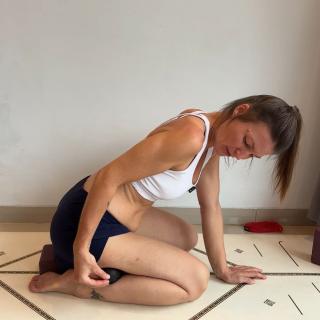
So if you are on the floor You just come down kneeling,
You're still placed at one foot on top of the ball,
But then you just move your entire body.
You may want to move all the way over.
On top of the ball you have maximum weight on it,
Depending on how hard your ball is.
Or you just want to lean and sit on the side.
The other leg.
Getting a bit more comfortable.
And a bit more gentle.
And similarly,
If you want to do that on a chair,
You can do that as well from your couch when you watch TV.
Sitting on there,
Leaning forward,
Pressing some extra weight on your knee so that you have some extra lever on the weight that is putting onto the ball.
So all of those options.
Are accessible and available.
I do find it still.
The most effective to do is standing.
Just because that gives you way more range of movement with your overall body,
You can be a bit more fine-tuned.
With the way that you are approaching and giving to the bowl.
So that's my preferred option,
Especially being next to the wall so that you make sure you don't need to worry too much about balancing.
That's a really good way to handle it all.
The same thing as we did on the first side we do here.
You explore between sole and toes.
You play with your body weight.
To add enough to find the trigger points and then give it space.
To open up.
In its own timing.
And always come back to your breath in through the nose.
Out through your mouth.
That is your breath here throughout the practice.
And this is signaling your body that it can't release the tension.
But it's also helping your nervous system to stay calm here.
Because when you're working on trigger points,
They can be irritating for your overall system.
Which is why it's so important that you don't apply too much pressure because that would signal pain to the body and it would start to protect.
And irridate your nervous system so you want to be.
.
.
Gentle enough.
To still create some shifts.
And conscious breathing supports that overall process.
So rather do one area that you're sensitive to.
Do that more frequently.
Over several days or weeks in doses.
Instead of doing it once and force through and just create.
Painful patterns and maybe even damage your tissue with that extra force that's unneeded.
So being gentle here helps you connect with your body,
Helps you understand what you're doing.
Where your body is sensitive.
Because we are working on the feet,
You are also doing foot reflexology right now?
I invite you to.
.
.
Remember the most painful points here,
Left and right,
And then after the session,
Maybe do some googling on foot reflexology and check out what organ does correlate to that specific point,
Because that's an indicator.
There's something out of balance here.
It's not quite working optimally.
And connected with the food reflexology is the idea.
Of meridians,
So in TCM.
You have a lot of meridians going through your feet,
Especially on the base,
On the sole.
You have the bladder meridian going through,
But with the pressure that you're applying,
You touch all the other meridians as well here.
The stomach,
The kidney,
The gallbladder,
The liver,
All of that that are starting down there.
So you're doing a lot for your overall system.
Just have a few more final breaths here.
Use that last point that you're working on to really tune into.
How the shift happens,
How it feels.
And then when it feels right to you,
Take your last inhale here.
Lift your foot and we'll come into another rebound here for the left foot.
Again,
Feel into if there's any movement that want to happen.
Shaking possibly.
Or maybe you just want to hold it still.
Maybe the foot is not yet ready to be stood on.
So give it some time to do the rebound,
The integration of all the tissue.
Long didn't fascia to reorganize itself.
And afterwards,
Drink some extra water to support the tissue in the rehydration as well.
Very,
Very important for a healthy fascia.
And if you can,
Sit down and just take maybe another minute.
Just for them to be without a lot of weight.
Support some extra.
Rebound here as well and some integration.
Yeah,
So that was that for today.
As said,
This is one of my favorite and most effective practices for your entire body.
So,
Invitation is to do this on a regular basis,
Multiple times a week if you can,
And that will help your lower legs,
It will help you with your lower back issues.
Even helps you with your shoulder and neck issues over time.
Obviously.
Iteration question.
Alright,
Thank you and see you in the next class.