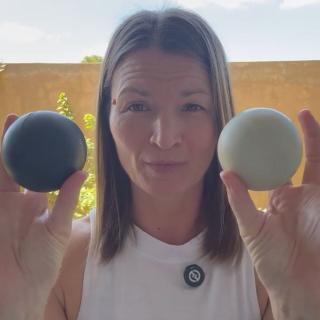
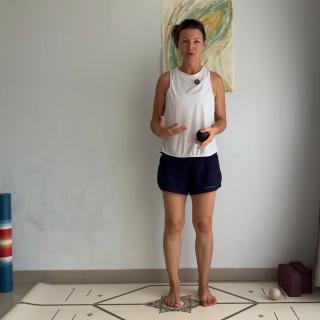
Welcome,
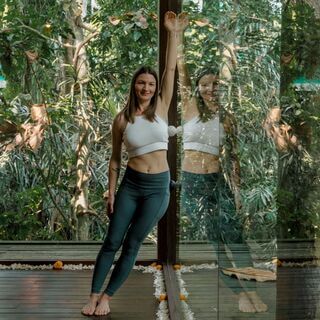
My name is Ellie.
I'm a transformation guide,
Somatic practitioner,
Yoga teacher and energy healer based in Bali.
After 15 years in the corporate tech world and two burnouts,
I turned towards the healing arts.
I now help high achieving professionals and conscious leaders reconnect with their body's wisdom,
Release stored tension and restore balance through embodied healing practices like myo-fascial release yoga,
Breath work and energy work.
My work bridges the practical with the spiritual and I'm really glad you're here.
This session is your beginner's guide to myo-fascial release yoga.
What fascia is,
How this practice works,
Which props you need,
How to apply pressure safely and how to make each session effective and supportive for your nervous system.
This prepares your body so you can receive the full benefits of myo-fascial release,
No matter whether you're doing a short practice or a deeper targeted session.
Myo-fascial release yoga is a slow,
Mindful,
Deeply therapeutic technique that works with your fascia,
The connective tissue that runs through your entire body like one continuous web.
Fascia wraps around every muscle,
Bone,
Nerve and organ.
It shapes how you move,
How you feel and how tension is stored.
Through gentle pressure and slow movement,
We help this tissue soften,
Hydrate and let go of the tightness that builds from posture,
Stress,
Emotions and just everyday life.
You can find out more about fascia and what to expect from a myo-fascial release yoga practice in my free track,
Myo-fascial Release Yoga,
Unlocking the Body's Wisdom.
For this practice,
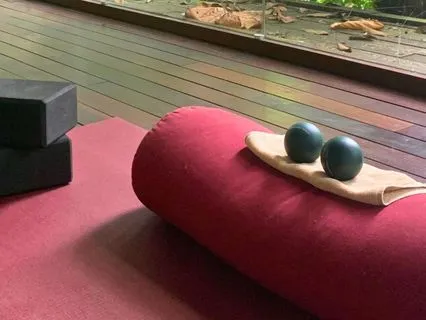
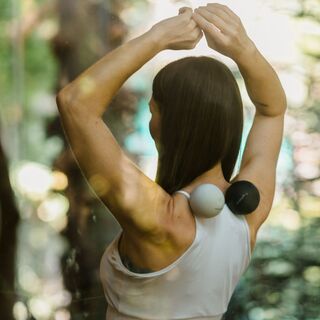
You'll need two balls,
Like tennis balls or release balls of some sort,
A yoga block or a thick firm book,
A towel or a small cushion for extra petting if and when needed,
A mat or comfortable surface,
Possibly a bolster.
The balls should be intentionally firm,
But you control the intensity through your body weight and potential usage of any of the petting options.
And here are the key principles of a good myofascial release yoga practice.
First,
Stay in comfortable discomfort.
You may feel tenderness or intensity,
But you should never feel sharp,
Shooting,
Electric,
Numb or bad pain.
Pain puts your system into protection mode and fascia will not release when it feels unsafe.
This protection mode may show up as a shallow breath,
A breath hold,
A faster heartbeat,
Sweat and or a tension somewhere else in your body,
Like a clenched jaw,
Fist,
Pressed eyelids.
These are all signs that your body feels under stress by the pressure on the trigger point.
Please reduce the body weight for these alarm signals to disappear again.
Second,
Adjust pressure at all times.
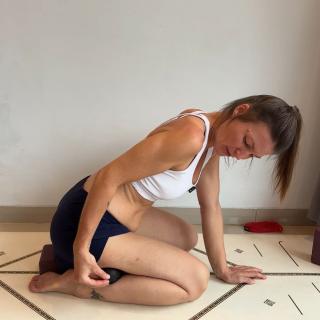
Soften by lifting part of your weight,
Placing a towel or a cushion over the balls,
Changing the angle using your hands to support your body.
You are in charge how you position your body on these balls and how much weight you allow to rest on these balls to support your trigger release.
Third,
Get comfortable as much as possible.
Use any of the props in a way that your body can get very comfortable.
The more relaxed you are overall,
The easier it will be to release the tension in the area of focus.
Fourth,
Move slowly.
Fascia responds to sustained,
Gentle,
Steady pressure.
Fast rolling does not release fascia,
It only agitates tissues.
Fifth,
Work with your breath.
Throughout the practice,
Inhale through the nose and gently exhale through your relaxed mouth.
Try to exhale slightly longer than you inhale.
This will signal your nervous system that you are safe and that it's safe to now release the tension and allow softness to happen.
Sixth,
This is not an alignment-based yoga practice.
There is no perfect pose here.
You explore your own body and follow its feedback moment by moment.
Listen inwards to what your body is telling you.
Seventh,
Stay as long as necessary.
Stay with one area as long as necessary in order to notice a shift.
Sometimes that may be 10 seconds,
Other times this may be two minutes.
You decide the timing and the focus.
Eighth,
Allow emotions to flow.
Myofascial release yoga works not only on the physical body but also on the emotional and energetic layers.
Fascia stores experiences,
Stress,
Habitual patterns and sometimes even moments we never fully processed.
As the tissue softens,
Emotional energy may naturally rise to the surface.
If emotions or memories come up for you during the practice or even afterwards,
Allow them to move through you without trying to suppress or control them.
Tears,
Warmth,
Sighs,
Laughter,
Trembling or a gentle sound are all natural expressions of release.
This is your system reorganizing itself.
Emotional release is not a sign that something is wrong.
It's a sign that your body feels safe enough to let go.
Treat this moment as a compliment to your inner resilience and capacity to hold yourself with kindness.
Simply breathe,
Stay present and let whatever arises complete this cycle.
Ninth,
Listen to your body.
Your body is the expert here.
My instructions are suggestions not rules and every moment listen closely to what your body tells you,
Shows you or asks for.
If something feels too intense,
Too light,
Too activating or not quite right,
Adjust.
You are in full ownership of your experience.
Myofascial release is most effective when you work with your body,
Not against it.
Trust your inner guidance.
If your body wants more time,
Give it more time.
If it wants stillness,
Stay still.
If it wants movement or a hand placed somewhere for comfort,
Honor that.
The more you listen to your body,
The more deeply this practice will support you physically,
Emotionally and energetically.
Tenth,
Consistency over intensity.
If you live with chronic pain or long-standing tension,
Please remember that release can take time.
Fascia responds to consistency rather than intensity.
It's completely normal if a point feels tenter,
Emotional or slightly activated.
Your only job is to stay curious,
Breathe and meet your body where it is today.
Your system will open when it feels ready.
Eleven,
Wear not to work.
Avoid areas with recent injury,
Inflammation,
Bruising or surgery,
Open wounds or sunburn,
Herniated discs or unstable spinal conditions,
Pregnancy for deep abdominal and pelvic regions as well as lower and mid-back sections.
All other areas would be safe to work on.
Also avoid working directly on the spine.
Otherwise,
This practice is accessible to most people.
After you finish working on an area,
Take a rebound minute.
This is a short pause,
About 45 to 90 seconds,
Where you stop all the pressure from the balls,
Feel the area you just worked,
Allow your body to integrate and let your nervous system settle and return to neutral.
Why is this important?
Because myofascial release works at the edge of intensity and even healthy intensity can momentarily activate your nervous system.
The rebound allows the tissue to reorganize,
Fascia to hydrate,
Your brain to register safety and the release to land more deeply.
You can stay still or place your hand on the area or make any movement your body requests.
Any shakes,
Circles,
Stretches,
Massages,
Taps,
Strokes,
Anything.
This pause is just as therapeutic as the pressure itself.
How to get the best results?
To make this practice deeply effective,
Move slowly and mindfully.
Breathe steadily in through the nose,
Out through the mouth.
Let the tissue meld in its own time.
Be curious instead of goal-oriented.
Notice what changes,
Even in subtle ways.
Notice any emotions or memories coming up.
Give them space to flow through you.
The more present you are,
The more your fascia will respond.
So now that you understand the foundations of myofascial release yoga,
You're ready to explore deeper practices.
If you'd like the guided session,
You can listen to any of the myofascial release yoga tracks on my profile.
From full body releases to targeted flows for specific areas of tension or join any of my upcoming live classes.
Please follow my profile,
Get notified about new tracks,
Courses and live events.
Thank you for being here.
I'll see you in the next practice.
May your body be your greatest teacher,
Your breath your guide and your heart your home.