What is the ideal meditation posture?
This question gets asked in a lot of the classroom discussions,
Particularly for my meditation courses.
They're like,
How should I sit during meditation?
It's this big contention among beginning meditators.
And I've got a few different approaches to offer you depending on where you are in your meditation journey.
First up,
If you are an absolute beginner,
If you are just starting out,
I would suggest to you personally that it doesn't matter.
The goal of a beginner meditator is to just get time on the mat.
Just meditate.
If that means you're sitting down,
Lying down,
Broken posture,
In a chair,
Standing up,
Whatever.
Just get meditating.
The only caveat to that is,
Is that you don't want to be in pain and you don't want to fall asleep.
So,
I typically suggest to people,
You know,
Take a seat or lie down,
You can close your eyes if you wish.
Get yourself comfortable.
But if you find yourself falling asleep,
You find yourself in pain,
Tweak it,
Twist it,
Make a change.
That's the first suggestion.
The goal here,
I look for sort of broad principles.
What's the broad principle of a beginning meditator?
Well,
To meditate.
How do you facilitate meditation?
By making it comfortable and easy.
Okay,
Let's not stress too much about posture.
Fair.
Now,
A more advanced meditator is going to start wanting to play with posture and start looking at how posture impacts mood.
If you were to just sit up straight with me right now,
Just sit up straight,
Sort of imagine a rope pulling your head to the roof and sort of just tuck your chin gently.
We're not forcing anything.
Notice the inner feeling.
When I sit,
You know,
A bit upright in a good posture,
I feel elated.
Yeah,
Now crumple yourself into a ball,
Huddle up,
How do you feel now,
Right?
Your posture can impact mood.
Same thing is if you are,
You know,
Laying down.
Laying down sort of implies sleep and sleep does lead to sort of different impacts.
You can play with the use of sleep as a focus point of meditation too.
So sort of deviating down these paths,
But what you'll find is that the deeper you dwell into meditation and spirituality and different traditions and practices,
Oftentimes they do suggest a posture.
Now once you've established a habit,
Once you are able to sit on the mat and you know you've cleared that space out in your life for meditation,
Then I would encourage you to start moving towards the posture,
But not doing it dogmatically.
As in some people look at sort of the technical aspects of the meditation,
I've got to say these words,
Sit in this posture,
Do this exact thing,
Pop,
Pop,
Pop,
Pop,
Pop.
And that's okay for some people,
But for a lot of people that technical approach sort of misses the overall principles of what we're doing here.
Once again,
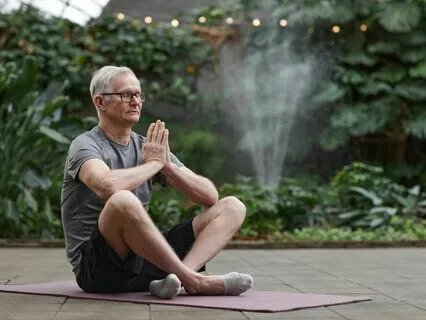
Does it matter if you're sitting in full lotus,
Perfect position to not moving a muscle?
Maybe.
But I would argue that the inner work and the response and the movement,
The introspection,
The looking at what's going on in your body,
The actual act of the practice of the meditation is more important than posture.
So with all of that said,
I would suggest that you do move towards a more formal posture,
But don't hold onto that idea too tightly.
And if you feel the need to hold onto that idea so tightly that it's like I've got to practice in this posture because that's what the guru says,
That's what the book says,
That's what the tradition says,
Yada,
Yada,
I would encourage you to just step back and just analyze that thought,
Introspect on that thought,
Let that thought percolate.
It's like,
Okay,
Does the posture really truly matter?
What does the nth degree of the spiritual practice that you're looking at suggest?
So my main focus when I meditate is on mindfulness,
Is non-dualistic meditation.
So in reality,
From that perspective,
The body posture is irrelevant.
It's all part of the same,
Ever-present now,
It's all transient.
But to attain that sort of awareness,
One must continue practicing,
Right?
One must practice daily.
Yeah,
Well,
There's arguments to suggest back and forth,
But that's neither here nor there,
But I practice.
I practice daily.
I sit.
I focus on the breath.
I focus on the sounds.
I do my meditation.
How I sit does sort of impact the quality of the meditation.
Now once again,
From a non-dual mindful perspective,
You only have the meditation you're having,
Or the meditation is just occurring.
It's just a noticing of the moment.
But I have noticed that I'm able to be more mindful when I am using a more formal posture.
I personally sit,
This is how I sit in meditation,
Either in a cross-legged position.
I'm capable of a full lotus,
I'm quite flexible,
But I find that it just,
I end up going numb,
It's annoying,
It's distracting,
It doesn't feel comfortable.
So I don't do it.
I just cross-legged on the floor with my back resting against a wall,
Or I sort of kneel on my feet and sort of sit in that sort of kneeling prayer posture.
And that's the way that I do it,
That's the way that I practice,
Because I find that that works best for me.
And that's where I want to leave it here,
Is find the position and posture that works best for you.
If you have certain physical conditions or disabilities or restrictions or movements or injuries or whatever it is,
Certain postures won't work for you.
I would argue that all traditions,
All practices,
All talks,
Everything,
Even this talk,
Is a finger pointing to the moon.
It can only guide you so far,
And you have to take that step into the,
For lack of a better expression,
The artistry of the practice.
You have to take it and embody it and make it yours.
With everything we do here in the meditation space,
In the spiritual space,
But also in life space,
It's like we sort of learn all the basic techniques and then we sort of embody them and then we just sort of discard them and we just act,
We just go,
We just do.
We have to sort of start to do that with our meditation practice because once it's internalized,
Once it's embodied,
How can words,
How can instruction,
How can anything get you to the deepest truth?
It can point you there,
But there is something internal,
Something sort of spiritual,
Something sort of ethereal that has to happen for you to attain that level of presence.
You can practice,
You know,
Letting everything drop away,
You can practice hyper-focusing on the present moment,
You can practice sitting in a super rigid meditation posture for hours,
Whatever it is,
But there'll be a moment where something,
Something happens that arises and then things just click into place.
And I guarantee you that that thing will be independent of a perfect posture,
There'll be something else going on.
So the summary is this,
If you're starting out in meditation,
Just meditate.
Don't worry about the posture,
Eyes closed,
Open,
Head tilted up or down,
Focused,
Whatever,
Just meditate.
You can be laying down,
Standing up,
Doesn't matter.
As you delve deeper into your practice,
Start playing around with the formal practices of your tradition.
Okay,
And in general,
That sort of upright,
Imagine a balloon pulling your head up to the roof,
Gentle but firm,
You know,
Sort of posture tends to be quite ideal.
But once again,
Consider that it's not about the posture,
It's about the practice.
The posture is just one part.
If you have any questions about this,
Let me know.
Catch up.