Hi,
I'm Caroline and today I'm sharing with you a deeply calming and relaxing breathing technique called Brahmari Pranayama.
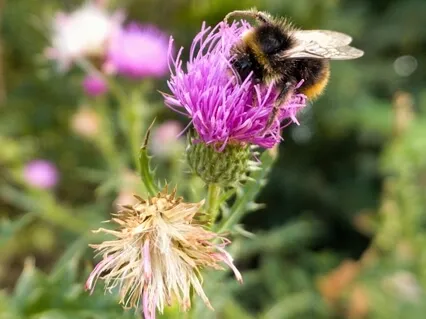
Brahmari is Sanskrit for humming bee and that is exactly the inspiration for this method of breathing,
Also known as bee breath.
While practicing bee breath,
A humming sound is created during a slow exhalation which mimics the sound heard from a buzzing bee.
The gentle humming produces a soft vibration that helps in relaxing the entire body.
Therefore,
This is a great breathing technique to practice when you're feeling anxious,
Stressed,
Or overwhelmed.
You can practice bee breath anywhere,
Well any place where you're comfortable humming because this breathing technique is not a quiet one.
In this guided meditation,
I will first share some benefits of the practice of bee breath,
When it could be used,
And finally guide you through a short practice.
Brahmari Pranayama can help release tensions and stress in your body which play a great role in controlling anxiety related symptoms.
The gentle humming sound can also serve as a focal point during your practice which helps to calm a mind that may be feeling scattered,
Also improving your concentration and even helping encouraging memory retention.
Practicing bee breath along with any physical yoga practice can help control and balance your energy by helping you to cool down your body after a workout.
Also,
Adding bee breathing to your daily routine or meditation practice can help you encourage a calming of your parasympathetic nervous system or your fight or flight response.
Finally,
Practicing at the end of the day can also help you fall asleep more quickly and more deeply as well.
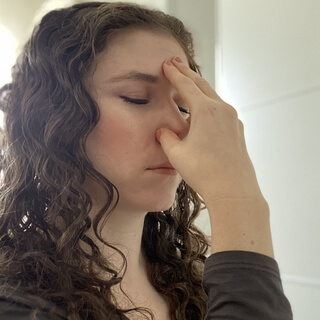
If you currently have a migraine or headache,
It might be best to either avoid this practice or to practice with your eyes open rather than closed.
Let's begin.
Come to sit or stand in any comfortable posture.
Create a long spine by reaching the top of your head up toward the ceiling or sky and tuck your chin slightly so the back of your neck is also long.
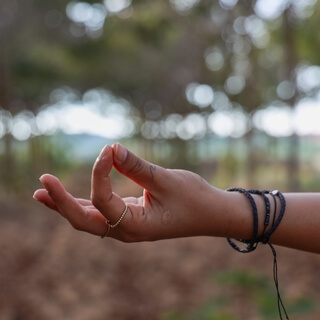
You may allow your hands to relax wherever they feel comfortable or feel free to take jnana mudra by bringing your thumb and index finger together and allowing the other three fingers to relax.
Your eyes can be open or closed while you practice,
Whichever feels better for you right now.
Take a brief moment to scan through your body and check in with yourself.
Maybe use this moment for the first time today to really ask yourself how you're feeling.
How does your body feel today?
Notice any areas of stress or tension,
But also notice the areas that feel good right now.
Physically relax through your face,
Your forehead,
Eyes and jaw.
Send your shoulders gently down and away from your ears.
Feel your seat or feel your feet on the surface of your body.
Feel your seat or feel your feet on the surface supporting you.
How does your mind feel right now?
If your thoughts are racing or feeling scattered,
Simply acknowledge that fact without telling yourself a story of why it might be good or bad.
If your mind already feels calm,
Notice that too.
If intrusive thoughts come by during your practice,
Try to notice them and then let them go.
Imagine they are simply floating past you like clouds drifting by on a breezy day.
How are your emotions feeling?
If you aren't sure,
Check back in with your body again.
If you're feeling stressed or anxious,
That might feel like upper back or shoulder pain.
If you're feeling tired,
Check back in with your body again.
If you're feeling stressed or anxious,
That might feel like upper back or shoulder pain.
If you're feeling nervous or scared,
That could feel like stomach discomfort.
If you're feeling sad,
That might feel like tension in your hips.
If you're feeling happy or loving,
That could feel like a warm glow in your chest.
Notice whatever emotions come up for you and try to resist labeling them as either good or bad.
They simply are.
How is your spirit feeling?
You don't have to consider yourself a spiritual person to check in with your own spirit.
Sometimes low physical or mental energy can be a result of a spirit that's feeling unfulfilled or even bored.
On the other side,
If you feel like you are caught up in ideas too often,
You might find comfort in some form of gentle grounding exercises such as this very practice.
After you finish checking in with yourself,
Start to bring your attention to your breath.
Breathe at your natural pace for a few moments.
Notice the natural length of your inhale and the natural length of your exhale.
Don't worry if you've automatically begun controlling your breath by now.
When we bring our awareness to our breathing,
It will automatically begin to feel different.
Begin to listen to the sound of your breath and notice how it feels coming in through your nose,
Into your lungs.
Feel as your lungs empty on your exhale and the air exits your nose a little bit warmer.
Continue your own natural pace of breathing.
Before I begin to cue bee breath,
I will demonstrate it briefly so that you can hear how it will sound.
I will inhale naturally through my nose and on the exhale I'll create a humming sound.
Notice how I extended the length of my exhale to be longer than my inhale.
This is because the longer that our humming is sustained,
The more relaxing the B breath can be.
However,
Forcing your breath to extend beyond your capacity can have the reverse effect and cause you even more stress.
So it's important to not force yourself to maintain any particular speed as you breathe.
I will be giving some specific cues to inhale and exhale,
Then allow you to take a few rounds on your own in silence.
Allow yourself to inhale whenever is necessary and let the buzzing sound last as long as it is comfortable for you.
If your attention has wandered,
Begin to bring it back to your breath.
Continue breathing in and out through your nose,
Keeping your lips sealed.
On your next exhale,
Make the sound of the letter M,
Essentially a humming sound.
Keep sustaining the sound until you feel the need to inhale.
Repeat this a few more times.
Notice the natural pitch of your hum.
Continue lengthening through your exhale.
Breathe in naturally through your nose and as you exhale,
Humming at the natural pitch of your normal speaking voice.
On your next exhale,
Very lightly press the back of your tongue upward toward the roof of your mouth.
If you press your tongue too firmly against your soft palate,
You could cause the air passage in your throat to be a bit blocked and no air will be able to escape and no sound will be made.
Therefore play slightly with the position of your tongue with your next few breaths.
Can also begin to experiment with the pitch of your hum,
Making it higher or lower with each new exhale and find whatever feels best for you right now.
As you continue to practice,
Notice how a slight lift of your tongue towards the roof of your mouth may shift the humming sound from your throat up toward your nasal chamber.
Continue to practice your bhamaari pranayama for about another minute.
Finish the full breath that you're currently experiencing.
Keep your eyes closed if you're able to right now and allow your tongue and throat to relax.
Take a few moments right here to quietly observe the effects of your practice.
Whenever you feel ready,
Gently allow your eyes to open.
Come back to this practice whenever you feel yourself becoming scattered,
Anxious,
Or stressed.
Continue to experiment with the pitch of your hum and find whatever sound feels most relaxing or pleasing to you in the moment.
Thank you so much for practicing with me today.
May you always see your inner courage,
Speak your strengths,
And hold joy in your heart.
Namaste.