Standing for Twist and Warrior II.
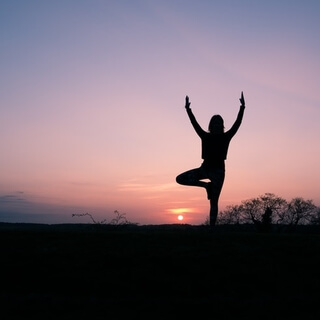
In Tadasana,
The shoulders feel light,
The whole weight of the body is supported by the skeleton with the heels growing roots into the ground,
Gravity pulling the lower half down,
The rebound enabling uplifting growth into the sky,
Like a tree spreading its branches outwards and upwards at the same time.
Take a simple step forward with the right leg.
Feet wide so you feel well balanced.
You can turn the back foot out if this helps.
Your legs feel strong and solid,
Reclaiming space for the internal organs,
A strong sense of an alert self.
Notice that your asymmetric position has already started the twist.
Your legs and pelvis remain fixed now.
Be aware of any tendency to collapse the front knee inwards or rotate the pelvis.
Let the spine extend upwards between the shoulder blades and take the weight out of the arms and legs as they release away from the shoulders and hips.
The arms and legs don't finish at the shoulders and hips,
But go all the way to the spine which supports them.
The uplift in the upper body is maintained as on an in-breath,
Space is created for the spine to move by releasing the muscles at the tops of the thighs.
You can imagine the breath coming up from the ground via the front foot traveling through the hips to the spine.
Locate the outer arches of the feet to help locate the tailbone and feel the spine extend from the tailbone to the top of the head.
Let the heels feel far away.
As you breathe out,
Rotate each vertebra from the tailbone upwards towards the atlas in the natural open direction towards the back leg,
Starting from deep down in the base.
Don't go higher than the shoulders yet.
Don't use the arms to leave around.
The shoulders are attached to the spine and it's the spine doing the moving.
The spine leads.
Your back is widening.
Your breastbone feels close to the spine.
There is a lightness in the upper body lifting up from your waist.
The amount of turn increases towards the head as you imagine moving up the spine vertebra by vertebra.
Vanda Scaravelli describes three twists,
Which she said should each be preceded by leaning the body forwards and elongating the arm.
When the shoulders are round as far as you want,
Moving with the spine and not pulling it round,
Allow the arms to float up to shoulder height.
You may find that they're at right angles from the starting position.
Then breathe space in between the neck vertebra and turn your head to glance at the back left hand.
Allow your chin to follow that shoulder blade down towards your waist.
Breathe in and then come back gently to the center.
Into Dassana again with surface muscles released so the weight of the body is supported by the skeleton.
Take a simple step forward with the left leg,
Keeping your feet wide so you feel well balanced.
Your legs feel strong and solid and there is no tendency to collapse the front knee inwards.
You have already started the twist or spiral because your hips are facing the open space to the right.
As you breathe in,
Feel space between the vertebrae as you let the spine extend upwards between the shoulder blades.
Allow this uplift in the upper body to be maintained as space is created for the spine to move by releasing the muscles at the tops of the thighs.
Activate the outer arches of the feet to help locate the tailbone and feel the spine extend from the tailbone to the top of the head.
Let the heels feel far away.
Feeling particularly aware of the back heel.
As you breathe out,
Rotate each vertebra from tailbone upwards in the natural open direction towards the back leg starting from deep down in the base.
Don't use the arms to leave around.
The shoulders are attached to the spine and it's the spine doing the moving.
The spine leads.
Your back is widening.
Your breastbone feels close to the spine.
There is a lightness in the upper body lifting up from your waist.
The amount of turn increases towards the head as you imagine moving up the spine vertebra by vertebra.
And when the shoulders are round as far as you want,
Moving with the spine and not pulling it round,
Allow the arms to float up to shoulder height.
Then breathe space in between the neck vertebra and turn your head to glance at the back right hand.
Allow your chin to follow that shoulder blade down towards your waist.
Breathe in and then come back gently to the center.
Into Darsana once more with the surface muscles released.
Make a step forward with the right leg again feeling well balanced.
As you breathe in,
Feel space between the vertebrae as you let the spine extend upwards just as far as the shoulder blades.
Activating the outer arches of the feet,
Feel the spine extend from the tailbone.
Let the heels feel far away.
As you breathe out,
Rotate each vertebra from tailbone up to the shoulders in the natural open direction towards the left,
Starting from deep down in the base.
The amount of turning creases towards the head as you imagine moving up the spine vertebra by vertebra.
When the shoulders are round as far as you want,
Moving with the spine,
Not pulling it round,
Allow the arms to float up to shoulder height.
Breathe in,
Feel you have space between the neck vertebra and turn your head to glance at the back left hand.
Allow your chin to follow that shoulder blade down towards your waist.
Breathe in once more to create space in the neck vertebra and turn your head back to neutral but this time continue turning to look at the front right hand and allow the front knee to bend in the direction of the little toe.
Stay balanced in both heels but be especially aware of the back one.
The tailbone keeps moving towards the floor.
Stay aware of your breathing and allow your arms to be like wings,
Not rigid but light,
Supported by the spine through the shoulders.
Go as far forwards as your body likes,
So long as you are anchored back.
There is no competition and there's not even much ambition.
Remember less is more.
Just do as much as your body likes.
Then come back gently to the dasana by reversing the movements.
Once more,
Take a step forwards with the left leg,
Keeping well balanced.
Breathing in,
Feel space between the vertebra as you let the spine extend upwards just as far as the shoulder blades.
As you breathe out,
Rotate each vertebra from tailbone up to the shoulders in the natural open direction towards the right.
When the shoulders are round as far as you want,
Moving with the spine,
Not pulling it round,
Allow the arms to float up to shoulder height.
Then breathe space in between the neck vertebra and turn your head to glance at the back right hand.
Allow your chin to follow that shoulder blade down towards your waist.
Breathe once more to create space in the neck vertebra and turn your head back to neutral,
But this time again continue turning to look the front left hand and allow the front knee to bend in the direction of the little toe.
Stay balanced in both heels,
But be especially aware of the back one.
The tailbone keeps moving towards the floor.
Stay aware of your breathing.
Allow your arms to be like wings,
Not rigid but light,
Supported by the spine through the shoulders.
Go as far forward as your body likes,
So long as you are anchored back.
There is no competition,
Less is more.
Just do as much as your body likes.
And finally,
Come back gently to Tadasana by reversing the movements.