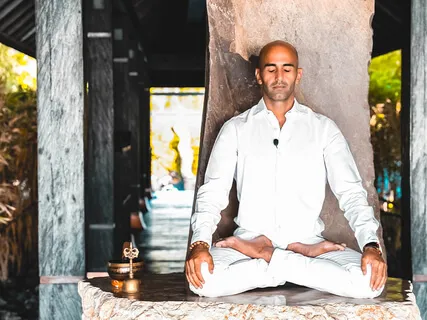
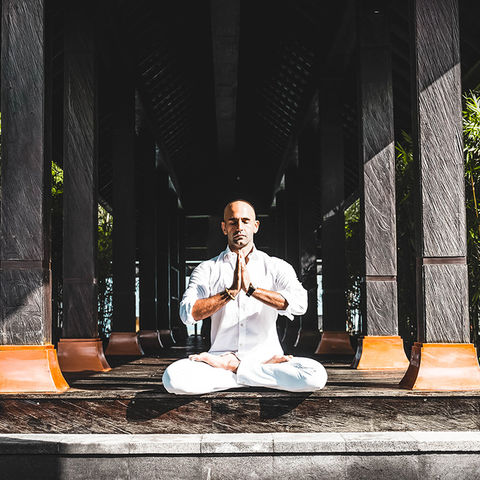
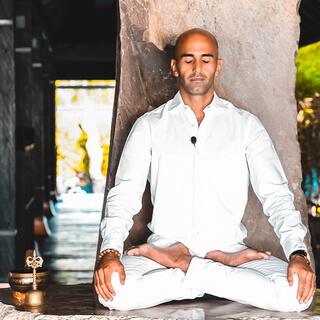
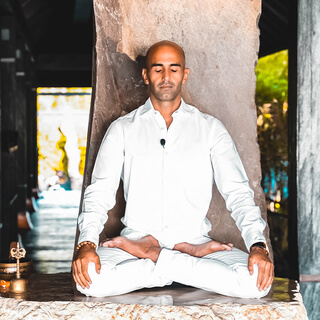
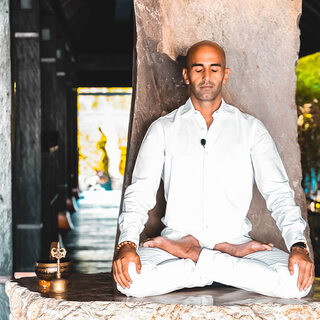
The first thing we need to do when we start sitting is to be able to arrange our cushion or our setup correctly so that we're comfortable.
Pain is going to be an inevitable part of this process but it doesn't need to be debilitating and it doesn't need to be because we're in the wrong position.
So set your cushion up in a way that allows your spine to be straight and for you to sit in as relaxed a fashion as possible while maintaining that posture.
So everyone pick a position.
The classic positions are obviously cross-legged,
Half Lotus,
Full Lotus or Japanese seated position,
Kneeling position.
Vajrasana.
If you're seriously debilitated then you could use a chair but the most stable positions for meditation are those ones that we talked about.
Good.
Then once you've picked a posture,
Slowly relax a little bit too much.
Let your spine bend and let yourself sit out of posture for a little bit.
Just completely relaxed.
How it would be just to relax in that position and then straighten yourself up a bit too much and tense yourself so that you're completely holding yourself rigid and straight,
Activating your muscles and then relax and find a point between those two.
We're using just enough balance tension to be able to hold the body,
The spine,
The neck straight but whilst not maintaining physical tension in the body and let your body sink into that posture.
Find the contact with the ground that keeps you stable.
It's gonna be important for us to get used to this balance to this position.
Then everyone close their eyes and let's start to get our first little touch of anupana.
The first thing we do is we slowly mark out an area with our mind and we tell our mind that it can't move from outside of this area.
This is the first test.
The area we're going to use,
We're going to cause the,
We're going to call the larger triangle.
It's the point from the top of the nose down to the corners of the mouth.
This is the larger triangle.
So now just take a minute.
Take a minute to find this larger triangle with your mind and to feel what it's like to keep your mind within here.
Do not visualize this area.
Do not use your imagination.
This is going to become very important later on.
Instead just feel this area and feel what it's like to keep your mind within it,
Not to let it move outside.
And then within this area slowly start to bring your awareness to the breath.
Feel the breath moving in and out of your nostrils.
Any way you can feel the breath in this larger triangle is okay.
Our only job is to feel it and not react.
If it's faint and it takes some time to feel it,
No problem.
Simply wait here patiently in the larger triangle,
Noting when you do feel the breath.
And then slowly work towards continuous awareness of the breath.
Whether it's strong or soft,
Whether it's faint or distinct,
Whether it's gross or subtle,
Simply feel the breath.
Let it be exactly as it is and maintain your awareness of it.
If your mind is distracted,
If it goes anywhere outside of this larger triangle,
Anywhere away from the breath,
Then we just do one thing.
We drop whatever it is that our mind has moved towards and we bring our awareness back to the breath.
Simple as that.
What could these distractions be?
They could be a sensation in another part of the body.
Any sensation that's outside of the triangle is a distraction and it simply lets us know we're not meditating.
It could be a sound that we hear in our environment.
If our mind moves towards one of those,
We simply bring it back.
It could be an emotion or a memory or a thought or a fantasy.
It doesn't matter where our mind moves,
We have one response.
If our mind moves outside of the triangle,
Away from the breath,
We simply bring it back.
As soon as we notice that we're not focusing on the breath,
We bring it back.
In this way,
We start to train the mind.
We start to get used to this idea that the mind is a muscle.
Actually,
When our mind moves away from the breath,
It's giving us an opportunity.
It's giving us an opportunity to flex this muscle that allows us to have control over our mind,
That builds this relationship with our mind.
The more we can flex this muscle,
The more easily we can start to control our mind.
So whenever our mind moves somewhere else,
Don't get upset,
Don't get annoyed at our lack of focus and clarity.
Simply flex the muscle of the mind and bring it back to the breath and see how long we can stay focused on the breath for,
Regardless of how faint or how gross it is.
Simply feel the breath.
Let's do this now for a while in silence.
If you need to change your posture or move,
Then do this,
But do this with as little disturbance as possible.
And our first choice should always be to use the recovery position,
Just to take a break for a minute to see if we actually do need to change or get up.
And if not,
Then simply come back into posture,
Come back into meditation.
Focus on the breath,
Keep the mind within the larger triangle.
Let's do this.
You you you you you you As we end these meditation group sits,
Let's get used to doing something specific.
One big mistake that can be made when practicing meditation is to think that when we get up off the mat,
When we open our eyes,
The meditation ends.
Let's not do this.
As we open our eyes,
We come out of our posture and we get up.
Let's look at this as an opportunity to continue our meditation in a different position.
Now we're starting to know what it feels like to sit here and meditate together,
To focus on the breath in this environment.
As we get up,
Let's continue to be aware of the breath and see what the difference is as we transition between the seated and the standing position,
Then the walking.
As we go back to our rooms,
Back to our places,
See if we can keep this continuous thread of awareness.
We're going to do this more and more as the course goes on.
What it does is it allows us to turn every situation into an opportunity for meditation.
And then we don't have 120 hours,
12 hours a day to meditate on this course.
Then we have all day.
Then we have all our lives.
If we can take this awareness to everything we do,
Then we significantly,
Significantly compound the benefit of awareness.
So now as you get up,
Don't draw a strong line between the focus state you're in on the mat and wherever your mind goes as you get up.
Slowly transition,
Carry your awareness with you,
Feel the breath,
Don't react to it.
Start to build this bubble of silence around yourself.
Maintain the silence even if you're meditating at home.
Whatever comes up,
Maintain the silence,
Focus on yourself,
Use everything that comes up as a distraction as an opportunity to notice that you're not meditating,
As an opportunity to bring the awareness back to the breath.
So now let's get up,
Get ourselves ready for bed and then we'll practice again in the morning.