Hello.
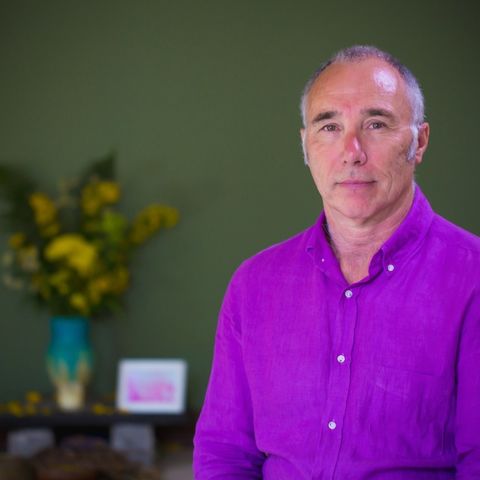
So this is a reading from one of my books,
A Mindful Life,
Who's This in the Shower with Me?
How to get out of your head and start living.
It's called Fiddling and Standing Back.
It's only a short reading,
It's actually a true story.
At the end I will explore it a little,
Pull out some points that I think are relevant and we'll end with a short meditation.
So Fiddling and Standing Back.
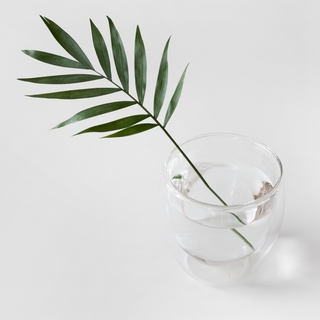
I'm sure most of us are familiar with flower arranging.
If you have not arranged a vase of flowers yourself,
You will at least have seen it done.
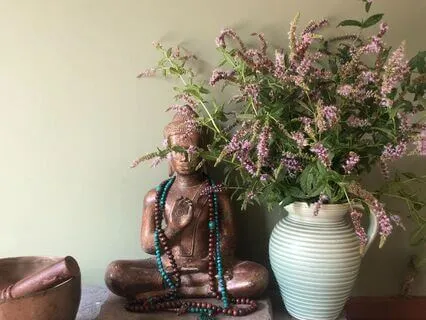
My wife Gayna often arranges flowers for the retreat we lead.
One particular morning I was sitting preparing for a retreat,
Sipping my cup of Yorkshire tea.
I was watching Gayna arranging the flowers.
She would fiddle with them and stand back.
She would fiddle a little more and stand back again.
She did this four or five times.
Then when she was happy with them,
She would put them onto the shrine in the meditation space.
Now she had to fiddle with the flowers or they would not have looked pretty.
But what was the point of her standing back and doing nothing?
Well she had to stand back to see how they looked in relation to each other,
The vase and the room.
The fiddling is absolutely essential,
But so is the standing back.
The standing back and just looking gave her a perspective on the flowers,
Which she could not get if she had been close up and arranging them.
When watching her I thought what she was doing was a good way of explaining meditation.
In life we have to fiddle.
In other words we have to be active.
We have to be in the doing mode much of the time or nothing would get done.
But there are times when we need to just stand back from life.
And this is what meditation is about.
When we sit in meditation or indeed when we come back to awareness in daily life,
We are in a way standing back from life.
We observe ourselves instead of just being lost in doing.
So when we sit in meditation for 20 minutes or so,
We get a chance to see our life from a different perspective.
One of being and observing instead of doing.
But when we meditate we are also standing back from something else.
We are standing back from our own experience.
We are observing our own thoughts and emotions instead of being lost in them.
And that's the end of that reading.
I just want to pull out one or two points.
I think this idea of standing back,
Of doing nothing,
Just sitting still.
I don't know whether you are familiar with this term but we have a term in the UK.
Don't just sit there,
Do something.
Well the Zen tradition turn it around,
Turn it upside down.
Don't just do something,
Sit there.
Which is the one I prefer.
So why?
Why just sit?
Why just observe?
Why just be?
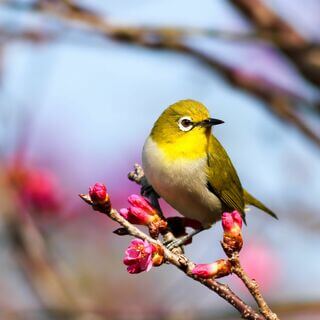
Well I like the metaphor of the bird.
A bird has two wings.
A bird with just one wing doesn't fly very well.
So for us to live a good life we have two wings.
We have doing and we have being.
But in my view the wing of doing is far more developed than the wing of being.
So how do we strengthen the wing of being?
Well we practice it.
We practice meditation.
We may take pauses during the day just to sit quietly and observe life.
Observe our thoughts.
And that observing the thoughts in my experience has been crucial.
That's the crux of it.
Because if I can't observe thoughts,
Actually let me put it another way.
There's two ways we can see thoughts.
First we can identify a thought.
Or identify thoughts.
Or we can identify with thoughts.
Now it's that one word,
Four letters,
With.
That makes all the difference.
When we identify with thinking we are immersed in it.
We are immersed in the story.
We're lost in the narrative.
That thought,
That thought world becomes our world.
So if it's anxious content we feel anxious.
And so on.
But if we can identify thought without the with,
Without that word.
We can identify thought as a thought.
And it just arises and passes away.
Causing a little more than a ripple to the pond of the mind.
Well when we're immersed in it.
The pond of the mind becomes cloudy and churned up and there's no clarity.
We are in that world.
We are in what I call a virtual reality.
So that's why I suggest to people to pause.
Even if for a few minutes,
Several times a day.
And sit in meditation for 5,
10,
15 minutes.
Doesn't need to be long.
So let's just have a few minutes of meditation.
Of quiet time.
Of doing nothing.
Just observing.
So just sitting quietly.
Getting comfortable.
Taking a couple of deep breaths.
That's it.
And drop down into the body.
You can feel the breath if you wish.
That rising and falling.
And particularly the end of the out breath.
There's a natural letting go there.
So just feel that.
And at some point,
Something will happen.
And that happening is that you will be immersed in thought.
You will identify with thinking.
It's just what we do.
It's a habit.
I'm going to go quiet occasionally just to allow you to really sense into this.
And when you do,
Lose yourself in thought.
Your awareness pops back.
I just want you to let those thoughts dissolve.
Let them melt away.
And you return back home to the body and the breath.
Now some thoughts may just arise and just tickle you so to speak and move on.
You can observe them.
You can identify the thought.
That's when thoughts don't create any anxiety,
Any problems.
When we just watch them.
But other thoughts?
We stick to them.
We get involved in them.
But the moment you see the involvement,
Release.
Let them go.
And return back to the body and the breath.
It's beautiful and simple.
There is nothing complicated about meditation.
We're not thinking about problems.
We're observing the thinking.
You are not your thoughts.
You are aware of them.
Okay,
We can bring this short session to an end.
So I hope you found that useful.
Do keep your meditation simple.
No need to complicate it with doing lots of things.
Resting in awareness,
Resting in the body with the breath.
Thank you.
Bye-bye.