Welcome to Sue Quiet Sleep.
I'm so glad you are here.
Before we begin our tonight's story,
Find a comfortable position.
Let your body settle into the surface beneath you.
Your shoulders can soften now.
If there is any tension in your jaw,
Let it release.
Soften the small muscles around your eyes and brow.
Let your hands rest gently and easily.
If your eyes are not already closed,
Allow them to close now.
Take a slow breath in through your nose,
Filling your lungs and breathe out through your mouth.
And again,
Breathe in and breathe out.
Let your shoulders drop a little more and allow your whole body to grow heavier and supported.
With each slow breath,
The sounds of your day begin to fade slowly into the background.
In their place,
A gentle mist begins to rise.
A quiet bridge between now and then.
And as tonight's story begins,
Imagine yourself stepping lightly through the mist,
Leaving the present behind and drifting into another time.
A slower,
Quieter world.
Tonight,
We step quietly into South Village.
A small village on the lower slopes of the Qingling Mountains,
Just south of Chang'an during the Tang Dynasty.
It is the hour before full dawn,
Late autumn.
The frost has not yet lifted.
In this village lives a retired official,
A man who served in the capital for many years and has now since returned to a quieter life.
Along the south wall of his courtyard,
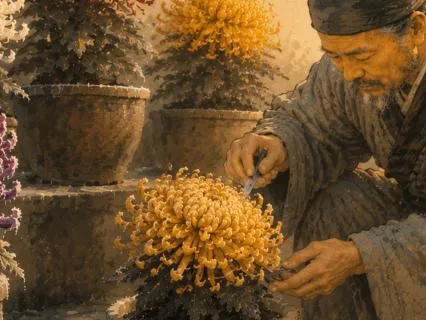
He keeps 14 pots of chrysanthemum,
Tending them through the season with the same unhurried attention he once gave to his documents and his duties.
Each autumn,
When the blossoms are ready,
He selects the finest and hands them to a helper who carries them to Chang'an to sell on his behalf.
This morning,
In the cold dark before sunrise,
He is already awake.
The room holds the last of the night.
He has been awake for some time already.
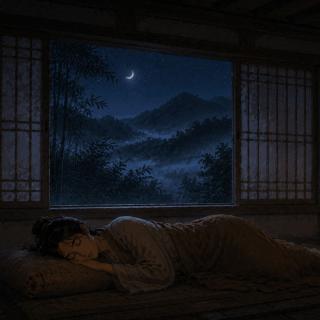
He lies on the edge of his sleeping bed,
Listening.
Beneath him,
The wooden frame presses cool and firm.
Folded clothes rest in quiet order on the shelf beside him.
Through the narrow seam at the base of the door,
Dry autumn air slides in without sound.
He does not rise yet.
He sits and lets the dark be dark for a little longer.
From somewhere beyond the wall,
Nothing stirs.
The village holds itself in the deep quiet that only comes in the hour before the sky begins to change.
When he rises,
He does so without haste.
His clothes shoe wait beside the sleeping bed.
He settles on them,
One and then the other.
He draws his robe over his shoulders,
Feeling the familiar weight of the quilted cotton settle along his back.
He ties his belt in the dark,
Fingers knowing the motion without thought.
One hand rests against the wooden door frame.
He breathes once.
Outside,
The sky carries a color that is not yet light and not quite dark.
A pale amber gray that seems to have arrived without moving,
Without announcing itself.
It rests above the roof line,
Still and patient.
He steps through the door.
The courtyard stones are cold beneath his soles.
He fills them through the thin cloth,
Flat,
Smooth,
Each one slightly uneven from years of weather and use.
His breath rises in a small pale cloud and vanishes.
Beyond the outer gate,
A village lane lies quiet in the cold.
Beyond the lane,
More houses stand in stillness.
Their roofs pill with frost.
And beyond them,
At the far edge of the plain,
The Ching Ling mountains rise as a faint gray line,
Barely separate from the sky,
Barely there at all.
He walks to the nearest port and rests both hands around it.
The cool weight of the clay settles into his palms at once.
The grit of dried soil brushes along the base of his fingers.
The earthway holds the whole night inside it,
Solid and unhurried.
The cold spreading from the clay into his skin.
He tends the port only a little.
Just enough to bring their bloom towards the thin morning light.
The chrysanthemum,
Long prized as the autumn flower of quiet endurance,
Is pale gold at the center and darkening at the outer petals.
Tiny beads of frost rest along the tips of each petal.
They hold the dim morning in a faint silver way.
He bends closer.
The scent that rises is dry,
Faintly bitter,
With something almost medicinal trace beneath it.
The particular smell of the chrysanthemum in cold air.
Soft and still.
From the inner fold of his robe,
He draws a small iron pruning knife,
Darkened with long use.
He holds it lightly.
He begins with the petals most touched by the frost.
The one where the cold has left its mark.
A slight translucence at the edge.
A softening of the firm center.
Each petal is loosened with a short,
Careful motion,
Lifted free and placed quietly on the stone beside the pot.
The sounds are almost nothing at all.
The soft brush of cloth against the pot rim.
The faint,
Thin scrape of metal.
Between one small sound and the next,
The amber-gray morning widens slowly over the courtyard stones.
He walks through the first bloom,
Then the second.
Some need only two or three petals removed,
One needs more.
He tends each flower towards what light there is.
Studies the firmness of the golden center.
Presses one finger lightly to the surface of the soil.
Firm,
Cool,
Holding moisture from the night before.
Now and then,
The frost shifts under his touch.
A small bead of coal becomes water,
Finds the crease of his finger,
And vanishes.
He does not think about this.
He simply walks.
The morning changes so gradually that it does not feel like change at all.
Only like time,
Moving gently through the frost.
When the first row is finished,
He straightens slowly and sets the knife back into the inner fold of his rope.
He crosses the courtyard to the outer gate and opens it only wide enough to see the inside.
He stands within the frame,
One hand resting on the rough wood of the door plank.
The lane beyond is empty.
Dry leaves have gathered at the far edge,
Where the wall cast shade,
Pale brown,
Still not moving.
The mud and wood walls of the neighboring compounds stand gray and quiet in the cold morning.
Near the locust tree at the lane's bend,
A small bird calls once into the cold air.
It flies away,
Then quiet again.
From somewhere farther along the lane,
A thin thread of wood smoke rises from another household and disappears.
The smell of it drifts in.
Clean,
Faintly bitter,
That particular smell of morning fires just caught.
He remains in the gate opening for a little while,
Not watching for anything,
Not expecting anything,
Just simply resting there.
The amber-gray light lies more clearly on the open earth than on the courtyard behind him.
Long shadows stretch from the trees and the village walls,
Still and unhurried.
No wind moves through them.
The pods wait for him behind the gate with patience.
Nothing is rushed.
The second row stands deeper in the shadow of the south wall.
Here,
The pods keep more of the night.
The cold of the clay enters his hands sooner when he lifts them,
Spreading through his palms before he has even settled his grip.
Frost lingers longer on these blossoms,
The small silver beads still intact at the outer tips.
He lifts one pod and then another,
Reading each flower with the same unhurried care.
One blossom will stay where it stands,
The petals firm,
The center dense and golden,
Needing only the morning light and nothing else.
Another should be turned a finger's width,
So it faces meets the sun later in the day.
He walks through them slowly,
His breath rising and fading in small clouds in the cold air.
Four of the fourteen are strong enough to make the journey to Chang'an.
He carries these one at a time to a separate line near the gate,
Setting each pod down with quiet attention.
The chrysanthemums rise above their pods in the color that Tang Dynasty gardeners have long cultivated and prized.
Pale gold,
Deep crimson,
Soft white,
And a muted violet that holds the cold morning in its own particular way.
Behind the north wall,
A shallow water basin,
A white ceramic bowl set on flat stone,
Carries a thin skin of ice across its surface.
He crouches beside it.
He touches the surface with two fingers and the fragile sheet of ice breaks without sound,
The pieces shifting beneath his touch and settling again.
He rinses his hands in the cold water.
The shock of it passes through his fingers and into his wrist.
Quiet now,
Only the basin water,
Only the faint creak of the ice,
Only the faint bitter scent of the chrysanthemum flowers circling in the still air.
The transport cloth hangs folded along the wall near the gate.
Strips of hem,
Rough and woven clothes,
Kept in the shade through the cold hours so they hold their firmness.
He brings them one by one to the four pods he has set aside.
The fabric is roughed against his fingertips.
He winds each strip carefully around the pod rim and lower the stem,
Tucking the ends so that nothing will come loose on the road to Chang'an.
Small,
Exact movements.
The cloth finding the curve of the clay,
The fingers pressing each fold into place.
This is not hurried work.
It is the kind of work that asks to be done only once and done right.
He pauses between the second pod and the third.
The courtyard has changed again since he began.
The frost has lifted from the stones nearest the south wall,
Leaving the darkened patches where moisture remains.
Along the farther edge,
Where eaves still cast shadow,
A fine white line continues to rest on the pod rims and the stone.
He is careful and touch and hurried,
Waiting for the sun to reach it.
The amber-gray light has shifted.
It is lighter now at the open end of the courtyard where the gate stands,
Lighter where the wrapped pods wait.
He looks briefly at the small pile of removed petals resting at the base of the wall.
The edges have begun to curl,
Tightening inward in the core.
He does not think about this for long.
Near the doorway of the inner room stands a low wooden stool.
He carries it out into the courtyard and places it where the sunlight and shadow meet across the stones.
Just at the edge of the warmth,
Not fully in it,
He sits.
The morning settles around him.
Beyond the gate,
The lane remains empty and still.
A sound comes from somewhere far off in the village.
A door opening and drawing shut.
Then,
Nothing more than that.
The rooftops of the neighboring houses catch the morning light now.
Their ridge lines cleaner against the sky than they were at first light.
The Ching Ling mountains,
Visible above the roof line in the distance,
No longer seem to be part of the same gray surface as the air.
Their shape is more distinct,
Solid,
Patient,
And changed.
The chrysanthemums stand where he has left them.
On some blooms,
The last frost cleans deep between the petals,
Where the sun has not yet reached.
On others,
It has already dissolved and gone,
Leaving the petal surfaces clean and faintly bright.
The cool weight of the clay pot is in his memory,
In his hands,
Though he is not holding any pot now.
He rests his hands on his knees,
Soft,
Still.
Nothing more is needed for a while.
After a time that does not require measuring,
He rises once more.
He turns two of the remaining pots by a finger width towards the light.
Small adjustment,
Almost invisible,
But attended to.
He gathers the fallen and removed petals at the base of the wall into both cupped hands and carries them to the corner,
Placing them there without ceremony.
Then,
He stands beside the four wrapped pots near the gate and looks over them.
Four pots,
Each wrapped with hem cloth at the rim,
Clay smooth and cool beneath the wrapping.
Pale gold,
Soft white,
Crimson,
And fainted violet,
Each bloom catching the morning in whatever way the morning has arrived.
The whole courtyard seems to have grown smaller now,
Not in its stone or walls,
But in the way the attention settles.
There is the wrapped row.
There is the water basin.
There are the remaining pots along the south wall.
There is the amber-gray light,
Which has thinned into something clearer.
Though it keeps its softness still,
Resting on the clay,
Finding the folds of his robe,
Touching each chrysanthemum with the same unhurried warmth.
He does not move for several breaths.
The air is less cold now,
But not warm,
Only gentler.
And the pots,
Steady in their places,
Keep the last of the night within them still.
The frost has gone from the upper petals,
From the poured rims,
From the open stones in the sun.
And yet,
Its presence lingers in quieter forms.
A trace of moisture at the flower's deepest edge.
A faint coldness that remains on the clay,
Even where the sun now rests.
The amber-gray light moves slowly across the courtyard,
Touching one pot,
Then the next,
Resting on the basin rim,
Lying along the stone in long,
Flat lines.
He lifts one pot briefly,
Not for any reason.
Only to hold it once more.
The cool weight settles into his palms the way it has all morning.
The grit of the clay against his fingers.
The night still faintly present in the earth way.
He put it back.
From beyond the gate,
The village begins in small and distant ways.
A muted sound.
A thread of smoke.
A door.
Then,
Stillness again.
The air shifts almost without movement.
The chrysanthemums open quietly and a little farther into the calmer light.
Nothing is hurried.
Nothing is held back.
And so,
The retired official remains in the courtyard as the morning completes its slow arrival.
The frost long lifted from the stones.
The four wrapped chrysanthemum flower pots waiting by the gate.
The amber-gray light now resting full and quiet along the south wall,
Where the chrysanthemums stand in their rows.
The night's coolness still faintly held in the clay,
Patient and unhurried,
The way it always is.
The world we visited tonight is quiet now.
And you are here again,
In the comfort of your room.
Your mind can rest.
Your body can relax.
If you are already drifting into sleep,
Allow yourself to sink deeper.
If you are still awake,
Simply listen to the quiet.
Thank you for joining me at Su Quiet Sleep.
I'll be here again soon to share another peaceful moment in time.
But for now,
Sleep well.
Good night.